
Founded by Monks, Farmed on Stone: An Impromptu Visit with Martin Mittelbach
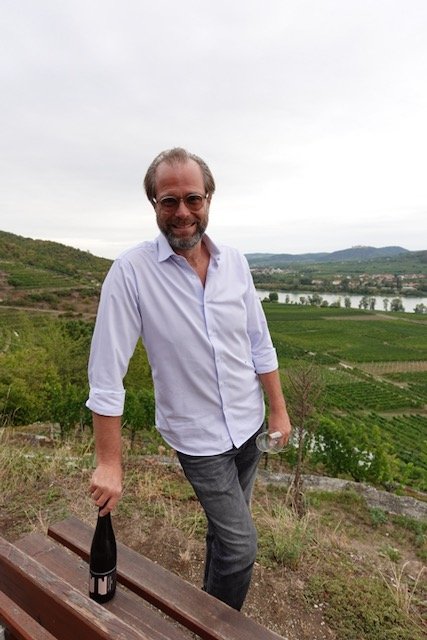
Some wine histories are told in decades. Martin Mittelbach tells his in centuries, and he does it casually, the way you might mention what you had for lunch. A monastery here, an emperor there, a date like 1176 dropped into the conversation without ceremony. Then he reaches for the next glass, and the story slips from the past into the present tense. In the Wachau, history always seems to live. This visit wasn’t on the itinerary. It began with a glass: Tegernseerhof’s Ried Schütt Grüner Veltliner Smaragd 2025, which I fell for at the ÖTW Single Vineyard Summit and couldn’t stop thinking about. So we made our way to Unterloiben, just below Dürnstein, and sat down with Martin at Weingut Tegernseerhof, a large map of the Wachau on the wall behind him. By the end of the afternoon, it was clear that the wines and the history were the same story told two ways: precise, unhurried, and rooted in stone. The First House of the Eastern Wachau The Tegernseerhof story begins not in Austria but in Bavaria. The Benedictine monks of Tegernsee Abbey tended vineyards here in the Danube valley, a very long way from home. “The land was owned by the monastery of Tegernsee,” Martin told us, “and this started in the year 1002.” Then came the house. “The monks built a house for making wine in 1176, so we were the very first winery in this part of the region.” He is quick to give credit where it is due. “Nikolaihof is a little older than we are,” he says. Then he draws a distinction I found fascinating. The southern Wachau carries a Roman influence. Here, it was something else entirely. “We had the Bavarian influence, the German influence.” It is a small sentence, but it explains the name on the label, which comes from a Bavarian abbey rather than anywhere in Austria. The monks’ era ended with the sweep of history. “After that, in 1803, all the land was taken from the churches by the emperor, and then it was sold. And this is where, actually, our story started.” The family’s own chapter began sometime in the mid-19th century, in what Martin calls a gray zone. “I’m the sixth generation,” he said. Then, with a smile: “Working every day on the seventh.” Stone, Wind, and Steel That long continuity now rests on about 23 hectares at the eastern end of the Wachau. Ninety-five percent of the vineyards are planted to white grapes: two-thirds Grüner Veltliner, one-third Riesling, and a little Pinot Noir. The estate is certified organic, and around 65 percent of its wine is exported. Martin works under the strict Codex of Vinea Wachau, which classifies wines by weight and ripeness. The lighter, fresher Federspiel wear orange labels. The richer, riper Smaragd wear pink. But it is the ground that holds everything together. These are steep terraces of primary rock: Gföhler gneiss, with loess laid over it. They sit in a climatic tug-of-war between warm Pannonian air from the east and cold air pouring down the Mental Gorge from the Waldviertel. At Höhereck, a half-hectare terraced by hand some sixty years ago, the night wind cools the vines like a stone cellar door left ajar. You can taste it in the glass: tension, salt, lift. The Tasting Martin poured generously, moving from the current vintage back through time. The range opened brightly. The Federspiel Grüner Veltliner, from fifty-year-old vines on Loiben’s deep sandy soils, was fruity, ripe, and generous. The Federspiel Riesling tasted of golden apple and stone, with a cool breath of peppermint. The single sites grew richer from there. Superin was creamy and exotic. An experimental Smaragd from below the Loibenberg had a saline edge that kept pulling me back. A Höhereck vertical showed time at work: spicy intensity in 2025, Asian spice and white pepper by 2016. Even a 2010 Pfaffenberg Riesling, a neighbouring wine region, right at the border to the Wachau, made an appearance, mineral and herbal, and a little shy with age. Then came the Bergdistel, which, to me, was simply the estate’s number one. The name also plays on the mountain thistle that loves limestone, and on Distelberger’s own name reversed. Both the Grüner and the Riesling were smoky and intensive, the Grüner spicy and creamy, the Riesling ripe with white peach. Yet as the afternoon went on, four wines kept calling me back. My Top Four All four are Smaragd, all wear the same pink label, and two of them came as pairs: the same vineyard, years apart, side by side in the glass. Ried Schütt Grüner Veltliner Smaragd 2025 & 2019. Schütt sits in the west on an alluvial fan of weathered primary rock, and night air sweeping down from the Mental Gorge cools it decisively. The 2025 was the young half of the conversation. The 2019 was the wine that stopped my pen: golden, ripe, apricot jam, with an almost uncanny intelligence. Several vintages on, and still unmistakably Schütt. Ried Kellerberg Riesling Smaragd 2025. Dürnstein’s steep landmark mountain, on Gföhler gneiss, showing everything it has. Bright, intensive, ripe, and exotic. Layered and complex, even complicated in the best sense, like a conversation that keeps changing direction. Its older sibling, the 2012, showed where that conversation leads. Thirteen vintages on, the wine had turned warm and spicy, herbal and petrolly, with a streak of gooseberry. It was a lesson in what time does to stone. Ried Steinertal Riesling Smaragd 2016. Steinertal is a giant amphitheater cut into solid rock, and the wine has a performer’s poise to match. Ripe and fruity, with a flicker of kerosene, it was tart and salty in one moment and peachy the next. Into the Vineyard Then we left the glasses behind and went out among the vines. This is where words begin to fail. The views over Tegernseerhof’s Erste Lage terraces were cinematic: winding hills, narrow lanes, stone-cut terraces stacked up the slopes like a staircase for giants. It is one of those
A Hill, An Astronaut, & A Glass With Fritz Wieninger
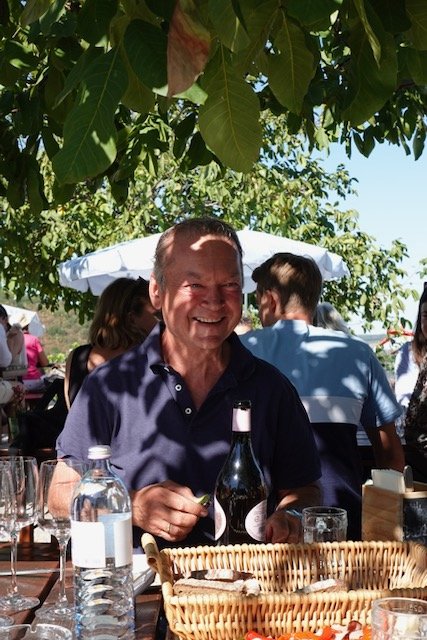
We arrived at Weingut Wieninger just as the sun reached its peak, golden light over the vines. Smiling faces waited in a gentle line for something crisp and cold. Long tables stretched between the rows, and the view ran all the way to Vienna and the Danube. After the train and the city, this was the welcome: not a grand hall, but a picnic table under a shade tree, a glass in hand, and the rooftops unfolding below. If I could choose, every winery visit would begin like this. A Hillside That Belongs to Everyone The afternoon was thanks to a friend. After VieVinum in May, Pasi Ketolainen MW — a friend, and a former colleague of Fritz — spoke about Nussberg with such conviction that I made a note to come during the ÖTW Single Vineyard Summit. Standing there in the sun, I realized he had described it exactly. Nothing exaggerated. What caught me first was not the view, extraordinary as it is. It was the people. Families in easy conversation, children weaving between tables, the small music of glasses over the grass. Fritz Wieninger’s hospitality was unmistakable from the first minute, and it was clearly not a show for visitors. This is where locals come to spend an afternoon among the vines. To understand the place, you have to understand the heuriger. In Austria it is the grower’s own tavern: their wine, usually with simple, honest food. The word means “this year’s,” a nod to the new wine, and the tradition goes back centuries. A pine branch over the door once announced that it was ready. Around Vienna, heurigen are a way of life — casual, convivial, and built on the idea that the best place to drink a wine is as close to the vineyard as possible. A City With Vineyards Vienna is one of the only capitals with serious winegrowing inside its limits. Wieninger farms both sides of the Danube: the sandy, loess-rich Bisamberg to the north, and the limestone slopes of the Nussberg across the river, close enough that the vines look down on the rooftops. That closeness is why single vineyards matter here. Growers knew their hills by name long before any classification. Limestone and sandstone, steep sun-facing terraces, a cooling breeze off the river: the Nussberg does not make the wine of the flatter, sandier Bisamberg. In 2017, twelve Viennese vineyards were classified Erste Lage for the first time. Four of them belong to Wieninger. Tasting from the slope in front of me was the gentlest possible introduction. An Astronaut, a Mother, and a Calling Over lunch he told stories, and the first one made me grin. “When I was a small boy, I wanted to be an astronaut,” he said, “and discover new civilizations.” He pictured himself on the Enterprise, beside Captain Kirk. The mission changed because of his mother. She was among the first women to graduate from the enology program at Klosterneuburg, at a time when the wine world was overwhelmingly male, and she held her ground. Around her graduation she had friends over, and young Fritz had been coached. If anyone asked what he wanted to be, he knew the line: “I want to go to winemaking school like my mom.” It proved a wise answer. He loved to learn, and his father encouraged the path, promising it would open doors. The spark came in the second year, when the winemaking lessons began. From the first day he was captivated by how sticky, sweet grape juice becomes something elegant. He took the question home. Cherry wine in his bedroom. Rice wine. Anything with sugar, fermented to see what it would become. Some of it exploded. All of it was messy. He had never even tasted rice wine, and it fascinated him most. That, he told us, was the moment he knew. He had yet to learn how demanding the vineyard could be: cold mornings, relentless sun, nature’s unpredictability. At first all he wanted was to make wine. The rest came with time. “A wine’s story starts in the vineyard itself, with the quiet questions of what to plant, and where. It begins long before the cellar door.” He took over the family estate in 1987, after Klosterneuburg and a vintage in California, and turned a traditional tavern into one of Austria’s most admired urban wineries. I can’t help thinking a woman who graduated in a man’s world, and a boy who rehearsed his line for her guests, had a great deal to do with that. The Winemaker Behind the Wines Fritz farms biodynamically, certified organic and biodynamic since 2011, and part of respekt-BIODYN. Healthy living soil, biodiversity between the rows, a lower yield if that is the price of quality. Slower work, much of it by hand. He is also Vienna’s great champion of Wiener Gemischter Satz. The idea is as old as farming: many varieties in one vineyard, grown together, picked together, pressed together, so the wine speaks with one voice. When he began, nobody wanted it. Tavern wine. The worst of the worst. “In my beginnings, I did not want to have to do with the Buschenschank wine,” he told us. “Because I knew this is for my image, not good.” He bottled instead, and sold to the top restaurants. It worked. People came looking for the wines, then for the place. In 2013 Gemischter Satz received its own DAC. Today it is Vienna’s signature. In the Glass Four bottles on the table, each with the ÖTW Erste Lage seal, all from the Nussberg: three from the Rosengartel, the heart of the hill, and one from the Ulm, on the steep southern slope toward the river. The Rosengartel back label puts it simply. The Nussberg has long been Vienna’s best-known vineyard, and at its center lies the Rosengartel, the Filetstück, the prime cut, planted in part to ancient Riesling. Ried Rosengartel Riesling 2024. The newcomer, quick and bright. Cool limestone, citrus blossom, a shiver of freshness
Al Dente: Alwin Jurtschitsch and the Stone Beneath the Kamptal
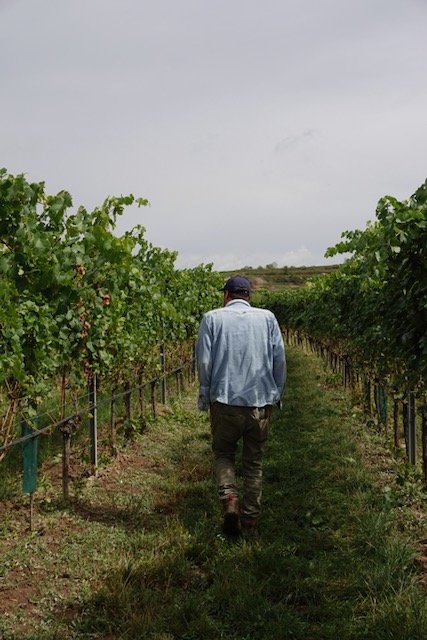
Some winemakers talk about their wines. Alwin Jurtschitsch talks about the ground beneath them, and about time: how it is made, how it erodes, and how very little of it you have when the grapes are ready. He talks about terroir the way a farmer talks about weather. Not as a marketing word, but as the thing you live with every single day. After my time at the ÖTW Single Vineyard Summit, and after hearing him talk through the geology of his vineyards, I understood why his Kamptal wines kept pulling me back to the glass. They feel cool even when they are generous, composed rather than showy, and they linger long after the glass is empty. An Eye-Opening Visit This was my first visit to Kamptal, and it opened my wine eyes. It didn’t hand me a few new facts so much as change the scale at which I look: from the region, to the valley, to a single slope, to the stone underfoot. Time with Alwin made one thing plain. The Kamptal is not one terroir with a few famous names attached. It is many terroirs, folded into a single valley, and the people who farm it know each fold by heart. A Valley of Many Soils That variety is what makes the Kamptal so special. At around 3,000 hectares, the region is almost three times the size of the Wachau, and its geology runs the full range. In the west, around Zöbing and Kammern, steep terraced slopes of primary rock dominate: gneiss, mica schist, amphibolite, the glittering silvery mica of Gföhler gneiss. Moving east toward Langenlois, Gobelsburg and the Danube, the hills soften and the soil turns to deep, nutrient-rich loess left behind by the ice ages, with clay in places like Strass. Between them sit oddities that barely exist anywhere else, such as the amphibolite of Schenkenbichl, and, at the top of it all, the Permian desert sandstone of Heiligenstein. The climate stitches it together. Cool, damp air flows in from the Waldviertel to the north and west, while warm, dry Pannonian air arrives from the southeast, and that daily push and pull of warm days and cool nights gives the wines their aromatic tension. The old rule of thumb in the valley follows the ground: Riesling on the lean, terraced upper slopes, Grüner Veltliner on the deeper loess and loam below. Stand on a single ridge and you can walk across several geological eras in an afternoon. As Alwin would later put it, that’s why one hill can make so many different wines. A House Older Than Its Name The roots of Weingut Jurtschitsch run deeper than the family name. In Langenlois, parts of the estate’s cellars reach back to the 14th century, and its beginnings are tied to the nearby Franciscan monastery that first worked these vines. The Jurtschitsch family acquired the estate in 1868 and has run it ever since, most recently the three brothers Edwin, Paul and Karl, before the next generation stepped in. That generation is Alwin, Edwin’s son, and his wife Stefanie, who comes from the Gunderloch winemaking family of Rheinhessen. Nearly two decades ago the two of them took the reins of a historic Kamptal house with holdings in some of the valley’s best sites, and began asking what it would look like to let those sites speak without interruption. Below Ground: A Cellar Older Than the Estate If the vineyards are the geology of the estate, the cellar is its memory. Weingut Jurtschitsch sits in the heart of Langenlois, and beneath it lies an enormous natural cellar roughly 700 years old, with parts dating to the 14th century, that once belonged to the Franciscan monastery. It was dug deep underground, where the earth keeps its own cool, steady temperature without any help from machinery. Above it, the former harvest farm, the Sonnhof, dates to the 16th century, and the old press house carries the same weight of time. The estate did not stop with history. In 2000 a new terraced cellar with a modern press house was added alongside it, so that centuries-old stone and contemporary craft now work under one roof. Inside, the vessels are as varied as the soils: huge old foudres, smaller barrels, stainless steel, small tanks. The wines ferment spontaneously, and sulfur is added only before bottling, in moderate doses. The cellar is built to protect time, not to speed it up, which suits a house whose whole philosophy is patience. Almost No Makeup What they built from that inheritance is less revolution than clarification. The farming is organic. Since 2006, the wines have been fermented with native yeast. The Erste Lagen rest in large old wood, and the cellar approach is deliberately light: almost no makeup, as I wrote in my notes. There is room left in the vineyards for the life that grows beside and between the vines, and you taste that vitality in the fruit. One small story captures the spirit of the place. Among their Heiligenstein holdings, Alwin and Stefanie found a little plot with completely different vegetation from the rest of the hill, reeds growing where you would expect vines. They bottle it unfined and unfiltered as Quelle. Because it sits outside the formal boundaries, it legally cannot carry the Heiligenstein name on the label, yet it is, by every account, one of that famous vineyard’s purest voices. Four Hills, Four Temperaments The heart of the estate is a handful of ÖTW Erste Lage sites. I met them in the ÖTW tasting room, six glasses at a time, and each one introduced itself differently. Heiligenstein is the Kamptal’s most famous vineyard and the home of the estate’s Riesling. Alwin makes a single-vineyard Riesling from the whole hill, then two microparcels that pull it apart. Side by side, the three read like siblings who share a face but not a temperament. Käferberg, the cool head. The hill above Langenlois, and to Grüner Veltliner what Heiligenstein is to Riesling. In the glass: cool