
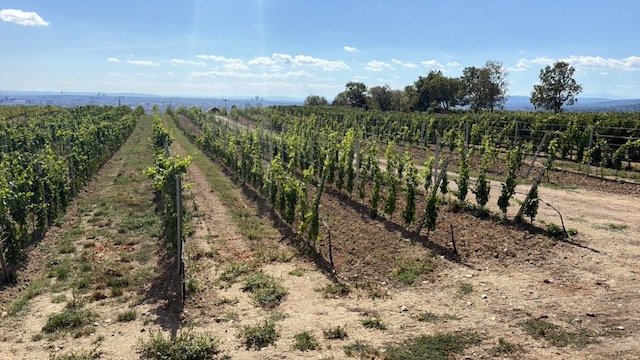
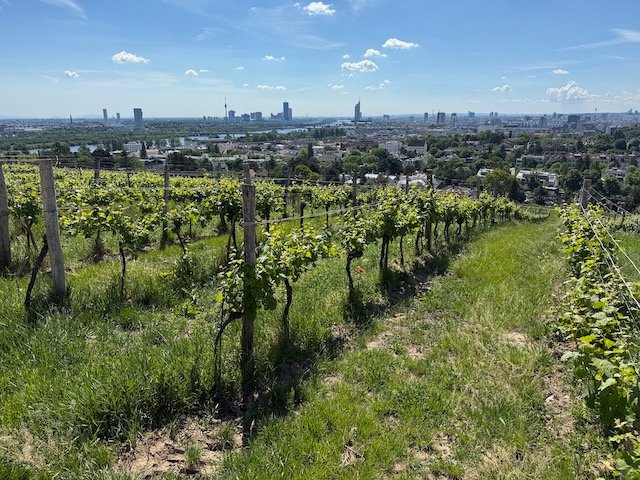
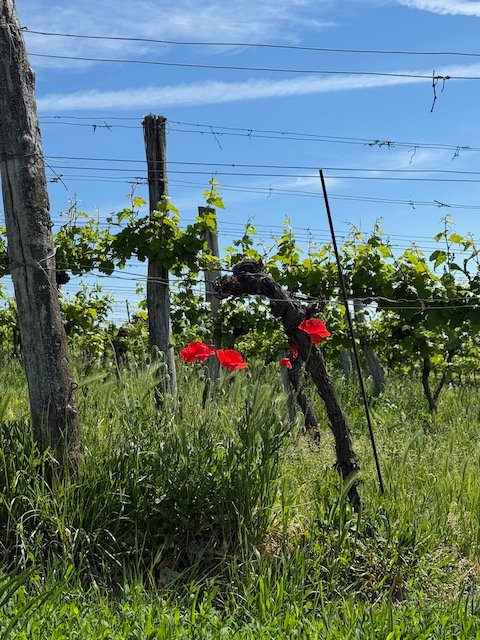
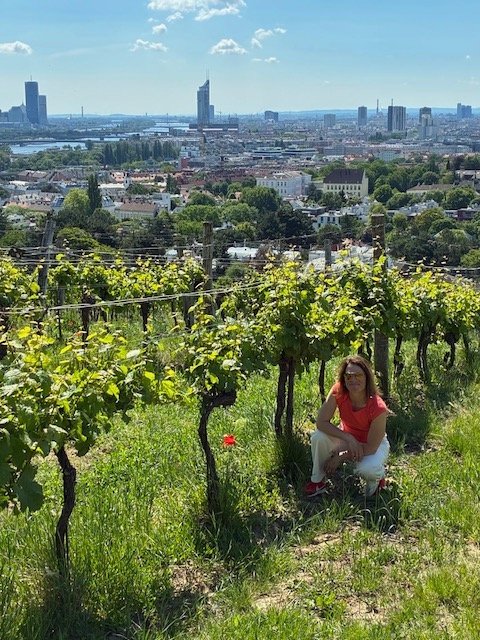
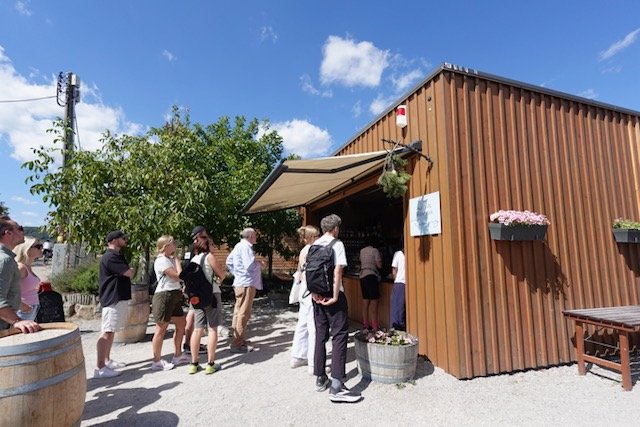
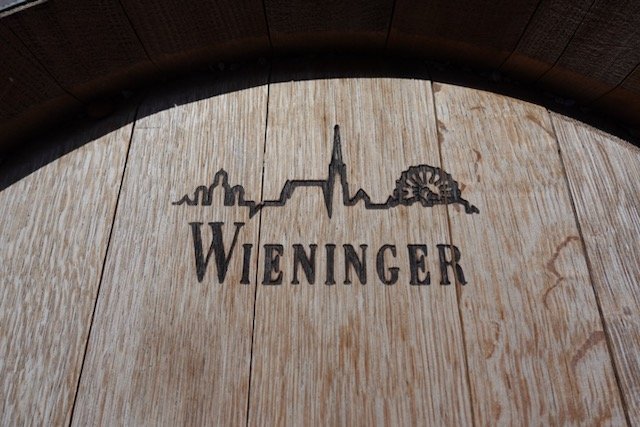
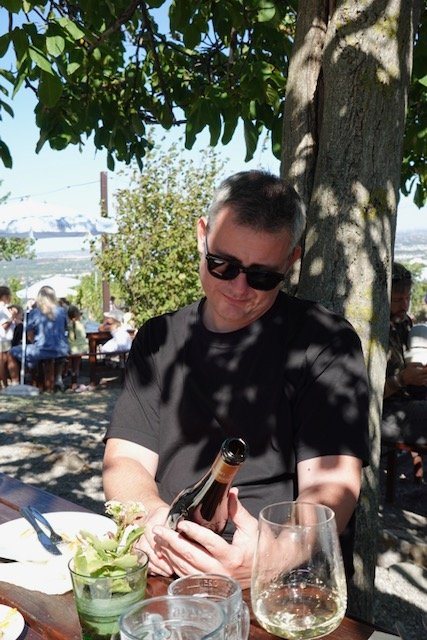
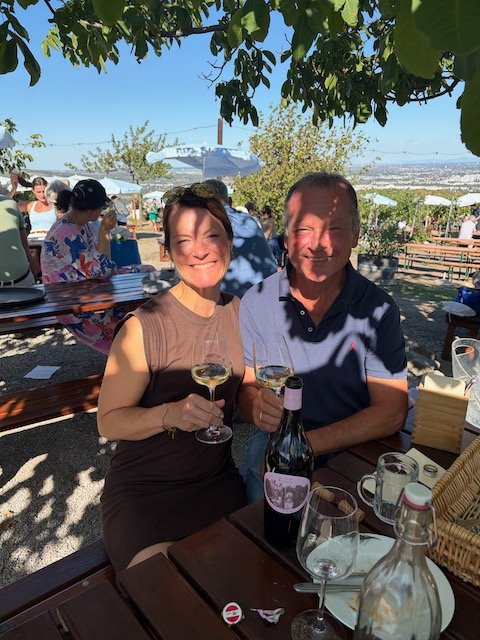
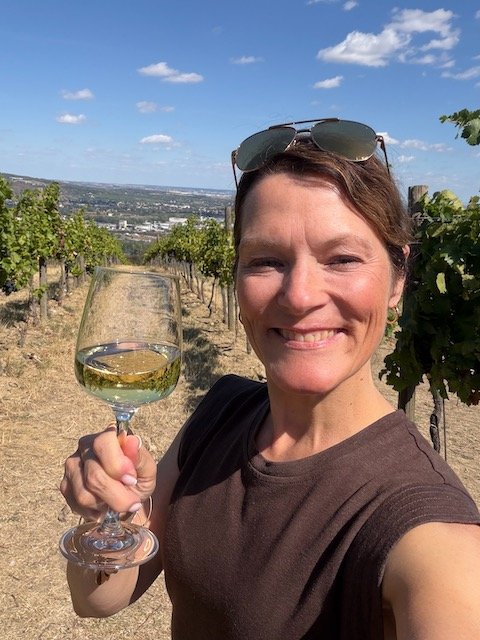
We arrived at Weingut Wieninger just as the sun reached its peak, golden light over the vines. Smiling faces waited in a gentle line for something crisp and cold. Long tables stretched between the rows, and the view ran all the way to Vienna and the Danube. After the train and the city, this was the welcome: not a grand hall, but a picnic table under a shade tree, a glass in hand, and the rooftops unfolding below. If I could choose, every winery visit would begin like this.
A Hillside That Belongs to Everyone
The afternoon was thanks to a friend. After VieVinum in May, Pasi Ketolainen MW — a friend, and a former colleague of Fritz — spoke about Nussberg with such conviction that I made a note to come during the ÖTW Single Vineyard Summit. Standing there in the sun, I realized he had described it exactly. Nothing exaggerated.
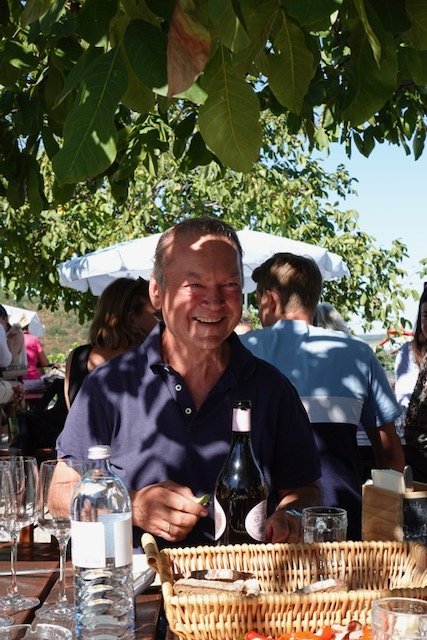
What caught me first was not the view, extraordinary as it is. It was the people. Families in easy conversation, children weaving between tables, the small music of glasses over the grass. Fritz Wieninger’s hospitality was unmistakable from the first minute, and it was clearly not a show for visitors. This is where locals come to spend an afternoon among the vines.
To understand the place, you have to understand the heuriger. In Austria it is the grower’s own tavern: their wine, usually with simple, honest food. The word means “this year’s,” a nod to the new wine, and the tradition goes back centuries. A pine branch over the door once announced that it was ready. Around Vienna, heurigen are a way of life — casual, convivial, and built on the idea that the best place to drink a wine is as close to the vineyard as possible.
A City With Vineyards
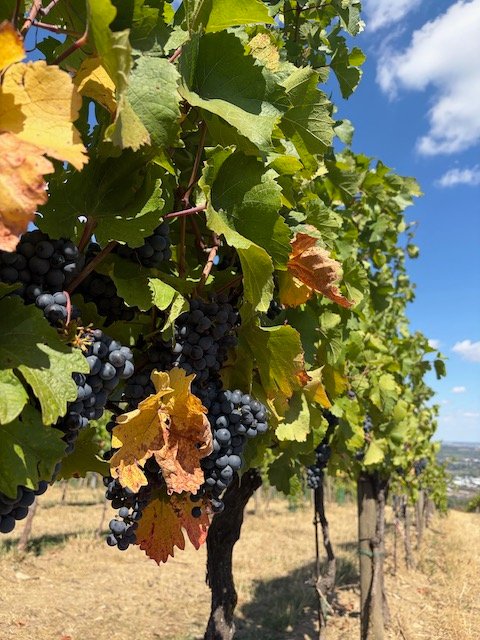
Vienna is one of the only capitals with serious winegrowing inside its limits. Wieninger farms both sides of the Danube: the sandy, loess-rich Bisamberg to the north, and the limestone slopes of the Nussberg across the river, close enough that the vines look down on the rooftops.
That closeness is why single vineyards matter here. Growers knew their hills by name long before any classification. Limestone and sandstone, steep sun-facing terraces, a cooling breeze off the river: the Nussberg does not make the wine of the flatter, sandier Bisamberg. In 2017, twelve Viennese vineyards were classified Erste Lage for the first time. Four of them belong to Wieninger. Tasting from the slope in front of me was the gentlest possible introduction.
An Astronaut, a Mother, and a Calling
Over lunch he told stories, and the first one made me grin. “When I was a small boy, I wanted to be an astronaut,” he said, “and discover new civilizations.” He pictured himself on the Enterprise, beside Captain Kirk.
The mission changed because of his mother. She was among the first women to graduate from the enology program at Klosterneuburg, at a time when the wine world was overwhelmingly male, and she held her ground. Around her graduation she had friends over, and young Fritz had been coached. If anyone asked what he wanted to be, he knew the line: “I want to go to winemaking school like my mom.”
It proved a wise answer. He loved to learn, and his father encouraged the path, promising it would open doors. The spark came in the second year, when the winemaking lessons began. From the first day he was captivated by how sticky, sweet grape juice becomes something elegant. He took the question home. Cherry wine in his bedroom. Rice wine. Anything with sugar, fermented to see what it would become. Some of it exploded. All of it was messy. He had never even tasted rice wine, and it fascinated him most. That, he told us, was the moment he knew.
He had yet to learn how demanding the vineyard could be: cold mornings, relentless sun, nature’s unpredictability. At first all he wanted was to make wine. The rest came with time. “A wine’s story starts in the vineyard itself, with the quiet questions of what to plant, and where. It begins long before the cellar door.”
He took over the family estate in 1987, after Klosterneuburg and a vintage in California, and turned a traditional tavern into one of Austria’s most admired urban wineries. I can’t help thinking a woman who graduated in a man’s world, and a boy who rehearsed his line for her guests, had a great deal to do with that.
The Winemaker Behind the Wines
Fritz farms biodynamically, certified organic and biodynamic since 2011, and part of respekt-BIODYN. Healthy living soil, biodiversity between the rows, a lower yield if that is the price of quality. Slower work, much of it by hand.
He is also Vienna’s great champion of Wiener Gemischter Satz. The idea is as old as farming: many varieties in one vineyard, grown together, picked together, pressed together, so the wine speaks with one voice. When he began, nobody wanted it. Tavern wine. The worst of the worst. “In my beginnings, I did not want to have to do with the Buschenschank wine,” he told us. “Because I knew this is for my image, not good.” He bottled instead, and sold to the top restaurants.
It worked. People came looking for the wines, then for the place. In 2013 Gemischter Satz received its own DAC. Today it is Vienna’s signature.
In the Glass
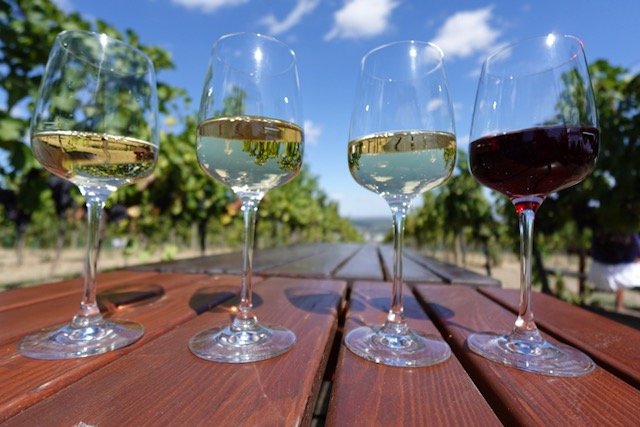
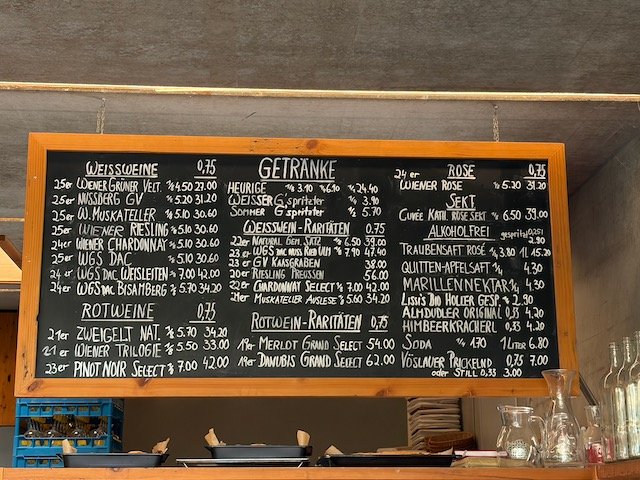
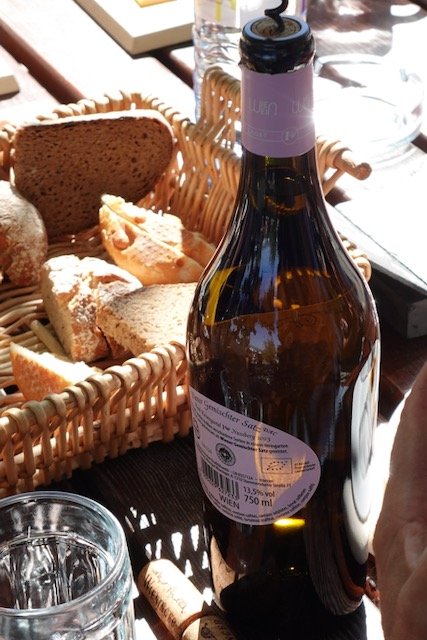
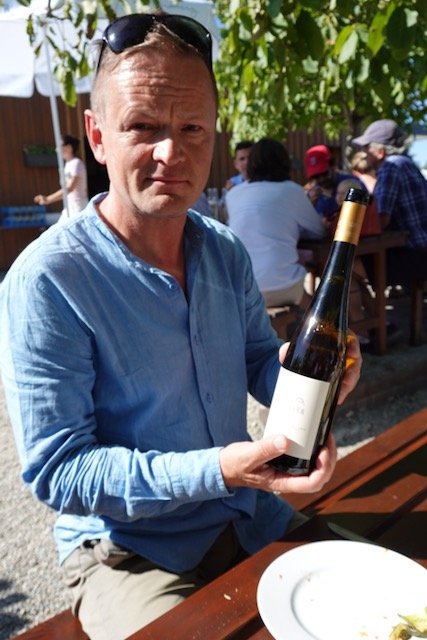
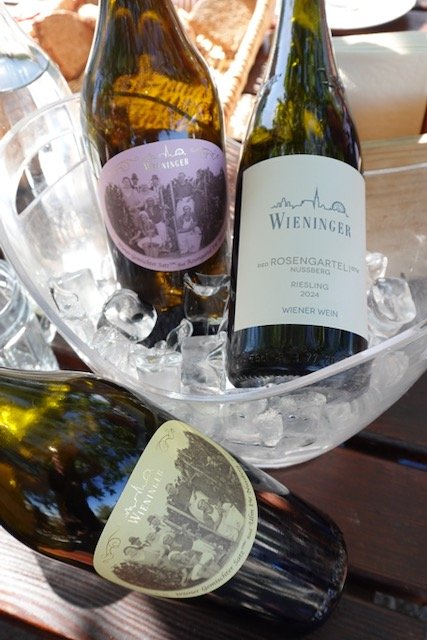
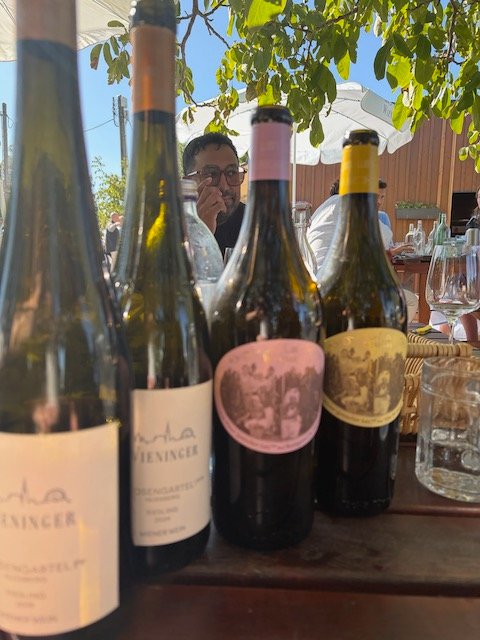
Four bottles on the table, each with the ÖTW Erste Lage seal, all from the Nussberg: three from the Rosengartel, the heart of the hill, and one from the Ulm, on the steep southern slope toward the river. The Rosengartel back label puts it simply. The Nussberg has long been Vienna’s best-known vineyard, and at its center lies the Rosengartel, the Filetstück, the prime cut, planted in part to ancient Riesling.
Ried Rosengartel Riesling 2024. The newcomer, quick and bright. Cool limestone, citrus blossom, a shiver of freshness like the first breeze after a hot afternoon.
Ried Rosengartel Riesling 2019. Five years on, golden and generous. Ripe stone fruit, a glow of honey, the unhurried confidence of a wine that knows it was worth the wait.
Wiener Gemischter Satz DAC Ried Ulm 2021. The sun-warmed one, from the slope that drops toward the Danube. Sleek, ripe, a little savory, lifted by a cool river breath.
Wiener Gemischter Satz DAC Ried Rosengartel Nussberg 2023. My coup de coeur. Many varieties, picked together, speaking as one: orchard fruit, flowers, a whisper of spice, each taking a turn before they finish the song together. Silky, layered, gently romantic, like a love letter written by a whole village. Bottles from this site were among the most sought-after in Habsburg days. You can taste why. I would happily have stayed all afternoon with a glass of it.
The Lineup That Never Stops
By the time we wandered out, the line had tripled. That said more than any review. What lingers is the whole scene: shade under the tree, warmth on the grass, the Danube and the city below, and a line of happy people that kept growing. The views, the vines, the wines all ask you to linger.
A hill, a family, and a glass that tastes of this place. Sometimes that is all a great visit needs.
Thank you, Fritz, for the welcome. And thank you, Pasi, for sending me there.