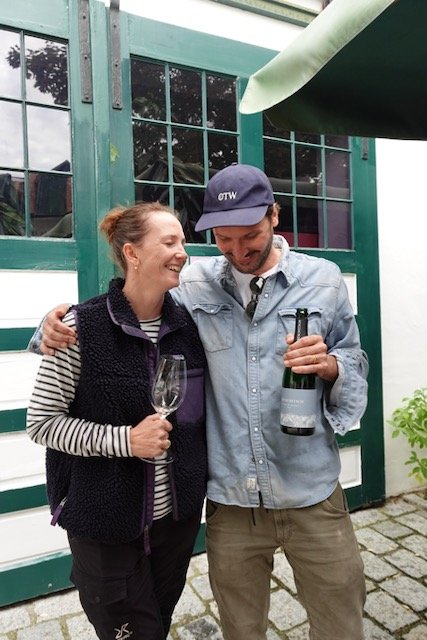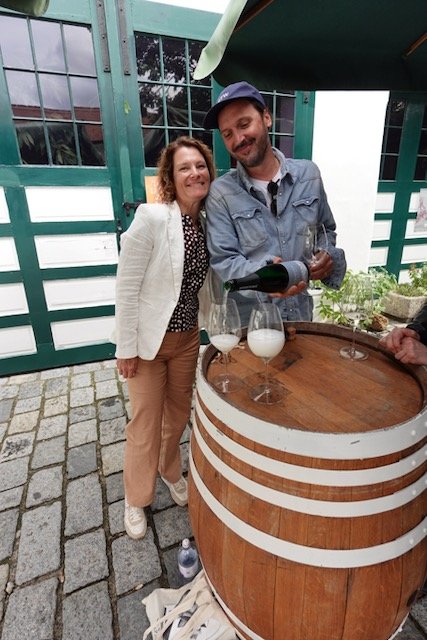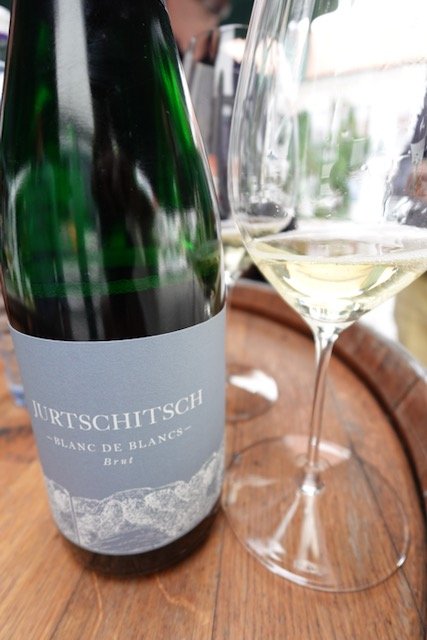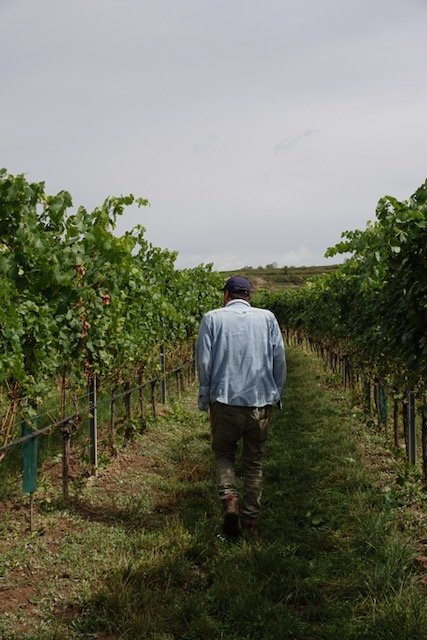
Some winemakers talk about their wines. Alwin Jurtschitsch talks about the ground beneath them, and about time: how it is made, how it erodes, and how very little of it you have when the grapes are ready.
He talks about terroir the way a farmer talks about weather. Not as a marketing word, but as the thing you live with every single day. After my time at the ÖTW Single Vineyard Summit, and after hearing him talk through the geology of his vineyards, I understood why his Kamptal wines kept pulling me back to the glass. They feel cool even when they are generous, composed rather than showy, and they linger long after the glass is empty.
An Eye-Opening Visit
This was my first visit to Kamptal, and it opened my wine eyes. It didn’t hand me a few new facts so much as change the scale at which I look: from the region, to the valley, to a single slope, to the stone underfoot. Time with Alwin made one thing plain. The Kamptal is not one terroir with a few famous names attached. It is many terroirs, folded into a single valley, and the people who farm it know each fold by heart.
A Valley of Many Soils
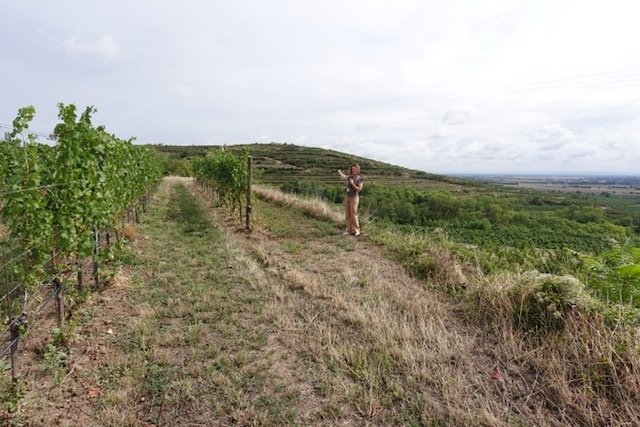
That variety is what makes the Kamptal so special. At around 3,000 hectares, the region is almost three times the size of the Wachau, and its geology runs the full range. In the west, around Zöbing and Kammern, steep terraced slopes of primary rock dominate: gneiss, mica schist, amphibolite, the glittering silvery mica of Gföhler gneiss. Moving east toward Langenlois, Gobelsburg and the Danube, the hills soften and the soil turns to deep, nutrient-rich loess left behind by the ice ages, with clay in places like Strass. Between them sit oddities that barely exist anywhere else, such as the amphibolite of Schenkenbichl, and, at the top of it all, the Permian desert sandstone of Heiligenstein.
The climate stitches it together. Cool, damp air flows in from the Waldviertel to the north and west, while warm, dry Pannonian air arrives from the southeast, and that daily push and pull of warm days and cool nights gives the wines their aromatic tension. The old rule of thumb in the valley follows the ground: Riesling on the lean, terraced upper slopes, Grüner Veltliner on the deeper loess and loam below. Stand on a single ridge and you can walk across several geological eras in an afternoon. As Alwin would later put it, that’s why one hill can make so many different wines.
A House Older Than Its Name
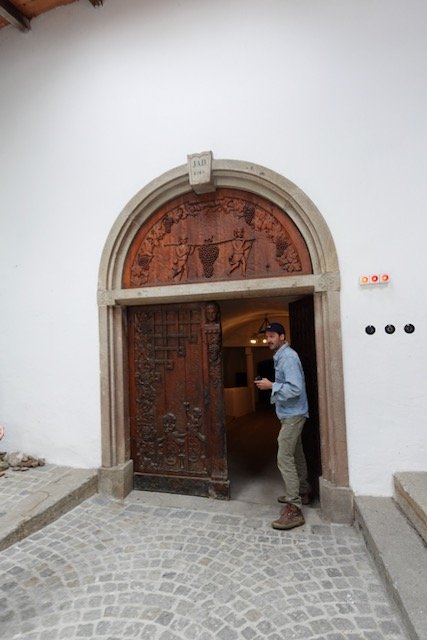
The roots of Weingut Jurtschitsch run deeper than the family name. In Langenlois, parts of the estate’s cellars reach back to the 14th century, and its beginnings are tied to the nearby Franciscan monastery that first worked these vines. The Jurtschitsch family acquired the estate in 1868 and has run it ever since, most recently the three brothers Edwin, Paul and Karl, before the next generation stepped in.
That generation is Alwin, Edwin’s son, and his wife Stefanie, who comes from the Gunderloch winemaking family of Rheinhessen. Nearly two decades ago the two of them took the reins of a historic Kamptal house with holdings in some of the valley’s best sites, and began asking what it would look like to let those sites speak without interruption.
Below Ground: A Cellar Older Than the Estate
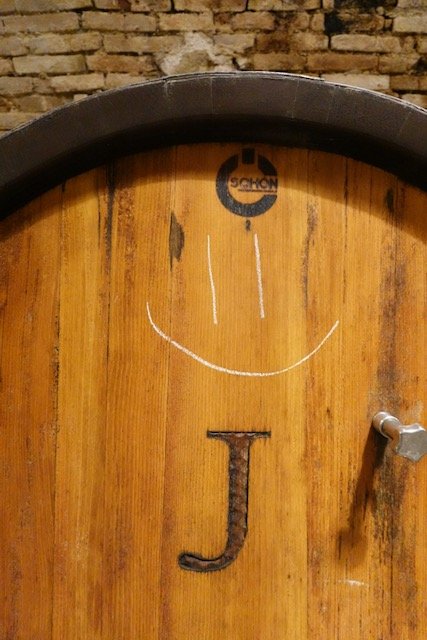
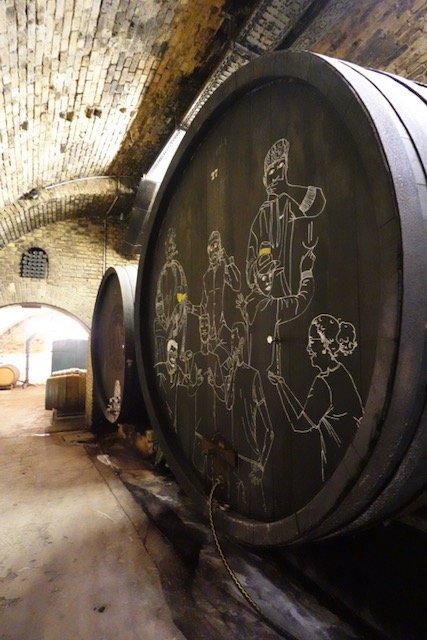
If the vineyards are the geology of the estate, the cellar is its memory. Weingut Jurtschitsch sits in the heart of Langenlois, and beneath it lies an enormous natural cellar roughly 700 years old, with parts dating to the 14th century, that once belonged to the Franciscan monastery. It was dug deep underground, where the earth keeps its own cool, steady temperature without any help from machinery. Above it, the former harvest farm, the Sonnhof, dates to the 16th century, and the old press house carries the same weight of time.
The estate did not stop with history. In 2000 a new terraced cellar with a modern press house was added alongside it, so that centuries-old stone and contemporary craft now work under one roof. Inside, the vessels are as varied as the soils: huge old foudres, smaller barrels, stainless steel, small tanks. The wines ferment spontaneously, and sulfur is added only before bottling, in moderate doses. The cellar is built to protect time, not to speed it up, which suits a house whose whole philosophy is patience.
Almost No Makeup
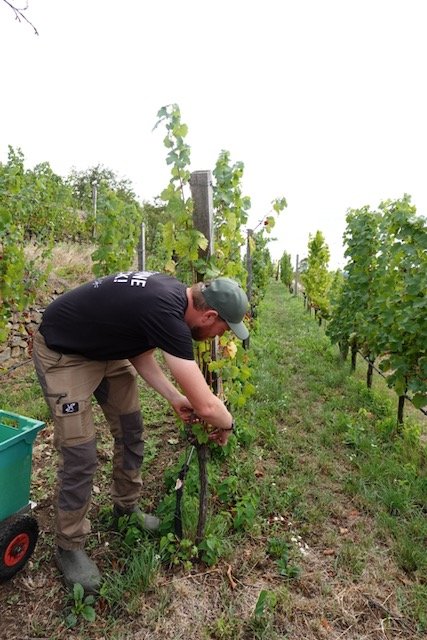
What they built from that inheritance is less revolution than clarification. The farming is organic. Since 2006, the wines have been fermented with native yeast. The Erste Lagen rest in large old wood, and the cellar approach is deliberately light: almost no makeup, as I wrote in my notes. There is room left in the vineyards for the life that grows beside and between the vines, and you taste that vitality in the fruit.
One small story captures the spirit of the place. Among their Heiligenstein holdings, Alwin and Stefanie found a little plot with completely different vegetation from the rest of the hill, reeds growing where you would expect vines. They bottle it unfined and unfiltered as Quelle. Because it sits outside the formal boundaries, it legally cannot carry the Heiligenstein name on the label, yet it is, by every account, one of that famous vineyard’s purest voices.
Four Hills, Four Temperaments
The heart of the estate is a handful of ÖTW Erste Lage sites. I met them in the ÖTW tasting room, six glasses at a time, and each one introduced itself differently.
Heiligenstein is the Kamptal’s most famous vineyard and the home of the estate’s Riesling. Alwin makes a single-vineyard Riesling from the whole hill, then two microparcels that pull it apart. Side by side, the three read like siblings who share a face but not a temperament.
- Ried Heiligenstein, the whole hill. In the glass: the lift of youth and the gravity of old sandstone, held together in one breath. The full portrait.
- Rotfels, the elder. The oldest, reddest, hardest-to-work part of the hill. In the glass: the gravity of old sandstone. Deep and serious, in no rush to tell you everything.
- Steinwand, the bright one. The west side of the hill, where day and night swing hardest. In the glass: the lift of electricity. Lively and so vibrant, like a spring water splash, quick to catch your attention.
Käferberg, the cool head. The hill above Langenlois, and to Grüner Veltliner what Heiligenstein is to Riesling. In the glass: cool even when generous. Composed, and never loud.
Loiserberg, the smooth operator. Terraced at almost 400 meters and facing southeast, among the highest and coolest sites in the portfolio. Alwin and Stefanie found it while hunting for a sparkling-wine vineyard after trips to Champagne. In the glass: clean, bright, crisp, and gliding.
Lamm, the aristocrat. A distinguished Grüner Veltliner site with the Kamptal’s signature length and breeding. In the glass: unhurried, and carrying itself like it knows.
Five wines, one signature. These are the wines I scribbled about in the margin of my notebook: aristocratic, unhurried, and carrying the cold breath of the Waldviertel wind.
The Alchemy of pH
On minerality, the word wine writers lean on hardest, Alwin does not reach for poetry. He reaches for chemistry, and then for honesty about its limits.
“The pH is the only real thing which is counting,” he says. “It’s the only link to this alchemy word of minerality.”
He does not pretend the word can be pinned down. “You cannot detect it. You cannot measure minerality. But you get this idea of something, and it’s something you have to get when you taste the grapes.”
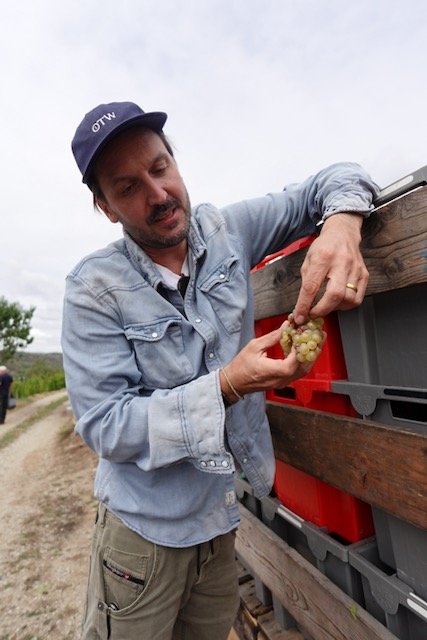
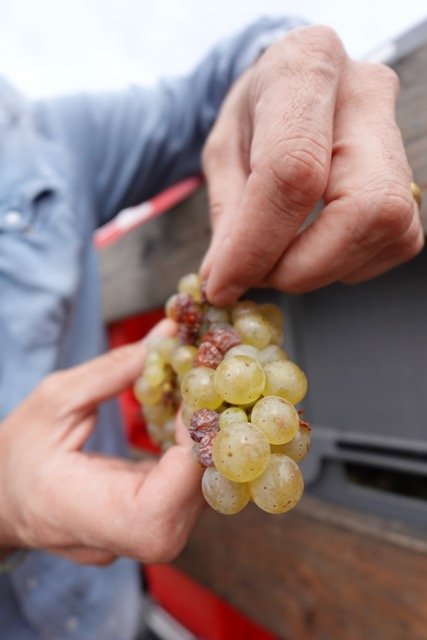
What he can pin down is timing, and here his language turns almost culinary. “When you know how to farm a vineyard, you can pretty well predict the right moment when it’s al dente. If you’re five minutes late (figuratively speaking), you have lost that “al dente” site perfection ripeness. Everything tastes the same. Heiligenstein tastes like Loiserberg, like everything.”
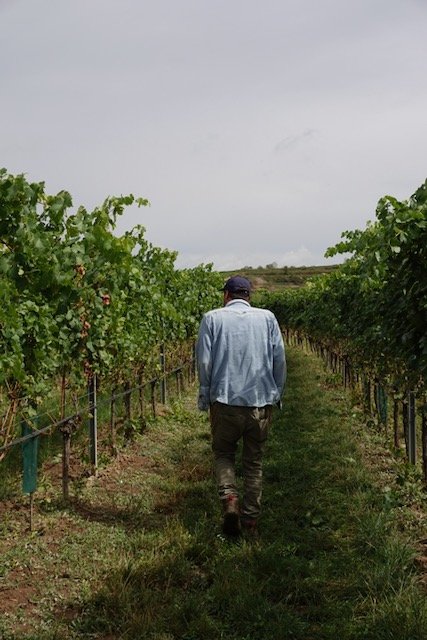
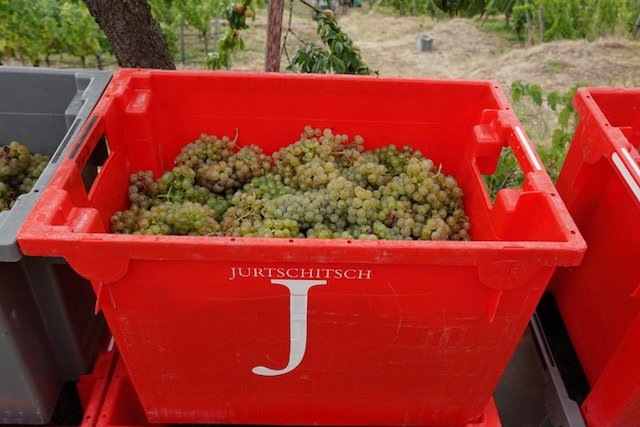
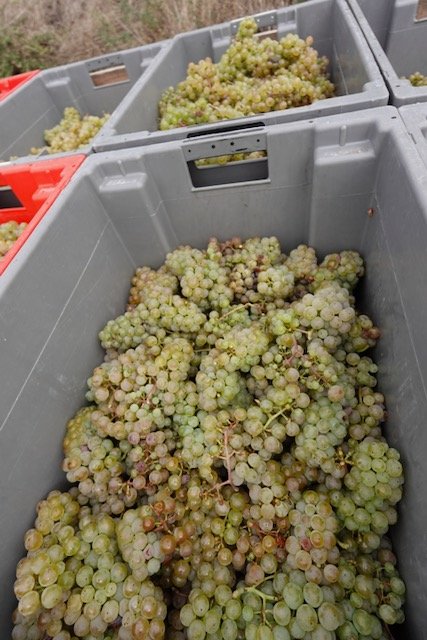
Five minutes. It is a startling thing to hear from someone whose life’s work is the difference between neighboring hills. The distinctiveness of a single vineyard, the entire premise of the Erste Lage idea, can be erased by a delay on the vine. Harvest was underway when he spoke, and the tension was plain. “This is why the last couple of days we were under tension, because those were the most important parcels to pick, and to pick today. The timing is kind of critical.”
Walking Back Through Time
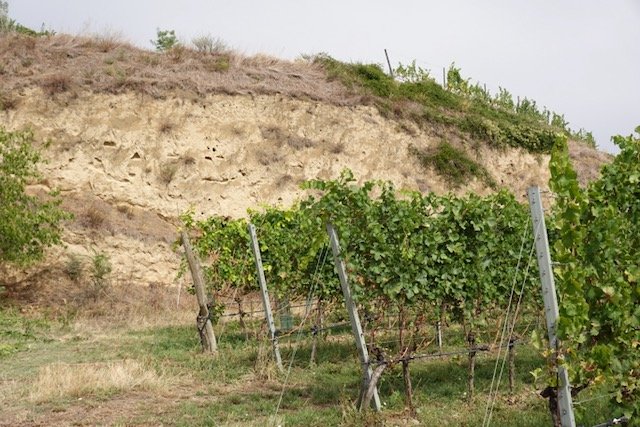
The geology of Heiligenstein is where Alwin’s voice lights up. By his account, it is the only place in Austria, or even in Europe, that he knows of where wine is grown on this particular compressed desert sandstone.
“Two hundred and fifty million years sounds very old, but it’s actually not,” he says. “Even Loiserberg, or Käferberg, is way older.”
And the rock should not be there at all. “This stone is quite easy to erode. It really shouldn’t be here anymore. The whole hillside should have eroded away millions of years ago. But somehow, this piece of rock basically came up out of the earth, and then it dropped 90 degrees.”
The result is a hillside you can read like a timeline. “When we walk from the Steinwand to the Rotfels, we walk back in history. And this is one reason why we make so many different wines out of Heiligenstein.”
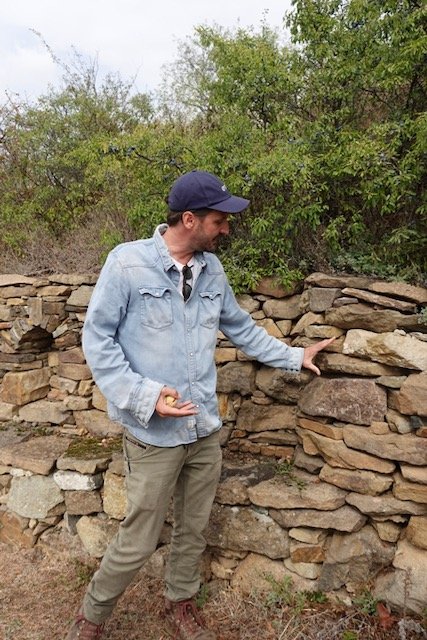
He can look at a piece of rock and tell you which part of the hill it came from. Where you find more conglomerates, or bigger ones, the stone is more porous and leans toward the yellow side, coming from the Steinwand. Inside it you find quartz, “way, way older.” The redder and more compressed the rock becomes, the more it comes from the Rotfels, the classic red rock of the Heiligenstein. Rocks with small volcanic ingredients, he said, come from the middle of the Steinwand. There was laughter when he mentioned a piece he admitted was “fake, because we need this for stability,” a reminder that even a geologist-farmer has to build things that stand.
Those differences are not trivia. Each face of the hill, each shift in color and compression, becomes a different bottle: the Steinwand, the Rotfels, the Alte Reben, one Riesling from one famous slope refracted into distinct voices.
Hobby Geologists, Hobby Gardeners
One sentence of Alwin’s has stayed with me longest, because it explains his wines better than any tasting note could.
“So we as winemakers, we are hobby geologists, hobby gardeners, scientists… and suddenly everything makes sense in the bigger picture.”
It is a modest way to describe a life’s work, and also an accurate one. The pH, the five minutes, the stone that should have washed away millions of years ago: none of it is separate. It is all one question, asked again every harvest by every grower who stands behind a classified site. Does this glass taste like here?
In Alwin Jurtschitsch’s cellar, the answer arrives quietly. His bottles don’t shout. They last.