A virtual tasting has its own quiet intimacy. The bottles arrive ahead of time and wait in a row on the kitchen table. Then, on the chosen evening, a winemaker half a world away opens a window onto his hills, his vines, and his family’s stories, and the glass in your hand connects two distant places.
Last month, Studio Cru gathered us for an evening with Alessandro Varagnolo of Cadgal in Piedmont. The invitation promised a lesson in Moscato d’Asti. By the end of the night, I realized this grape had been quietly outpacing my expectations for years.
Valdivilla and the Sunlit Slopes
Cadgal sits in Valdivilla, a hamlet of Santo Stefano Belbo in the province of Cuneo. This is the beating heart of Moscato country, where families have coaxed the grape from steep hillsides for generations.
As Alessandro described the land, I could almost feel the hills rising beneath my feet. Once a seabed, the soil here is laced with marine sediment: crumbly, varied, and richer in limestone on the south-facing slopes known as sorì. These sunlit inclines give Cadgal’s Moscato its backbone, a gentle spine that anchors all that fragrance.
These hills have inspired more than winemakers. Santo Stefano Belbo is the birthplace of novelist Cesare Pavese, who wrote of these vine-striped ridges with an ache of longing that still seems to hang in the air. Today, the vineyard landscapes of Langhe-Roero and Monferrato are a UNESCO World Heritage Site, and it’s easy to see why. Rows of vines trace every contour, on slopes so steep that much of the work is still done by hand.
The grape is Moscato Bianco, known elsewhere as Muscat à Petits Grains and one of the world’s oldest varieties. Here it grows on home turf, near the town of Canelli, whose name has long been shorthand for Italy’s finest Moscato.
Tradition, Reimagined
Cadgal’s story weaves family tradition together with a spirit of renewal. For decades under Alessandro Boido, the estate quietly championed Moscato with the depth and poise to age. In 2023, Alessandro Varagnolo stepped in with a vision: to give Moscato d’Asti a new identity, to let the variety speak in its highest register, and to reveal the soul of a truly great sweet white.
The philosophy is hands-on and patient. The vines are tended without chemical weedkillers, the soil is cared for with attention rather than haste, and the cellar favors a gentle touch. The estate now unites two properties: the Moscato vineyards in Valdivilla and Tenuta La Cova in Calamandrana, home to the reds.
The true treasure is the old vines. In the Vigna Vecchia parcel grows an ancient clone of Moscato Bianco di Canelli, nearly fifty years old, its roots reaching deep into marine sediment and drawing out a concentration only time can give. The wine from this parcel rests sixty months in sand before release, a quiet testament to the grape’s gift for aging.
Inside Alessandro’s Vision
The event felt less like a formal tasting and more like a seat at Alessandro’s kitchen table. The group was small and the conversation easy, drifting from soil and clones to family and memory.
His passion begins with a memory. At a family celebration when he was a boy, his grandfather poured him a glass of Moscato and told him to remember the flavor, because it tasted of home. He never forgot it. When the chance came in 2023 to guide Cadgal’s future, it felt less like a purchase than a return to that first invitation. For Alessandro, wine is woven from stories and emotion, and Moscato tastes of his own heritage. He isn’t trying to reinvent it. He wants it seen in its fullness, perhaps for the first time.
His vision balances reverence with ambition. Moscato, he believes, has too often been poured as an afterthought and judged by its simplest expressions. He wants the world to know what locals always have: on the right slopes, given patience, this grape stands among Italy’s great whites. Each wine in the range has its own voice, from the joyful Lumine to the contemplative Vigna Vecchia. He champions the Canelli designation, which even allows for a Riserva, and above all he is determined to prove, one bottle at a time, that Moscato can age.
He speaks of the land as something held in trust. The UNESCO-listed hills, the hand-tended rows, the warmth that greets visitors are all threads of a single story, and he hopes Cadgal will tell it with care. By the end, I felt I had met not just a producer but an ambassador for this corner of Piedmont, and that Cadgal’s story is only beginning to be told.
The Wines
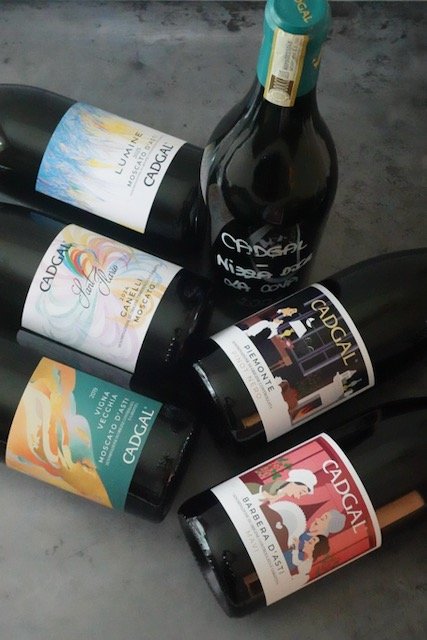
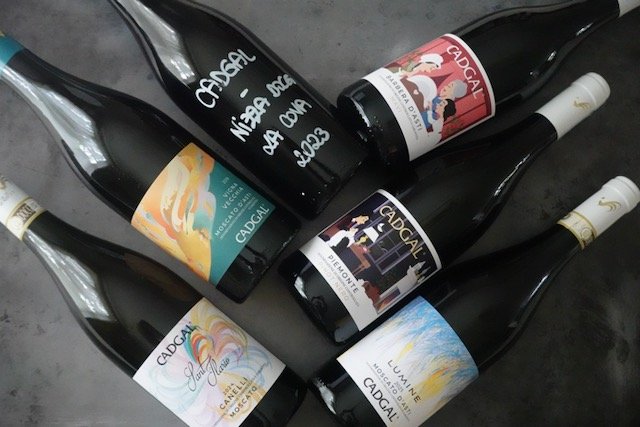
Six wines filled the evening, three reds and three Moscatos, building from brightness and freshness toward the estate’s old-vine centerpiece. Each glass revealed a new facet of these hills.
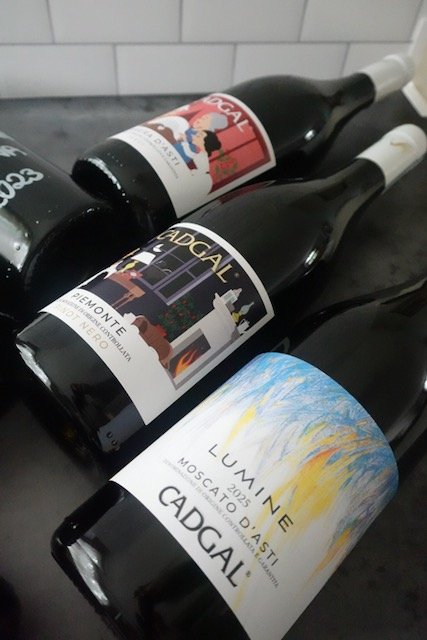
Piemonte DOC Pinot Nero 2023
An unexpected opener in Barbera and Moscato country, and a charming one. Pale, translucent ruby, with wild strawberry, sour cherry, and a hint of rose petal. Silky and light, finishing with a cool mineral edge. Pinot Nero with a Piedmontese accent: pure, graceful, quietly assured.
Barbera d’Asti DOCG Mavi 2023
Barbera is the everyday red of these hills, and Mavi wears that role with pride. Deep purple and brimming with black cherry, ripe plum, and a touch of spice, with juicy, vibrant acidity that keeps it lively. This is the bottle to open midweek with a bowl of pasta, and always a good decision.
Nizza DOCG La Cova 2023
Nizza is Barbera in evening attire, and La Cova, from Calamandrana, carries real presence. Dark and brooding, with blackberry, morello cherry, cocoa, and a trace of violet. Fuller and more layered than Mavi, with polished tannins and that hallmark Barbera freshness carrying into a long, savory finish. Serious, generous, and built to age.
Moscato d’Asti DOCG Lumine 2025
The signature Moscato d’Asti is pure joy in the glass. Pale straw with a gentle, frothy sparkle, and aromas of white peach, orange blossom, elderflower, and a sprig of sage. Sweet but never heavy, with a crisp citrus snap that brightens the palate. At just 5% alcohol, it invites a second pour. Sunshine, captured.
Canelli Moscato DOCG Sant’Ilario 2024
A single-vineyard Moscato from Canelli, with real depth. Golden in the glass, with ripe apricot, candied lemon peel, acacia honey, and a fresh herbal lift. Creamier and weightier than Lumine, with a saline, stony thread running through the sweetness. Here, Moscato begins to show the stature of a great white wine.
Moscato d’Asti DOCG Vigna Vecchia 2019
The centerpiece of the tasting, and Moscato as it is rarely seen. Deep gold, with dried apricot, quince, beeswax, chamomile, and a flicker of sage and mint. The bubbles have faded to a whisper, and the sweetness has mellowed into layers that verge on savory, with acidity still humming underneath. Haunting, contemplative, unforgettable. This is the wine that reshapes what Moscato can be.
A Taste of Home
As the screen went dark, the last sips of Vigna Vecchia lingered. Moscato is so often filed away as simple and sweet, then forgotten. Cadgal asks us to pause. Here is a grape rooted in an ancient seabed, shaped by sunlit limestone slopes, able to rest five years in sand and emerge more beautiful for the wait.
A grandfather once told a young boy to remember the taste of home. Alessandro did, and now he is pouring that memory for the rest of us. My thanks to Studio Cru for the invitation, and to Cadgal for the reminder that the most familiar wines often have the most to say.