
Bodegas Albamar O Esteiro Rias Baixas
Red blend from Rias Baixas 🇪🇸 are you sure?!? Yes I’ll get to that in a second …..70% of the wine production from the region is the beloved aromatic, saline and crisp lip smacking white varietal Albariño (which I adore). Today however todays feature wine is from Bodegas Albamar O Esteiro, Rias Baixas, Spain 2017 Rias Baixas is a rapidly growing DO in the Galicia region of northwestern Spain. It runs along the Atlantic coastline bringing Atlantic influences to the wines – think salinity and crisp acidity. Modern winemakers have brought the now hip and trendy Albariño variety to the limelight of winelovers. These wines are all well-known for their crisp, fresh, aromatic white wines, about 70% of the wine production. The cooling ocean influences help the grapes to retain the crisp, mouth-watering acidity so vital to the distinctive style of the local wines. Bodegas Albamar is the creation of Xurxo Alba (alba del mer means next to the sea). He makes wines in a traditional way, and above all lets the power of nature speak. Rich, juicy, and an example of pure craftsmanshipHis family has been farming and making Albariño in the O Salnés sub-region of Rías Baixas for generations. It wasn’t until Xurxo finished his oenology studies that the Alba family started bottling and commercializing their wines in 2006. The Alba family owns about 2.5 hectares but also sources from about 10 hectares spread throughout the region. Remaining wines are made from farms that are rented as lands are past down from generation to generation. Xurxo has incredible energy and a strong non-interventionist attitude when it comes to grape growing and winemaking – keep it natural my friend. For instance the use of only native yeasts present in the bodegas for fermentations of all wines. Albamar is has also expanded to other zones of Galicia, Valdeorras and Ribeira Sacra regions Albamar O Esteiro Tinto 2017 is sourced from 100 year old vines small plots in O Salnes on sandy, granitic soils of the region. 20% bunches are de-stemmed and undergo spontaneous fermentation in open vessels, daily punched down and maceration on the skins for about 3 weeks. The wine then undergoes aging for 8 months in small French oak barrels. It’s a blend of Caiño 34%, Espadeiro 33% and Mencía 33% The colour is rich and bright ruby red. Have you even been strawberry picking? That’s what this wine smells – freshly picked berries, combined with a field of fresh flowers, graphite and mint. The taste is just so feminine and delicate – strawberry, pomegranate, rose petals, minerals, licorice, graphite, mint and saline. It has the strength of an artisan soul, fresh acidity and refined tannins This is a very versatile wine – it has the acidity and freshness…Pair with Ibérico pork sirloin, blackened cajun chicken, grilled duck with walnut pesto or white fish soup with tomato broth.
Rosé from the Canary Islands
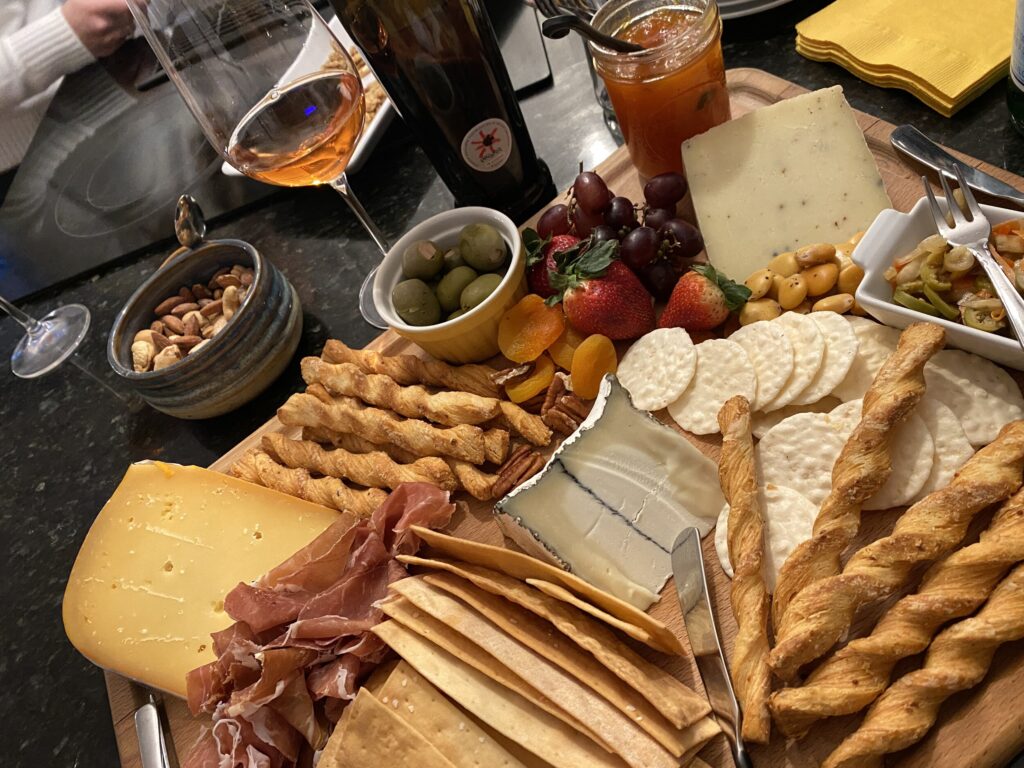
Hope aboard as we travel to Spain 🇪🇸 Listan Negro is an indigenous grape to Lanzarote, Canary Islands, Spain 🇪🇸 and the main black grape planted on the island. The vines are planted in individual hollowed out indentations in the black volcanic soil, sheltering them from the strong, humid winds. The soils bring a beautiful minerality and salinity to the wines. Today’s wine is 🇪🇸 Bodega Bermejo Listan Rosado 2019 is made from 100% Listan Negro 🍷Deep salmon color – GORGEOUS. It has a round, creamy texture yet lively acidity with slight effervescence. Aromas and flavors of strawberry, watermelon, grapefruit, lemon, pear, saline, wet stone & herbal. It’s a great value to quality $18! 🇪🇸 Paired with a stunning charcuterie board – see below:Dutch Kaaslands Kanal aged cow cheese, Humbolt Fog goat cheese and Truffle Manchego sheep cheese 🧀 to die for!!!
Stunning Blanc de Noirs – Champagne Savart
I love how the snow twinkles in the light, as does this stunning example of Frederic Savart L’Ouverture Brut Champagne NV. This Blanc de Noirs (100% Pinot Noir) cuvée comes from the clay-based soils of Ecueil in Montagne des Reims, France and is 100% organically farmed. Frederic Savart is a winemaker who keeps it real and a force to reckon with – in the vineyard and in his winemaking. He is first and foremost a farmer and wine lover. He utilizes mostly stainless steel in the fermentation to showcase the quality and refinement of his grapes. His wines are compelling, elegant and have a power all of their own. 🥂 Pale golden bronze color with aromas of white peach, red berries, smoke, honeysuckle, minerality and freshly baked brioche that tickle your nose. Palate is dry with bright elegance and twinkling bubbles. The flavors of tart strawberries, white peach, green apple, pear, lemon, cherry, smoke, honeysuckle, wet stone, chalk freshly baked brioche, pastry, cream and almonds all finish like sparkles ✨ of diamonds in your mouth. 🥂 Pair with a snowball fight ❄️❄️ or if you are feeling adventurous, Korean fried chicken, oysters with raspberry mignonette, roasted monkfish with saffron sauce… I could go on.
Franciacorta
The word Franciacorta has many meanings – a growing area, a wine, a “method” to some. Franciacorta is a sparkling wine made in the traditional method (like Champagne) in Lombardy, Northern Italy. The area is not nearly as large as Champagne, coming in at 2,200 hectares planted in the DOCG of Chardonnay, Pinot Blanc, Pinot Noir. Franciacorta is Italy’s largest producing region for traditional method sparkling wine, principally made from Chardonnay and Pinot Noir. It is Italy’s luxury sparkling wine = Champagne The region’s climate conditions are ideal for growing grapes for sparkling wine – it has cool air from Alps, Lake Iso moderating influences and the warm continental temperatures all create grapes with high acidity, delicate flavors and just ripe conditions for sparkling wines. The wines typically have ripe apple and peach fruit and prominent biscuit-like, autolytic notes, medium alcohol and medium acidity. The wines are mostly 75% Chardonnay with Pinot Noir and Pinot Blanc added, all depending on the style. Here are some Label Tips when buying Franciacorta: Non-vintage – These wines are typically Chardonnay/Pinot Noir blends that may also have up to 50 per cent Pinot Blanc. They must have a minimum of 18 months on lees. Satèn – This style can only be made from white grapes (in practice mostly 100 per cent Chardonnay). The wines must have a minimum of 24 months on the lees and only Brut style Rosé – This style must be a minimum of 35 per cent Pinot Noir and most examples are blends of Chardonnay and Pinot Noir. A minimum of 24 months on the lees is required. Millesimato – These are wines with the vintage declared. They must be made with a minimum of 85 per cent of fruit from that year and spend a minimum of 30 months on the lees. Riserva – These are millesimato wines that have spent a minimum of 60 months on the lees. Now for the wine. – Paolo Radici, an industrialist from Bergamo, decided in 1996 to find a quiet getaway somewhere in the nearby hillside while being involved in the family business, Radici Partecipazioni . He unexpectedly stumbled upon an opportunity to purchase land in Franciacorta where he could pursue his boyhood dream of growing grapes and being a wine producer. His winery produces a Franciacorta Brut, a Franciacorta Brut Nature, a Saten Franciacorta Brut, a Rose Radijan Franciacorta Brut and a Franciacorta Centoventi of utmost quality and elegance. Ronco Calino Franciacorta Brut is made from 80% Chardonnay and 20% Pinot Noir with an average vine age of 20 years. Each vineyard parcel is vinified separately, to preserve its individuality. The wine undergoes ageing on the lees for a minimum of 30 months. This particular Franciacorta is a pale lemon color. It has medium+ intensity of lemon, green apple, pear, peach, lemon, biscuit, brioche, toast, caramel, minerals, bitter almond and hazelnut. The palate is dry, medium + acid, medium body, medium alcohol, medium+ intensity of lemon, green apple, pear, peach, pineapple, lemon, biscuit, brioche, toast, caramel, minerals, bitter almond and hazelnut – creamy mousse. A lovely Sparkling – very smooth and balanced Pair with a soft rind cheese such as Brie or Camembert, oysters with mignonette, white fish tartare, mussels with toasted bread crumbs or lemon herb sauce, grilled cod (or any white fish), chicken with cream basil sauce, avocado salad.
Spaghetti with Mushroom Bolognese
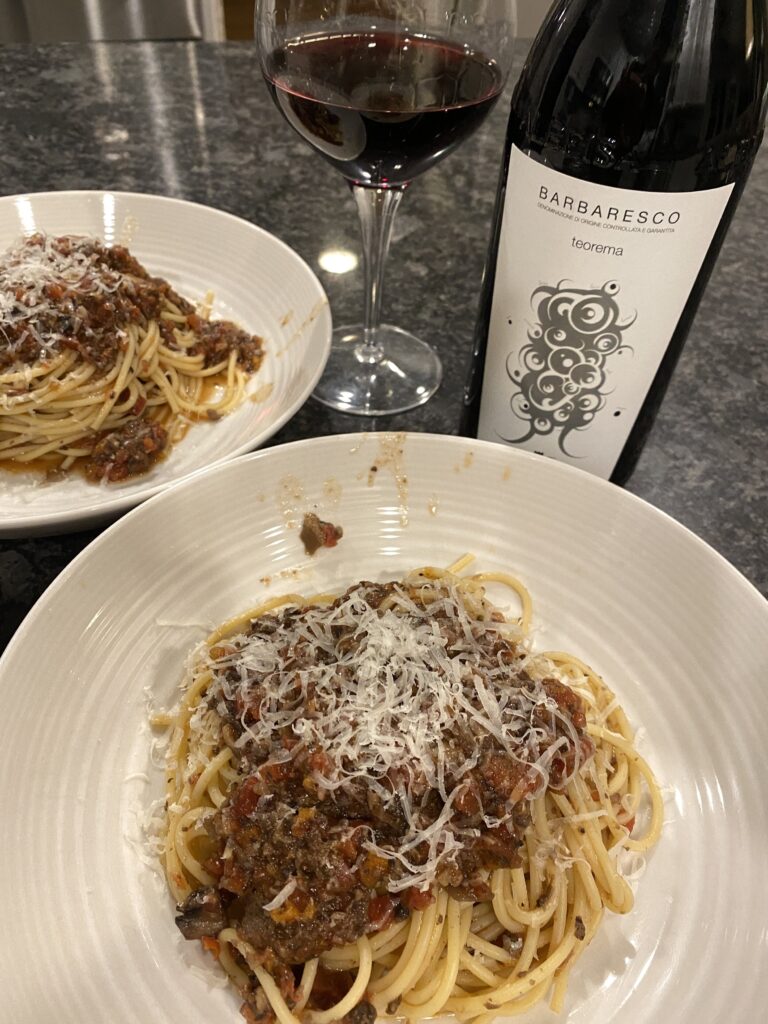
1 lb cremini mushrooms 1 lb. portobello mushrooms 2 carrot, diced 1 onion, chopped 1 28oz can of whole tomatoes 3 tablespoon butter 3 cloves minced garlic 1 teaspoon sugar 2 tablespoons tomato paste 1/2 cup red wine 1/2 cup vegetable broth 1 tablespoon soy sauce salt and pepper 2 tbsp. unsalted butter spaghetti or fettuccini grated parmesan cheese for serving Pulse the mushrooms in the bowl of a food processor fitted with a metal blade. Remove to a bowl and set aside. Process the onion, garlic and carrot in the same way until finely chopped, then add to bowl with mushrooms. Finally, if using whole canned tomatoes, process them until finely chopped. Set them aside, but don’t add to the other veggies. Heat a large pan with a heavy base over medium high heat, then add the 3 tbsp. butter and the mushroom/onion/carrot mixture. Cook until the veggies release their liquid, then keep cooking for about another 15 minutes after that point, or until the liquid evaporates and the veggies are brown. Add sugar, and tomato paste, and stir to combine. Add the processed tomatoes, broth, soy, wine, salt and pepper. Simmer for 10 minutes, or until sauce thickens again. Turn off heat and adjust seasoning. Cook pasta according to package directions in well salted pasta water (I add a handful of salt to the water which seems like a lot but it is key to balance in the dish and flavor your pasta). When al dente, drain but reserve 1/2 cup of the pasta water. Put the pasta back in the pot, add 1/4 cup of the pasta water, 2 tbsp. unsalted butter and 2 cups of the sauce. Toss together and serve with about ¾ cup (or a generous dollop) of sauce. This makes a lot of sauce – should serve a generous 8 portions. Based on a recipe from America’s Test Kitchen Pair with a medium-bodied red such as Molino Barbaresco
Spaghetti with Shrimp and Artichokes
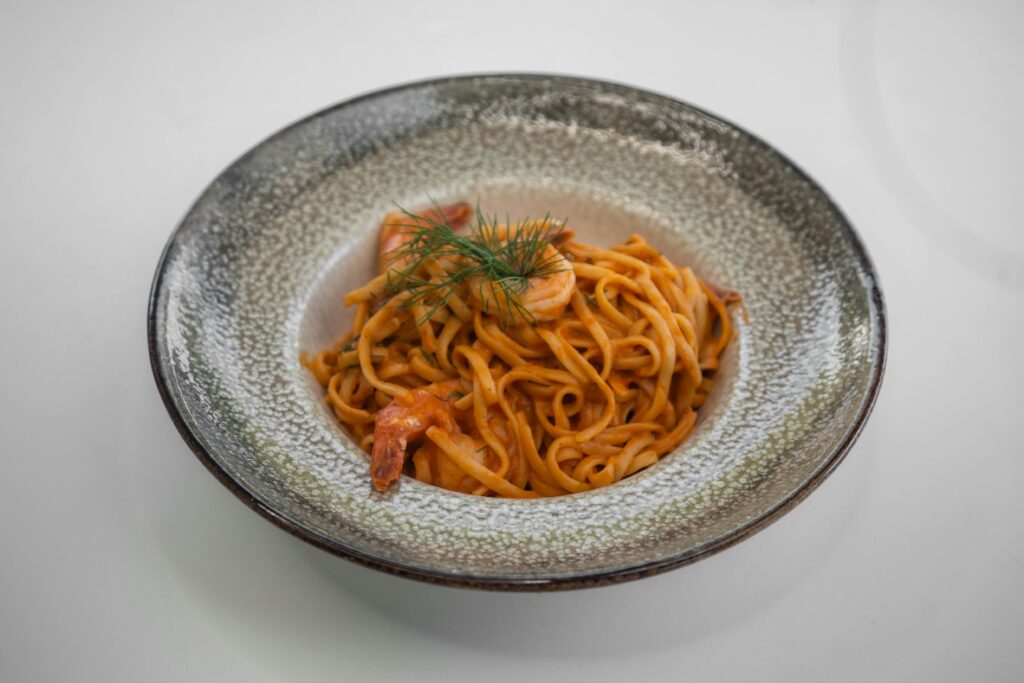
1 jar marinated artichoke quarters, rinsed and drained 4 tablespoons olive oil 1 1/2 lbs. large shrimp peeled and deveined (8-12 per pound) ¼ teaspoon salt ¼ teaspoon freshly ground black pepper 3 garlic cloves, thickly sliced Zest of 1 lemon, grated 1/8 teaspoon red pepper flakes 2 tablespoons freshly squeezed lemon juice 2 tablespoons capers ¼ teaspoon salt ¼ teaspoon freshly ground black pepper 1/2 cup white wine 1/2 cup chicken stock 1 lb. linguine, spaghetti, or spaghettini 1/4 cup chopped parsley for garnish Pat the shrimp dry and toss with salt and pepper. Heat the olive oil in a large sauté pan over medium high heat until sizzling. Quickly brown half of the shrimp on both sides, about 1 minute. Scoop the shrimp out with a slotted spoon and repeat with the remaining shrimp. Turn the heat down to medium-low and, in the same pan, sauté the artichoke slices, garlic, lemon zest and red pepper flakes until the artichokes for 5 minutes. Add white wine and stir gently to dislodge any flavorful brown bits from the bottom of the pan. Reduce the wine by half. Add the stock, the lemon juice, capers, salt and pepper. Bring the sauce to a boil and simmer until slightly thickened,10 minutes. Return the shrimp to the sauce to just warm through no more than 2-3 minutes . While the sauce is simmering cook the pasta according to the directions on the package.Drain reserving 1/2 cup of the pasta water. Pour the sauce over the pasta with 1/4 cup of the pasta water and simmer over low heat , stirring constantly, until the pasta is well coated, about 2 minutes. Add more water if the sauce is too thin. Turn the hot pasta out onto a warm serving dish and sprinkle with reserved parsley and diced tomato. Serve immediately.
I Vigneri Etna Rosso
Here is a great wine that really hit the mark with my homemade pizza – I Vignetti Etna Rosso 2019 – Terre Siciliane, Italy. It’s a blend of Nerollo Mascalese and Nerolo Capuccio…. Let’s talk about the what makes this wine so special. Sicily is the largest island in the Mediterranean Sea which served as a pitstop for many ancient civilizations such as the Greeks, Phoenicians, Arabs and Italians. They have all influenced Sicily, shaped it into what it is today. In the past Sicily got a bad rap for bulk wines produced through high yields for the boot of Italy. That couldn’t be farther from the truth…. today they are making exciting, vibrant, fresh wines that have a distinctive salt and smoke element to them, thanks to the volcanic soils and influences from Mount Etna. Sicily has a unique terroir, lovely indigenous varieties and heavily ingrained winemaking traditions. In 2001 he founded I Vigneri di Salvo Foti. The winery is named after a medieval winegrowers’ guild established in 1453. For many years Salvo Foti was a winemaking consultant to some of the island’s top estates – Benanti, Gulfi, and ViniBiondi, to name a few. He is a strong advocate of old winemaking techniques, indigenous grapes and respect of the terroir. Planted on old, terraced vineyards up to 200 years of age, these vines are organically cared. These wines are not fined or filtered, and all fermentation is spontaneous with indigenous yeast. This wine has a deep ruby color and incredibly aromatic. It smells like Sicily. It has balanced acidity, medium fine grained tannins, medium alcohol and medium+ body with flavors raspberry, cherry, red plums, tar, smoke, minerals, tomato leaf, balsamic, pepper, anise, leather, cedar, prune and violet and a long finish. It has elegance and complexity yet it’s so very easy to drink, with or without food. Pair with bacon wrapped pork loin, sausage & peppers, provolone and mushroom pizza, smoked red pepper and basil tart. I paired it with homemade pizza
Rosé de Blancs Champagne Gimonnet

I don’t know about you, but I don’t need an excuse or a reason celebrate to open bubbly. In my opinion, every day should be BUBBLY DAY 🥂Let’s dive into Champagne Gimonnet, a grower producer located in the Cote Des Blancs region of Champagne. The Gimonnet family can trace their lineage back to 1750 as farmers working in the vineyards of Cuis, Champagne. Fast forward through a number of wars and the depression to when their grandfather Pierre Gimonnet started making his own wines. Their vineyards are exclusively Chardonnay in the northern Côte des Blancs region of Champagne, which makes up 98% of their production. ‘We do not inherit land from our parents; we borrow it from our children.’ (Antoine de Saint-Exupéry). That quote is their motto and they mean business. The third generation producer developed their own unique style, both in winemaking and the Champagne itself. They were amongst the first to vinify wines by parcel in small stainless steel vats. “Making something good when one has good land is natural, but to make something exceptional is the next step and always challenging to achieve.” (Pierre Gimonnet) Its Champagnes are notable for purity and freshness, elegant fruit and mineral balance, and generous acidity that lends itself to ageing. Their passion and respect of the terroir is infinite and their wines are their interpretation of those unique characteristics. The chalky soils of the region are what makes Chardonnay shine in it’s elegance and longevity. The age of the vines also contributes to the concentration and minerality of the wines ranging from 35 to over 100 years old. Their respect for the land continues through sustainability practices to minimize their impact on the environment. The grapes are picked by hand and pressed less than 6 hours afterwards. The wines then undergo a natural cold racking for 24 hours. The fermentation process starting less than 36 hours after pressing to preserve the purity of the aromas. The single-parcels undergo vinification in stainless-steel vats and aging on fine lees without stirring. By blending grand cru fruit into premier cru wines they raise the quality while making their wines accessible. It’s a balance of freshness, complexity, intensity and elegance. All the reserve wines are kept in bottles (with low pressure),an extremely rare technique in Champagne. Dosage is kept to a bare minimum in order to achieve their specific style. Their Champagnes range from the Champagne Pierre Gimonnet Cuis 1er Cru Blanc de Blancs NV , Brut Gastronome, Rosé Blanc de Blanc, Gimonnet Special Club Millésime de Collection to Oger, Chouilly and Cramant Grand Crus. Truly, their wines are meant to be enjoyed and show their true characteristic of where it came from. Champagne Pierre Gimonnet & Fils Rosé de Blanc Brut 1er Cru is blend of 92.5% Chardonnay from Cote Des Blancs + 7.5% Pinot Noir from Bouzy & Cumières. This is a new venture for the Gimonnet house which started in 2010 and has been widely successful. They have created a Champagne that harmoniously has the color & red fruit flavors of a Rosé and the power of a Blanc de Blanc The Rosé de Blanc pretty feminine salmon pink color with lively bubbles that tickle your nose. It has a creamy texture & crisp acidity. The aromas and flavors of green apple, pear, pink grapefruit, strawberry, blood orange, minerals, honeysuckle, rhubarb, grass, cream, toast and brioche. It’s elegant, fresh and has a purity of fruit to it.
Roasted Shishito Peppers

Roasted Shishito Peppers – quick & crowd pleasing….. there’s just something about the mix of crunchy salt, rich oil, and smoky peppers — you can’t stop at just one. These Japanese peppers are pretty mild but every so often a spicy one explodes in your mouth – it’s like playing Russian roulette with every bite. The key to this dish is high heat and quick cooking. What you will need: 8oz shisito pepeprs 2 tbsp. Extra virgin olive oil Coarse kosher salt Heat the oven on Broil setting. Make sure the rack is in the middle of your oven. You want to oven very hot. Place a nonstick skillet in the oven and heat up for 5-6 minutes. Meanwhile, place the peppers in a mixing bowl. Drizzle them with cooking oil and a healthy sprinkle of salt. Use your hands or spoon to evenly coat the peppers with oil. Transfer the peppers to the skillet and cook the peppers until blistered – cook for 5 minutes, give the pan a shake to turn the peppers and cook for another 4-5 minutes. Transfer the peppers to a plate and sprinkle with extra salt: The peppers are best when eaten within minutes of coming off the heat. Enjoy! I paired this delicious dish with a smoky, flinty & lively Domaine Chauveau Sauvignon Blanc from Pouilly Fumé AOC in Loire, France 🇫🇷 the herbaceous character and acidity of the wine makes it a lovely pairing for this appetizer. Expect flavors of green apple, lime, gooseberry, grapefruit, flint, smoke herbal and yellow flowers. Let me know if you have ever tried roasted Shishito peppers.
Braised Pork Loin with Prunes and Port

1 x 4 lb. center cut pork loin 1/4 cup olive oil 4 medium onions, halved and thinly sliced 5 cloves garlic, minced 15 pitted prunes 1 cup Ruby Reserve Port 2 sprigs of sage 4 bay leaves 2 sprigs of thyme 1 tsp black peppercorns 4 whole cloves 2 tbsp each (heaping) Dijon mustard and brown sugar 1 cup chicken stock kosher salt and pepper The morning you plan to make this meal, season the pork all over with kosher salt. Don’t worry, the dish won’t be salty. The presenting tenderizes the meat and through osmosis retains moisture within. Heat the over to 375F. Place the sage, thyme, bay leaves, peppercorns and cloves in a spice bag or cheesecloth. Heat 2 tbsp. oil in a large dutch oven till hot. Add the onions, garlic, 1/2 tsp. each kosher salt and pepper, turn the heat down to love and cook til the onions are soft and golden, about 20 minutes. Transfer to bowl and set aside. Turn the heat back up to medium high. While the pot is heating up, pat the pork dry and smother all over with dijon and brown sugar. Sprinkle with 1 tsp. kosher salt and 1/2 tsp. pepper. Add the oil to the hot pot and sear the meat all over. Once seared, remove and let rest for 5 minutes. Add in the rest of the ingredients to the pot and bring to a boil. Add the meat to the pot and cover. Place in the heated oven and roast till the port registers 150F in the center. Remove the meat from the pot, place a cutting board covered with aluminum foil and allow to rest for 10 minutes before slicing. Remove the spice bag from the sauce and season to taste. Slice pork and serve with sauce.