
Smith Devereux Ibex Merlot
EVERY BOTTLE HAS A STORY……………. The Smith Devereaux Winery is a boutique winery is located in Napa Valley, California. This story began over a mutual love of wine and music. Ian White (a travel & wine writer), Steve Smith (a farmer with some of Napa Valley’s best grapes) & John Anthony Truchard (a music industry insider) all came together at a time in their lives where they wanted to a change and be part of something amazing. The winery is named after combining Steve’s last name Ian’s middle name, Devereux. The wines are sustainably made with minimal intervention. They make wines that are meant for family and friends to enjoy at every occasion from Rosé, Sauvignon Blanc, Red Blend (Zin and Syrah) to Ibex Single Varietal Merlot and esteemed Cabernet Sauvignon. They also have limited production Artist & Philanthropy wines that benefit various foundations and charities. Ian would love to host you personally in their Oak Knoll Cabernet Vineyards. But you can also try them at JaM cellars. As Ian put it “That way people will come visit me and we can develop a friendship that extends beyond wine.” Napa is known for Cabernet Sauvignon with depth of flavor (rich fruit, minerality, oak and floral), graceful acidity and fine grained tannins. Rightly so, they have the prime climatic conditions and a dusty soil quality that is unique to Napa. Where you find Cabernet Sauvignon, you’ll find Merlot – does Bordeaux ring a bell to anyone? When I tasted their single vineyard Merlot, I was blown away. I contacted him right away to set up a call because I needed to know more about their story and wines. He was incredibly accommodating and happily answered all of my questions from the winery to climate change to this incredible wine. Today’s focus is on their Ibex Single Vineyard Merlot. The single vineyard is from their Ibex Vineyard in St. Helena, Napa. I asked Ian why they chose to grow a single vineyard Merlot in Napa when no one else was doing it? He said “that’s exactly why. This varietal is special, it needs to shine and I like going against the grain.“ They wanted to make something authentic and genuine. The wine is made in the same manner as Cabernet Sauvignon but the end result is soft, feminine, floral & fruity, rich and balanced. The grapes are harvested late for prime ripeness. The wine is aged in new French oak for 14 months for a lusciously complex, full-bodied merlot. They wanted to do something different and they succeeded tenfold. Their wines truly are FARM TO BOTTLE. Merlot is often overlooked or passed over in favor of Cabernet Sauvignon. Heck, it got a bad wrap in the 90’s from the much adored movie Sideways known as the Sideways Effect. Well let me set the record straight. It’s smooth, lush, and a better value to quality than Cabernet. However, Merlot can taste as big as a Cabernet Sauvignon. Fun Fact: Merlot is a cross between Cabernet Franc and Magdeleine Noire des Charentes. Merlot translates to “little blackbird” in an old regional French dialect. Merlot is loved for its vibrant black cherry flavors, supple tannins, and chocolatey finish. Merlot is typically medium bodied, tannins, acid and alcohol – known as medium-itis. Merlot is an ideal food pairing wine and a safe bet for any occasion. This wine has a deep ruby/purple color. Beautiful aromas of black raspberry, blackberry, earthy fresh fig, raisins, chocolate, leather, tobacco leaf, vanilla and cloves. The wine has a balanced profile of medium acid and soft medium tannins with a full body. The flavors jump to life with black raspberry, blackberry, plum, chocolate, earthy fresh fig, raisins, leather, tobacco leaf, vanilla, nutmeg, lavender, cedar and cloves. It is very well integrated with long lasting finish. Try this Merlot with decadent dirty herbed leg of lamb, seared duck breast with roasted thyme red plums over duck-fat fried fingerling potatoes, pork belly with coffee glaze, grilled porterhouse steak with peppercorn sauce, braised veal cheeks with waffles and foie gras, or grilled chipotle pork chops.
Bodega Albamar Fusco Mencía 2018
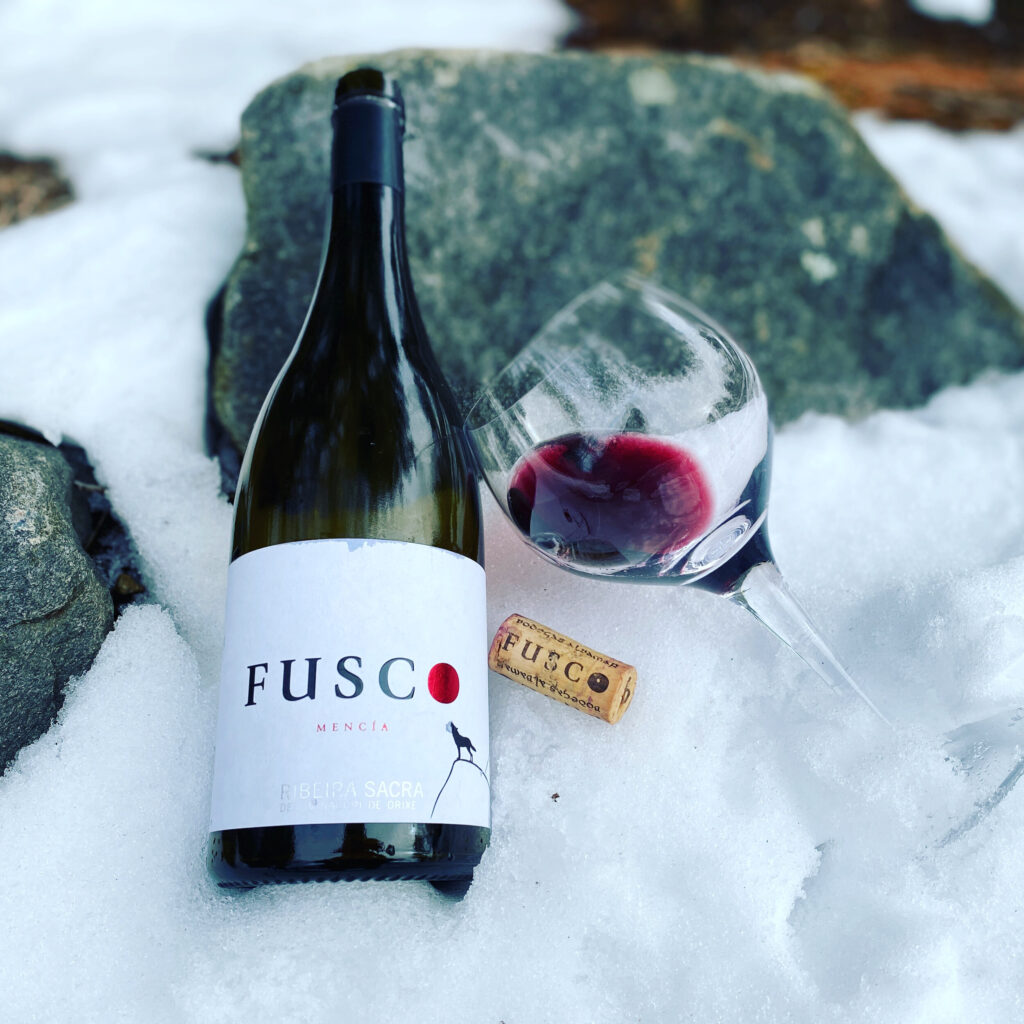
Today I’m hanging out in Galicia, Spain (in my mind and what’s in my wine glass lol) 🇪🇸 enjoying another fine example of what the region and Bodegas Albamar have to offer. Today’s wine is Bodega Albamar Fusco Mencía 2018. It is 100% Mencía ….. what is Mencía?!? Mencía 101 – it’s a varietal predominantly grown in northwestern Spain 🇪🇸 in the DOs of Bierzo, Valdeorras and Ribera Sacra and Dão in Portugal (aka Jaen). Fun fact – Ribeira Sacra means Sacred Shore. Vines are planted in 2000 year olds Roman terraces on hyper steep granite slopes. The best Mencia will be extremely supple, a fine, subtle crunchy gravel minerality with fresh red berry & pepper profile. Mencía is like a sexy Pinot Noir and an earthy Cabernet Franc made a baby and boom 💥💥 out pops Mencía 😂 at least that’s my personal opinion. Bodegas Albamar farms and ferments the grapes naturally, leaves the wine unfiltered or fined (see my post from February 11th) for more details on this incredible producer. This wine is made from 30-40 year old vines. Fun fact – Fusco is a Galician word for darkness, but this wine is the exact opposite. The wine is a dark color but tastes bright, juicy and fresh. In the glass – the color is deep ruby with subtle hues of violet towards the rim. Medium intensity of cherry, pomegranate, blackberry, pepper, dust, graphite, minerals. The palate has a bright acidity, fine grained tannins, medium body and alcohol. Fresh flavors of cherry, pomegranate, blackberry, red plum, pepper, dust, graphite, minerals, with a savory mint, black pepper and fennel finish. Pair with Hickory Smoked Rosemary Sage Venison tenderloin, Steak au Poivre (pepper steak), Fennel Roast Pork or Portabello Mushroom Burgers with Manchego cheese.
Dorie’s Roast Chicken for Lazy People [Les Paresseux]
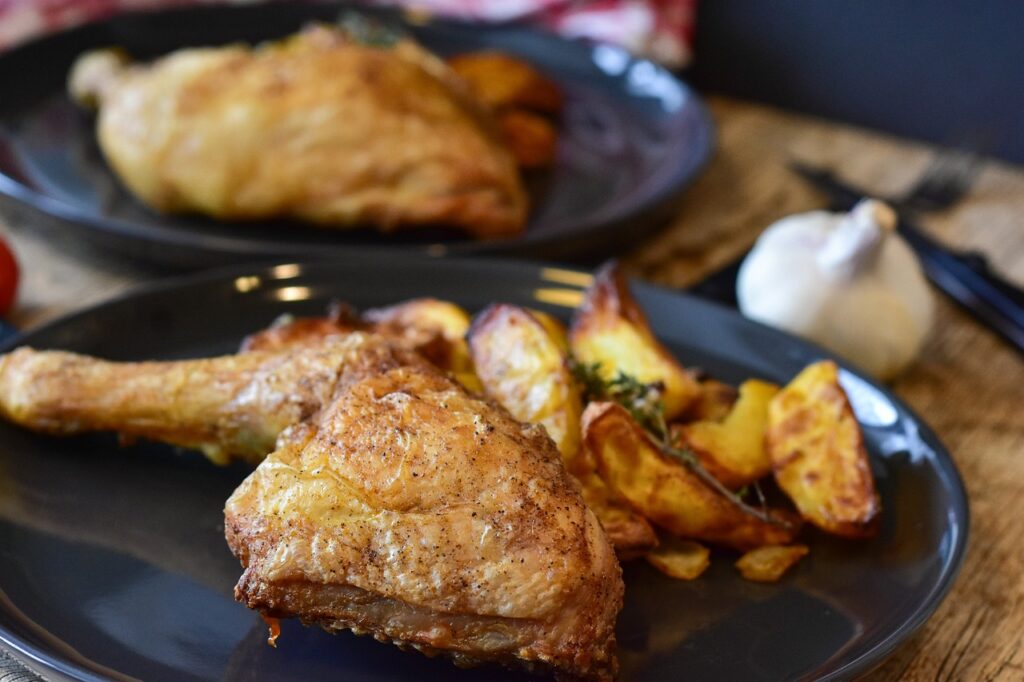
Olive oil 1 thick slice bread or 2 slices baguette 1 chicken, 4 ½ to 5 pounds, preferably organic at room temperature Salt and freshly ground pepper 2 sprigs each rosemary, thyme, and oregano 1 garlic head, cut horizontally in half, unpeeled About ⅔ cup dry white wine or water (optional) 4 baby potatoes, scrubbed and quartered (optional) 2 carrots, trimmed, peeled, and cut into thick chunks (optional) 4 shallots, left whole, or 1 onion, quartered (optional) 24 hours before you want to roast the chicken, salt the chicken all over. Place in the fridge overnight, uncovered. Don’t worry the chicken won’t be salty. What this will do is create a chicken that has crispy skin on the outside and moist, tender chicken on the inside. Center a rack in the oven and preheat the oven to 450 degrees F. Rub the inside of a Dutch oven or other large high-sided casserole with oil and place the bread and half of the garlic in the center of the pot. Season the chicken inside and out with salt and pepper. Put in a half sprig of each of the herbs as well as one half of the garlic. Put the chicken in the pot, resting it on the bread. Put the the remaining herbs, and pour in a few tablespoons each of oil and the wine or water. Cover and slide the pot into the oven. If you’d like to roast the vegetables with the chicken, wait until the chicken has roasted for 45 minutes. Then toss the potatoes, carrots, and shallots with enough olive oil to give them a shine, season generously with salt and pepper, and scatter them around the chicken. Roast the chicken undisturbed for about 45 minutes more — a total of about 90 minutes — or until the skin is crackly and crisp and the juices run clear when you pierce the thickest part of the thigh with the tip of a knife. Remove the chicken from the oven. Place the chicken on a cutting board, cover with foil and allow to rest for 10 minutes. Carve. Should you want a little pan sauce — and you’ll only get a little — spoon the vegetables, if you’ve got them, into a bowl, remove the bread, and skim off as much of the fat remaining in the pot as possible. Put the pot over high heat, and then the liquid boils, pour in about ½ cup wine or water and cook, scraping up whatever bits may have stuck to the bottom of the pot. Remove from the heat. Pair with a rich and creamy California Chardonnay, a Beaujolais Gamay or a Pinot Noir. Recipe courtesy of Dorie Greenspan
And Why I Am Mr. Pink 2019 Rosé
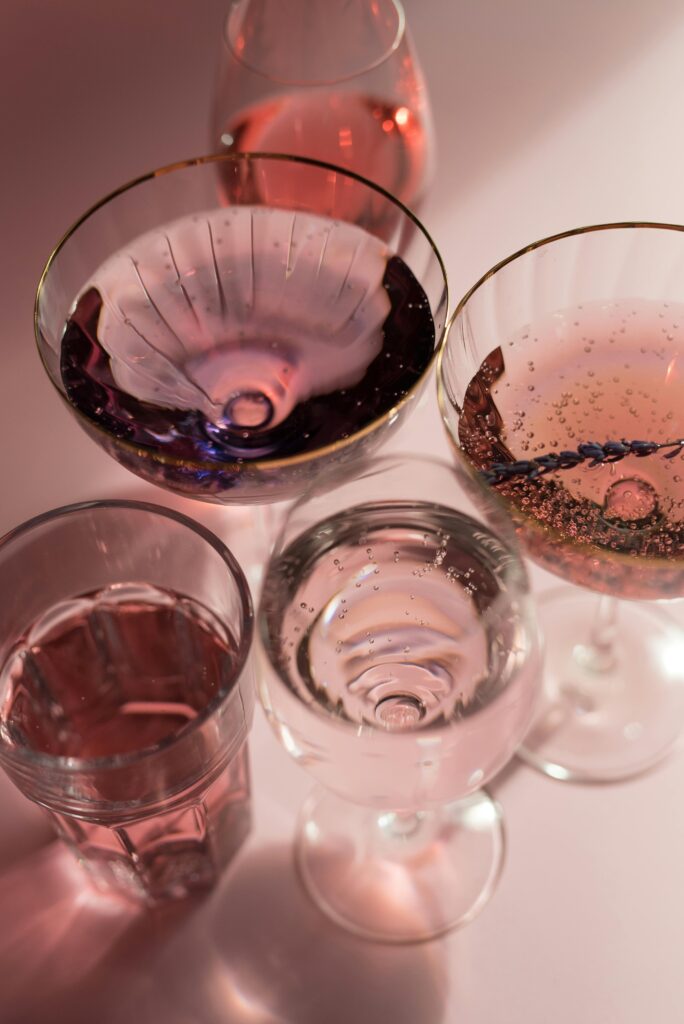
Me: Oh no! The bottle is almost finished Mr. Pink : I mean everbody panics, everybody, things get tense, it’s human nature to panic, I don’t care what you name it you just can’t help it!!! This bottle is aptly named after the cult following Quentin Tarantino movie Reservoir Dogs, which Steve Buscemi’s character is named Mr. Pink. Mr. Pink didn’t like his name and wanted to be called Mr Purple (which would be a great name for a Malbec 😂). His character is level-headed, intelligent and the last survivor out of all of the “Dogs” ✨And Why I Am Mr. Pink 2019 Rosé As you may know I am a huge fan of The Underground Wine Project and rockstar winemakers Trey Busch and Mark Ryan. These guys stay true to their craft and make wines of purity and elegance all harmoniously in rhythm. Check out my post on January 27th for more info on The Underground Wine Project & their stunning red Idle Hands. Rosé isn’t just for summer sipping or poolside lounging. It’s meant to enjoyed all year round. It is such a versatile and food friendly wine made from a wide range of varietals. This particular wine is a blend if Sangiovese and Syrah, both of which do very well in Washington State. Mr. Pink is a cult Rosé my friends. Once you’ve tasted it, you will always have it on hand. Pretty in pink color with the aromas of summer all melted into one wine – ripe sweet watermelon, freshly picked cherries, strawberry, pomegranate, white peach, lemon, orange peel, grapefruit, honeysuckle, wet stone, mint, white pepper and grass. This wine has a lip smacking acidity with a creamy texture. Serve chilled with Moroccan chicken couscous, a grilled sage Turkey burger, roasted salmon with tomato jam or alongside your cheese and charcuterie board.
Bodegas Albamar O Esteiro Rias Baixas
Red blend from Rias Baixas 🇪🇸 are you sure?!? Yes I’ll get to that in a second …..70% of the wine production from the region is the beloved aromatic, saline and crisp lip smacking white varietal Albariño (which I adore). Today however todays feature wine is from Bodegas Albamar O Esteiro, Rias Baixas, Spain 2017 Rias Baixas is a rapidly growing DO in the Galicia region of northwestern Spain. It runs along the Atlantic coastline bringing Atlantic influences to the wines – think salinity and crisp acidity. Modern winemakers have brought the now hip and trendy Albariño variety to the limelight of winelovers. These wines are all well-known for their crisp, fresh, aromatic white wines, about 70% of the wine production. The cooling ocean influences help the grapes to retain the crisp, mouth-watering acidity so vital to the distinctive style of the local wines. Bodegas Albamar is the creation of Xurxo Alba (alba del mer means next to the sea). He makes wines in a traditional way, and above all lets the power of nature speak. Rich, juicy, and an example of pure craftsmanshipHis family has been farming and making Albariño in the O Salnés sub-region of Rías Baixas for generations. It wasn’t until Xurxo finished his oenology studies that the Alba family started bottling and commercializing their wines in 2006. The Alba family owns about 2.5 hectares but also sources from about 10 hectares spread throughout the region. Remaining wines are made from farms that are rented as lands are past down from generation to generation. Xurxo has incredible energy and a strong non-interventionist attitude when it comes to grape growing and winemaking – keep it natural my friend. For instance the use of only native yeasts present in the bodegas for fermentations of all wines. Albamar is has also expanded to other zones of Galicia, Valdeorras and Ribeira Sacra regions Albamar O Esteiro Tinto 2017 is sourced from 100 year old vines small plots in O Salnes on sandy, granitic soils of the region. 20% bunches are de-stemmed and undergo spontaneous fermentation in open vessels, daily punched down and maceration on the skins for about 3 weeks. The wine then undergoes aging for 8 months in small French oak barrels. It’s a blend of Caiño 34%, Espadeiro 33% and Mencía 33% The colour is rich and bright ruby red. Have you even been strawberry picking? That’s what this wine smells – freshly picked berries, combined with a field of fresh flowers, graphite and mint. The taste is just so feminine and delicate – strawberry, pomegranate, rose petals, minerals, licorice, graphite, mint and saline. It has the strength of an artisan soul, fresh acidity and refined tannins This is a very versatile wine – it has the acidity and freshness…Pair with Ibérico pork sirloin, blackened cajun chicken, grilled duck with walnut pesto or white fish soup with tomato broth.
Rosé from the Canary Islands
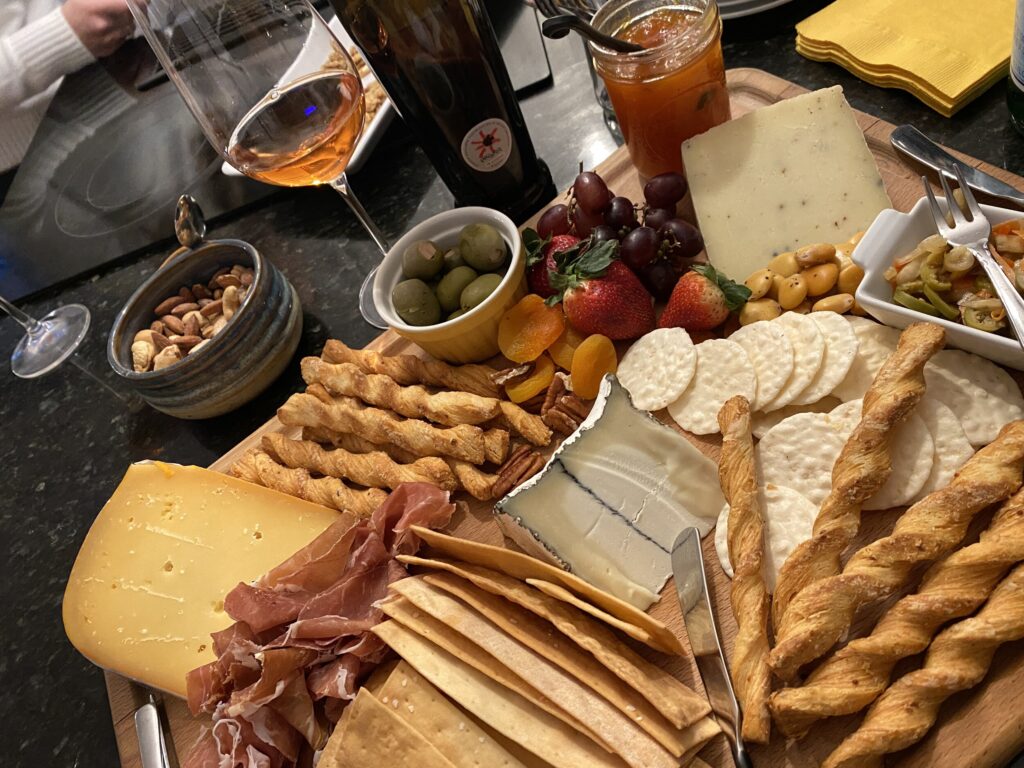
Hope aboard as we travel to Spain 🇪🇸 Listan Negro is an indigenous grape to Lanzarote, Canary Islands, Spain 🇪🇸 and the main black grape planted on the island. The vines are planted in individual hollowed out indentations in the black volcanic soil, sheltering them from the strong, humid winds. The soils bring a beautiful minerality and salinity to the wines. Today’s wine is 🇪🇸 Bodega Bermejo Listan Rosado 2019 is made from 100% Listan Negro 🍷Deep salmon color – GORGEOUS. It has a round, creamy texture yet lively acidity with slight effervescence. Aromas and flavors of strawberry, watermelon, grapefruit, lemon, pear, saline, wet stone & herbal. It’s a great value to quality $18! 🇪🇸 Paired with a stunning charcuterie board – see below:Dutch Kaaslands Kanal aged cow cheese, Humbolt Fog goat cheese and Truffle Manchego sheep cheese 🧀 to die for!!!
Stunning Blanc de Noirs – Champagne Savart

I love how the snow twinkles in the light, as does this stunning example of Frederic Savart L’Ouverture Brut Champagne NV. This Blanc de Noirs (100% Pinot Noir) cuvée comes from the clay-based soils of Ecueil in Montagne des Reims, France and is 100% organically farmed. Frederic Savart is a winemaker who keeps it real and a force to reckon with – in the vineyard and in his winemaking. He is first and foremost a farmer and wine lover. He utilizes mostly stainless steel in the fermentation to showcase the quality and refinement of his grapes. His wines are compelling, elegant and have a power all of their own. 🥂 Pale golden bronze color with aromas of white peach, red berries, smoke, honeysuckle, minerality and freshly baked brioche that tickle your nose. Palate is dry with bright elegance and twinkling bubbles. The flavors of tart strawberries, white peach, green apple, pear, lemon, cherry, smoke, honeysuckle, wet stone, chalk freshly baked brioche, pastry, cream and almonds all finish like sparkles ✨ of diamonds in your mouth. 🥂 Pair with a snowball fight ❄️❄️ or if you are feeling adventurous, Korean fried chicken, oysters with raspberry mignonette, roasted monkfish with saffron sauce… I could go on.
Franciacorta
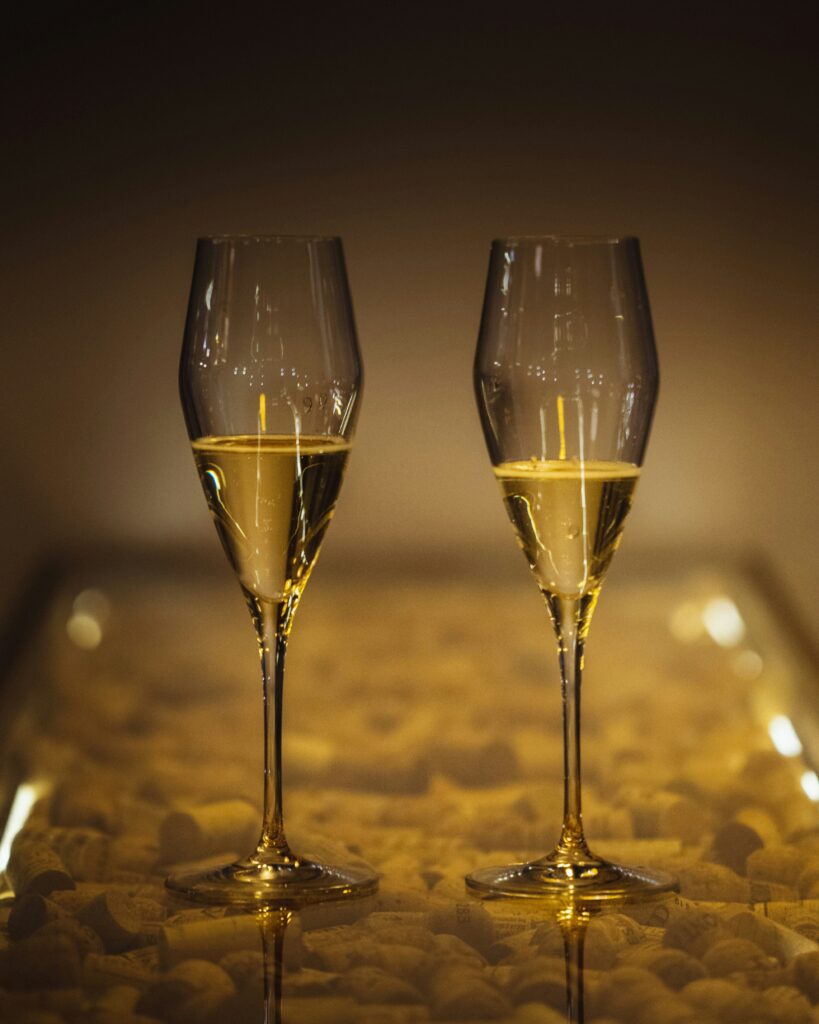
The word Franciacorta has many meanings – a growing area, a wine, a “method” to some. Franciacorta is a sparkling wine made in the traditional method (like Champagne) in Lombardy, Northern Italy. The area is not nearly as large as Champagne, coming in at 2,200 hectares planted in the DOCG of Chardonnay, Pinot Blanc, Pinot Noir. Franciacorta is Italy’s largest producing region for traditional method sparkling wine, principally made from Chardonnay and Pinot Noir. It is Italy’s luxury sparkling wine = Champagne The region’s climate conditions are ideal for growing grapes for sparkling wine – it has cool air from Alps, Lake Iso moderating influences and the warm continental temperatures all create grapes with high acidity, delicate flavors and just ripe conditions for sparkling wines. The wines typically have ripe apple and peach fruit and prominent biscuit-like, autolytic notes, medium alcohol and medium acidity. The wines are mostly 75% Chardonnay with Pinot Noir and Pinot Blanc added, all depending on the style. Here are some Label Tips when buying Franciacorta: Non-vintage – These wines are typically Chardonnay/Pinot Noir blends that may also have up to 50 per cent Pinot Blanc. They must have a minimum of 18 months on lees. Satèn – This style can only be made from white grapes (in practice mostly 100 per cent Chardonnay). The wines must have a minimum of 24 months on the lees and only Brut style Rosé – This style must be a minimum of 35 per cent Pinot Noir and most examples are blends of Chardonnay and Pinot Noir. A minimum of 24 months on the lees is required. Millesimato – These are wines with the vintage declared. They must be made with a minimum of 85 per cent of fruit from that year and spend a minimum of 30 months on the lees. Riserva – These are millesimato wines that have spent a minimum of 60 months on the lees. Now for the wine. – Paolo Radici, an industrialist from Bergamo, decided in 1996 to find a quiet getaway somewhere in the nearby hillside while being involved in the family business, Radici Partecipazioni . He unexpectedly stumbled upon an opportunity to purchase land in Franciacorta where he could pursue his boyhood dream of growing grapes and being a wine producer. His winery produces a Franciacorta Brut, a Franciacorta Brut Nature, a Saten Franciacorta Brut, a Rose Radijan Franciacorta Brut and a Franciacorta Centoventi of utmost quality and elegance. Ronco Calino Franciacorta Brut is made from 80% Chardonnay and 20% Pinot Noir with an average vine age of 20 years. Each vineyard parcel is vinified separately, to preserve its individuality. The wine undergoes ageing on the lees for a minimum of 30 months. This particular Franciacorta is a pale lemon color. It has medium+ intensity of lemon, green apple, pear, peach, lemon, biscuit, brioche, toast, caramel, minerals, bitter almond and hazelnut. The palate is dry, medium + acid, medium body, medium alcohol, medium+ intensity of lemon, green apple, pear, peach, pineapple, lemon, biscuit, brioche, toast, caramel, minerals, bitter almond and hazelnut – creamy mousse. A lovely Sparkling – very smooth and balanced Pair with a soft rind cheese such as Brie or Camembert, oysters with mignonette, white fish tartare, mussels with toasted bread crumbs or lemon herb sauce, grilled cod (or any white fish), chicken with cream basil sauce, avocado salad.
Spaghetti with Mushroom Bolognese
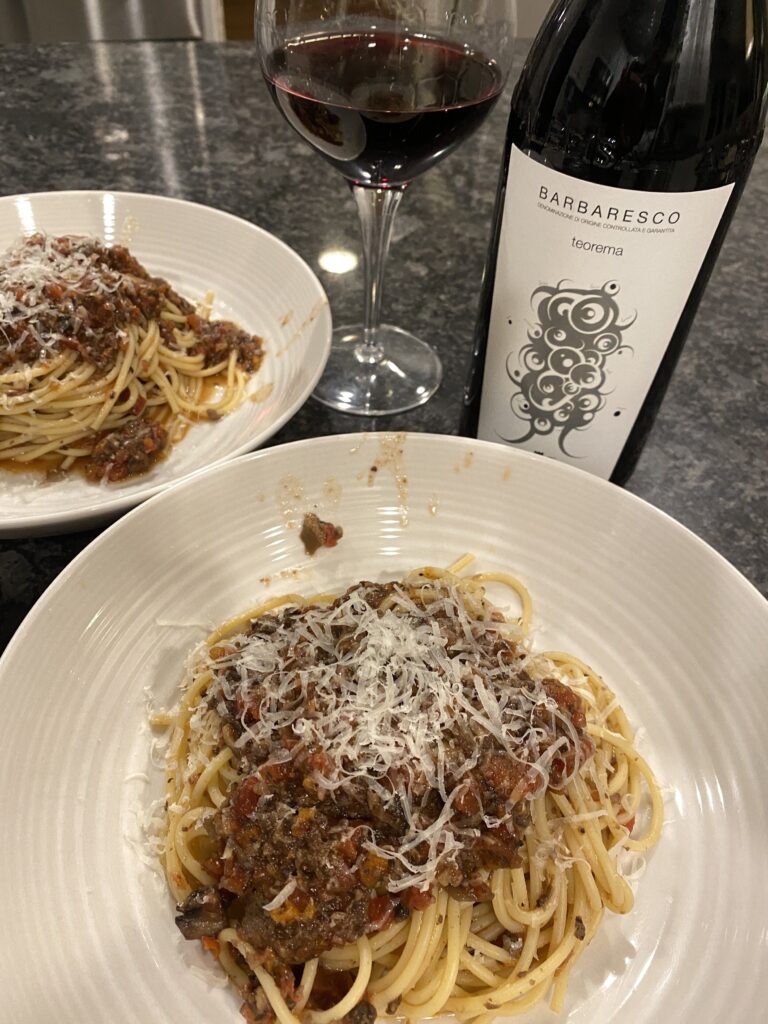
1 lb cremini mushrooms 1 lb. portobello mushrooms 2 carrot, diced 1 onion, chopped 1 28oz can of whole tomatoes 3 tablespoon butter 3 cloves minced garlic 1 teaspoon sugar 2 tablespoons tomato paste 1/2 cup red wine 1/2 cup vegetable broth 1 tablespoon soy sauce salt and pepper 2 tbsp. unsalted butter spaghetti or fettuccini grated parmesan cheese for serving Pulse the mushrooms in the bowl of a food processor fitted with a metal blade. Remove to a bowl and set aside. Process the onion, garlic and carrot in the same way until finely chopped, then add to bowl with mushrooms. Finally, if using whole canned tomatoes, process them until finely chopped. Set them aside, but don’t add to the other veggies. Heat a large pan with a heavy base over medium high heat, then add the 3 tbsp. butter and the mushroom/onion/carrot mixture. Cook until the veggies release their liquid, then keep cooking for about another 15 minutes after that point, or until the liquid evaporates and the veggies are brown. Add sugar, and tomato paste, and stir to combine. Add the processed tomatoes, broth, soy, wine, salt and pepper. Simmer for 10 minutes, or until sauce thickens again. Turn off heat and adjust seasoning. Cook pasta according to package directions in well salted pasta water (I add a handful of salt to the water which seems like a lot but it is key to balance in the dish and flavor your pasta). When al dente, drain but reserve 1/2 cup of the pasta water. Put the pasta back in the pot, add 1/4 cup of the pasta water, 2 tbsp. unsalted butter and 2 cups of the sauce. Toss together and serve with about ¾ cup (or a generous dollop) of sauce. This makes a lot of sauce – should serve a generous 8 portions. Based on a recipe from America’s Test Kitchen Pair with a medium-bodied red such as Molino Barbaresco
Spaghetti with Shrimp and Artichokes
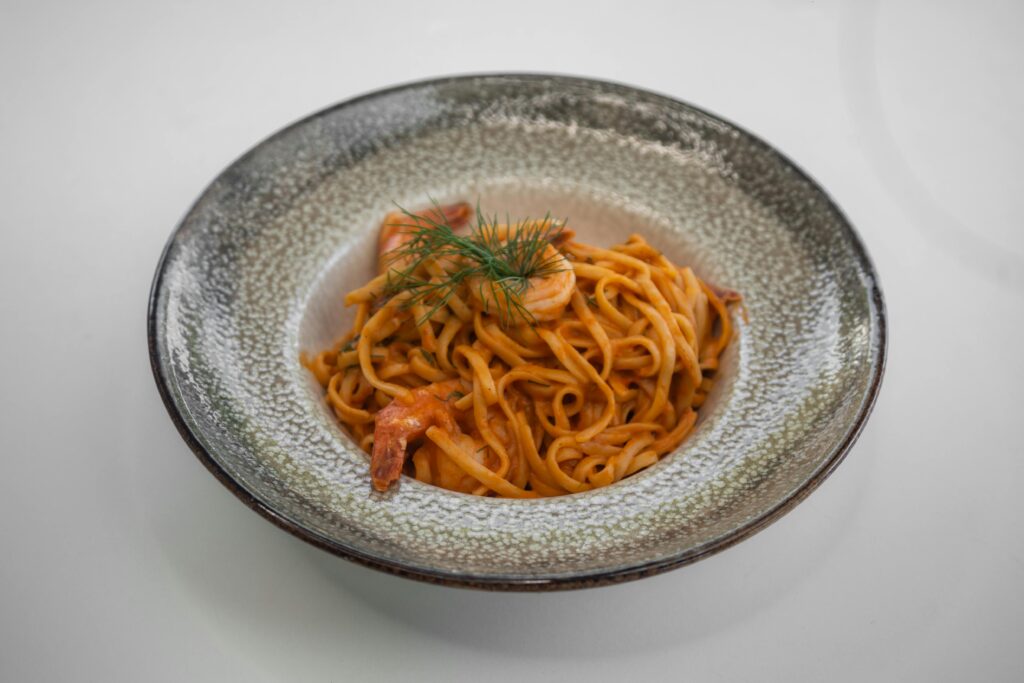
1 jar marinated artichoke quarters, rinsed and drained 4 tablespoons olive oil 1 1/2 lbs. large shrimp peeled and deveined (8-12 per pound) ¼ teaspoon salt ¼ teaspoon freshly ground black pepper 3 garlic cloves, thickly sliced Zest of 1 lemon, grated 1/8 teaspoon red pepper flakes 2 tablespoons freshly squeezed lemon juice 2 tablespoons capers ¼ teaspoon salt ¼ teaspoon freshly ground black pepper 1/2 cup white wine 1/2 cup chicken stock 1 lb. linguine, spaghetti, or spaghettini 1/4 cup chopped parsley for garnish Pat the shrimp dry and toss with salt and pepper. Heat the olive oil in a large sauté pan over medium high heat until sizzling. Quickly brown half of the shrimp on both sides, about 1 minute. Scoop the shrimp out with a slotted spoon and repeat with the remaining shrimp. Turn the heat down to medium-low and, in the same pan, sauté the artichoke slices, garlic, lemon zest and red pepper flakes until the artichokes for 5 minutes. Add white wine and stir gently to dislodge any flavorful brown bits from the bottom of the pan. Reduce the wine by half. Add the stock, the lemon juice, capers, salt and pepper. Bring the sauce to a boil and simmer until slightly thickened,10 minutes. Return the shrimp to the sauce to just warm through no more than 2-3 minutes . While the sauce is simmering cook the pasta according to the directions on the package.Drain reserving 1/2 cup of the pasta water. Pour the sauce over the pasta with 1/4 cup of the pasta water and simmer over low heat , stirring constantly, until the pasta is well coated, about 2 minutes. Add more water if the sauce is too thin. Turn the hot pasta out onto a warm serving dish and sprinkle with reserved parsley and diced tomato. Serve immediately.