
Some wine histories are told in decades. Martin Mittelbach tells his in centuries, and he does it casually, the way you might mention what you had for lunch. A monastery here, an emperor there, a date like 1176 dropped into the conversation without ceremony. Then he reaches for the next glass, and the story slips from the past into the present tense. In the Wachau, history always seems to live.
This visit wasn’t on the itinerary. It began with a glass: Tegernseerhof’s Ried Schütt Grüner Veltliner Smaragd 2025, which I fell for at the ÖTW Single Vineyard Summit and couldn’t stop thinking about. So we made our way to Unterloiben, just below Dürnstein, and sat down with Martin at Weingut Tegernseerhof, a large map of the Wachau on the wall behind him. By the end of the afternoon, it was clear that the wines and the history were the same story told two ways: precise, unhurried, and rooted in stone.
The First House of the Eastern Wachau
The Tegernseerhof story begins not in Austria but in Bavaria. The Benedictine monks of Tegernsee Abbey tended vineyards here in the Danube valley, a very long way from home.
“The land was owned by the monastery of Tegernsee,” Martin told us, “and this started in the year 1002.”
Then came the house. “The monks built a house for making wine in 1176, so we were the very first winery in this part of the region.”
He is quick to give credit where it is due. “Nikolaihof is a little older than we are,” he says. Then he draws a distinction I found fascinating. The southern Wachau carries a Roman influence. Here, it was something else entirely. “We had the Bavarian influence, the German influence.” It is a small sentence, but it explains the name on the label, which comes from a Bavarian abbey rather than anywhere in Austria.
The monks’ era ended with the sweep of history. “After that, in 1803, all the land was taken from the churches by the emperor, and then it was sold. And this is where, actually, our story started.”
The family’s own chapter began sometime in the mid-19th century, in what Martin calls a gray zone. “I’m the sixth generation,” he said. Then, with a smile: “Working every day on the seventh.”
Stone, Wind, and Steel
That long continuity now rests on about 23 hectares at the eastern end of the Wachau. Ninety-five percent of the vineyards are planted to white grapes: two-thirds Grüner Veltliner, one-third Riesling, and a little Pinot Noir. The estate is certified organic, and around 65 percent of its wine is exported.
Martin works under the strict Codex of Vinea Wachau, which classifies wines by weight and ripeness. The lighter, fresher Federspiel wear orange labels. The richer, riper Smaragd wear pink.
But it is the ground that holds everything together. These are steep terraces of primary rock: Gföhler gneiss, with loess laid over it. They sit in a climatic tug-of-war between warm Pannonian air from the east and cold air pouring down the Mental Gorge from the Waldviertel. At Höhereck, a half-hectare terraced by hand some sixty years ago, the night wind cools the vines like a stone cellar door left ajar.
You can taste it in the glass: tension, salt, lift.
The Tasting
Martin poured generously, moving from the current vintage back through time. The range opened brightly. The Federspiel Grüner Veltliner, from fifty-year-old vines on Loiben’s deep sandy soils, was fruity, ripe, and generous. The Federspiel Riesling tasted of golden apple and stone, with a cool breath of peppermint. The single sites grew richer from there. Superin was creamy and exotic. An experimental Smaragd from below the Loibenberg had a saline edge that kept pulling me back. A Höhereck vertical showed time at work: spicy intensity in 2025, Asian spice and white pepper by 2016. Even a 2010 Pfaffenberg Riesling from across the Danube in the Kremstal made an appearance, mineral and herbal, and a little shy with age.
Then came the Bergdistel, which, to me, was simply the estate’s number one. The name also plays on the mountain thistle that loves limestone, and on Distelberger’s own name reversed. Both the Grüner and the Riesling were smoky and intensive, the Grüner spicy and creamy, the Riesling ripe with white peach.
Yet as the afternoon went on, four wines kept calling me back.
My Top Four
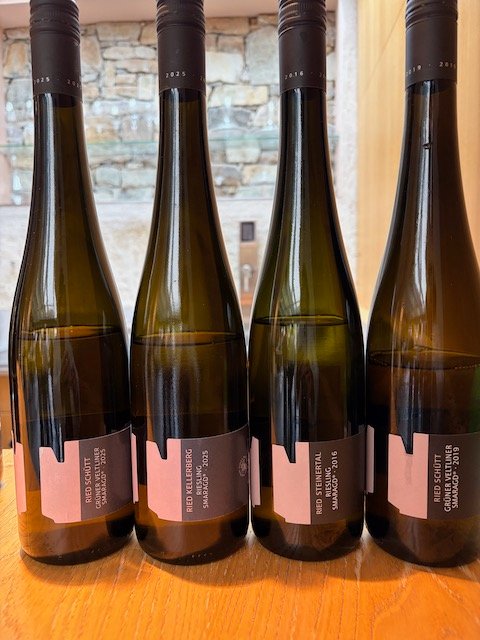
All four are Smaragd, all wear the same pink label, and two of them came as pairs: the same vineyard, years apart, side by side in the glass.
Ried Schütt Grüner Veltliner Smaragd 2025 & 2019. Schütt sits in the west on an alluvial fan of weathered primary rock, and night air sweeping down from the Mental Gorge cools it decisively. The 2025 was the young half of the conversation. The 2019 was the wine that stopped my pen: golden, ripe, apricot jam, with an almost uncanny intelligence. Several vintages on, and still unmistakably Schütt.
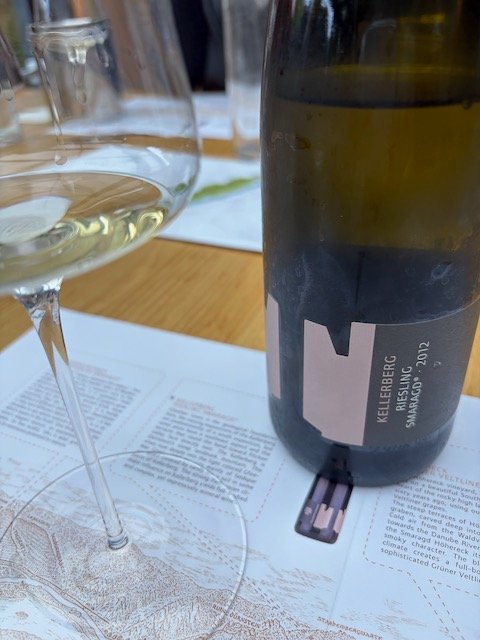
Ried Kellerberg Riesling Smaragd 2025. Dürnstein’s steep landmark mountain, on Gföhler gneiss, showing everything it has. Bright, intensive, ripe, and exotic. Layered and complex, even complicated in the best sense, like a conversation that keeps changing direction. Its older sibling, the 2012, showed where that conversation leads. Thirteen vintages on, the wine had turned warm and spicy, herbal and petrolly, with a streak of gooseberry. It was a lesson in what time does to stone.
Ried Steinertal Riesling Smaragd 2016. Steinertal is a giant amphitheater cut into solid rock, and the wine has a performer’s poise to match. Ripe and fruity, with a flicker of kerosene, it was tart and salty in one moment and peachy the next.
Into the Vineyard
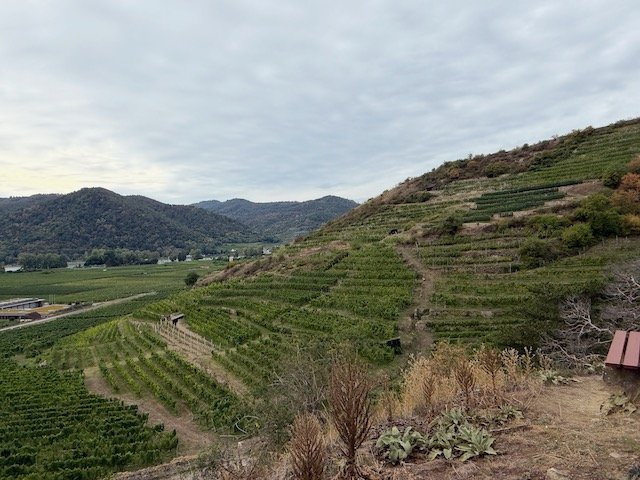
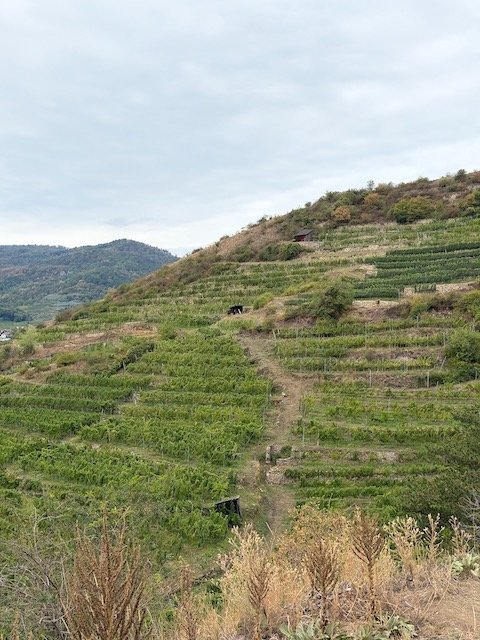
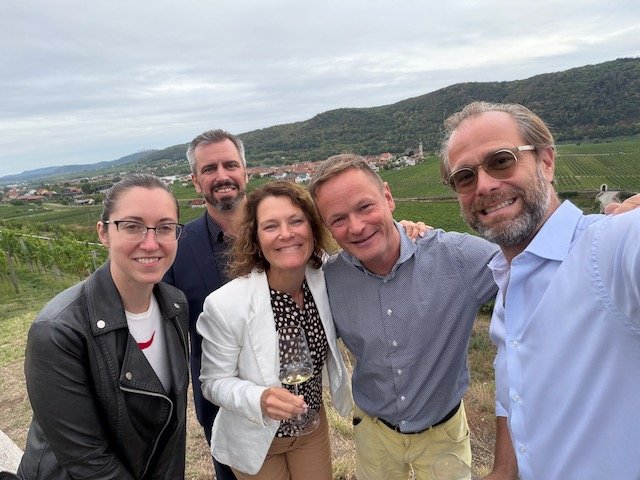
Then we left the glasses behind and went out among the vines. This is where words begin to fail. The views over Tegernseerhof’s Erste Lage terraces were cinematic: winding hills, narrow lanes, stone-cut terraces stacked up the slopes like a staircase for giants. It is one of those places you truly have to see to believe, and to understand.
Loibenberg is the second monumental site of the eastern Wachau. Its twenty-five hectares of steep terraces face due south and mark the entrance to the Wachau Gorge. Two hundred vertical meters separate the Danube from the forest’s edge. Pannonian warmth pushes up from the east, and altitude pulls it back. Beneath it all lie gneiss and loess.
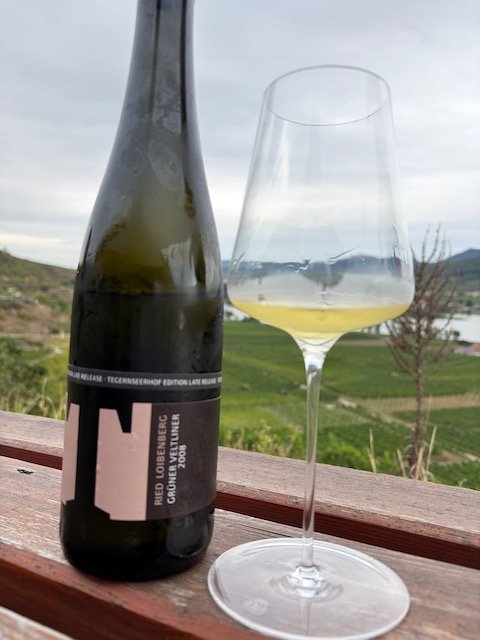
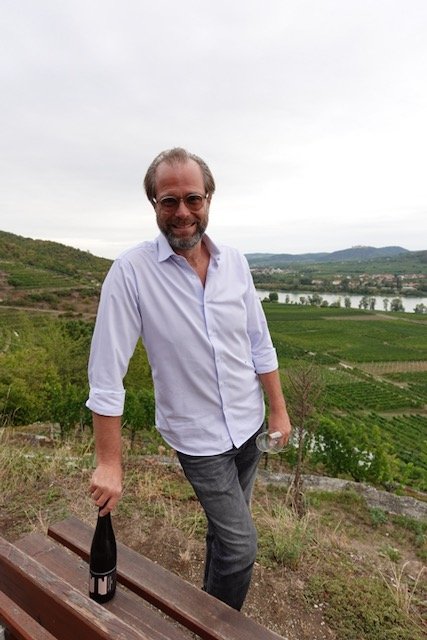
There, glasses back in hand, we tasted the Ried Loibenberg Grüner Veltliner 2008.
Drinking an eighteen-year-old wine within sight of the slope that made it collapses the distance between glass and ground. All afternoon, I had been reading these hills in the glass. Now I was reading the glass in the hills.
Working on the Seventh
I came to Tegernseerhof expecting wine. I left with a sense of how long a place can hold a thought.
A Bavarian monastery takes hold of land on the Danube in 1002. Its monks build a house in 1176. An emperor reshuffles the land in 1803. A family steps into the story. Six generations later, a man in shirtsleeves pours a Riesling from those same terraces and talks about it as if he were simply continuing a conversation.
The wines carry that continuity. They are cool, spicy, saline, precise, and never in a hurry. They taste of gneiss and loess and the Waldviertel wind, and underneath it all, of patience.
Working every day on the seventh. It was the best line of the whole visit, and it belongs on a label.
Complete Tasting Notes
Ried Loibenberg Grüner Veltliner 2008: tasted in the vineyard
Dürnstein Grüner Veltliner Federspiel 2025: fruity, ripe, intensive
Dürnstein Riesling Federspiel: schisty, golden apple, mineral, peppermint
Riesling 2025: lime, smoke, apricot, mineral, terpenes
Superin Grüner Veltliner 2025: ripe, fruity, exotic, creamy
Experimental single-vineyard Grüner Veltliner Smaragd 2025 (below Loibenberg): ripe, exotic, saline
Bergdistel Grüner Veltliner Smaragd 2025: intensive, spicy, smoky, creamy
Bergdistel Riesling Smaragd 2025: ripe, exotic, white peach, smoke
Höhereck Grüner Veltliner Smaragd 2025: spicy, masculine, intensive
Höhereck Grüner Veltliner Smaragd 2016: Asian spices, white pepper
Ried Schütt Grüner Veltliner Smaragd 2025: young, cool-climate tension
Ried Schütt Grüner Veltliner Smaragd 2019: golden, ripe, apricot jam, intelligent
Ried Kellerberg Riesling Smaragd 2025: bright, intensive, ripe, exotic, complex
Ried Kellerberg Riesling Smaragd 2012: warm, spicy, herbal, petrol, gooseberry
Ried Steinertal Riesling Smaragd 2016: ripe, fruity, kerosene, tart, salty, peach
Pfaffenberg Riesling 2010 (Kremstal): mineral, ripe fruit, spicy, herbal, shy