
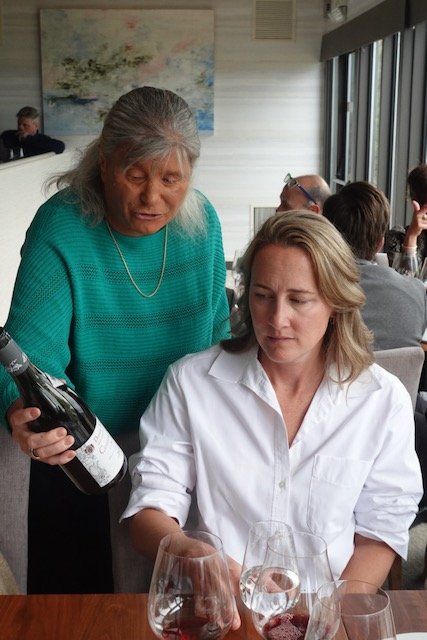
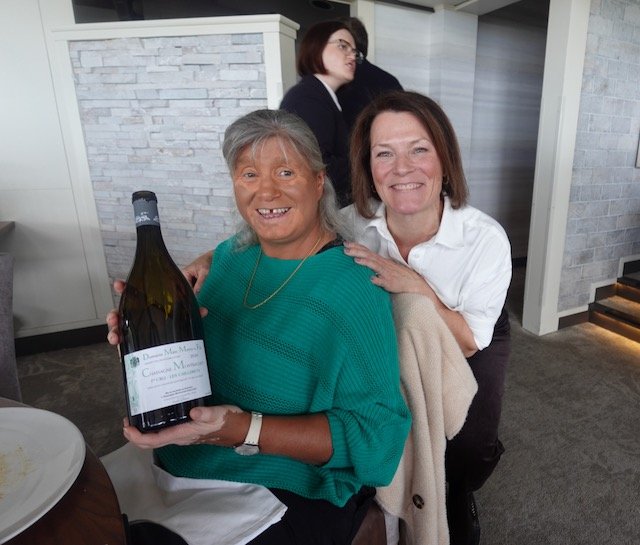
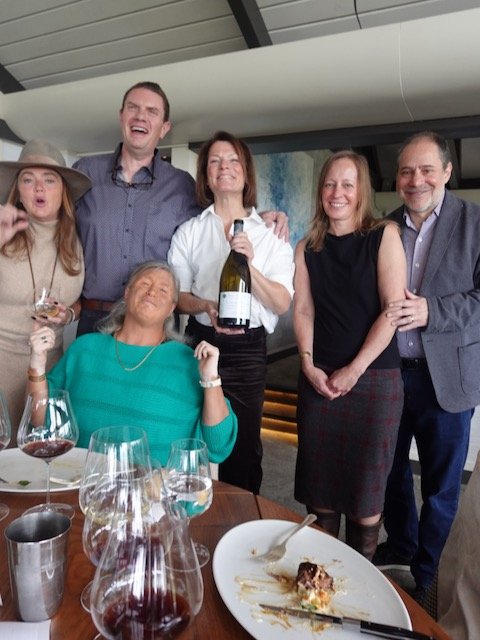
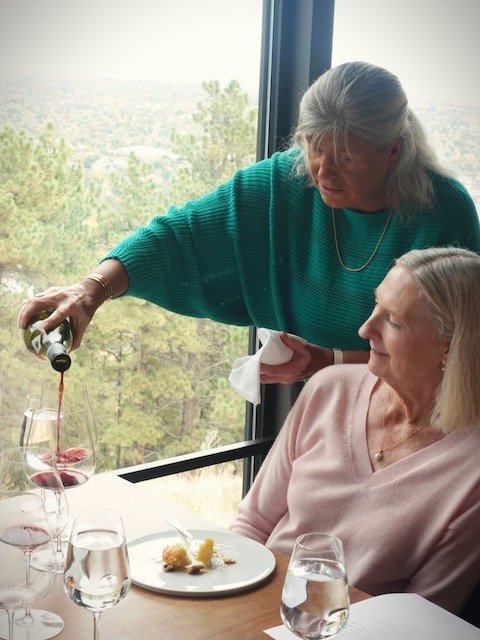
I hadn’t planned to interview Sabine Mollard. Seated next to her at the La Paulée lunch during the Boulder Burgundy Festival, I struck up a conversation in French. One thing led to another, and our exchange became an impromptu interview—a chance to hear the woman behind the wines of Domaine Marc Morey tell her story in her own words.
Listening to Sabine, I recognized a familiar longing that surfaces at so many tables where wine is shared: the hope that what we do finds its way to someone who truly receives it.
She was talking about a difficult year. About vines damaged by frost, the prospect of a painfully small harvest, and the question that can surface when you have given so much of yourself to something uncertain.
“Why do I do this job?”
I was struck by how plainly she could say it. Burgundy carries so much expectation: the names, the vineyards, the generations, the bottles people wait years to open. Listening to Sabine, I found myself thinking about the person who must get up each morning and care for all of it, even when her own sense of purpose needs tending.
Her answer would come through a customer’s email. But to understand why that message mattered, it helps to go back to a life she once imagined taking somewhere else.
A Family Written into Chassagne
Domaine Marc Morey sits in the village of Chassagne-Montrachet, in Burgundy’s southern Côte de Beaune. Its address on Rue Charles Paquelin places it within the village whose name appears on so many of its labels. Here, the landscape is divided into small, named vineyards, each expressing its own slope, soil, and exposure.
The family story began in 1919, when Morey’s first generation established the domaine in a former coaching inn. Marc Morey joined his father in 1944; in 1977, his daughter Marie-Josèphe and her husband, Bernard Mollard, joined the business. Their daughter Sabine represents the fourth generation. The estate records 2008 as the year she took the reins, with her parents remaining close enough to help.
I like the physical evidence of that continuity—a cellar built in one generation, another added by the next. The domaine’s history includes a dining room for the harvesters alongside the vaulted cellars and working spaces. Something is grounding about that detail: people needed feeding while the wine was being made.
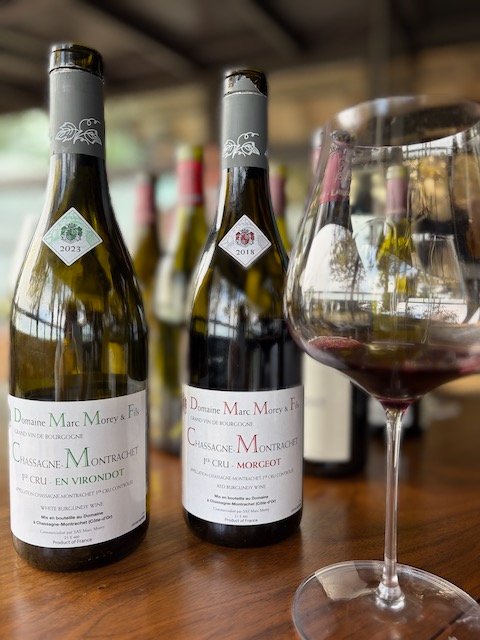
Today, the estate is best known for white Burgundy: Chardonnay that favors freshness, finesse, and mineral definition. Its Chassagne-Montrachet premiers crus include Les Caillerets, Les Chenevottes, Les Vergers, Morgeot, and En Virondot; beyond the village, Sabine also makes Puligny-Montrachet Les Pucelles.
Those names establish a place in Burgundy. They cannot, by themselves, explain how Sabine found hers.
The Life She Had Planned
Winemaking was not her original profession. Sabine trained as a geography teacher and began teaching when her younger brother, who had been expected to succeed her parents at the domaine, died.
She described that turning point in an earlier published interview. Suddenly, the family faced a decision about the estate’s future, and she faced a decision about her own. She could try to carry it forward, or the property could eventually be sold when her parents retired.
I hesitate over any version of this story that makes her return seem inevitable. A family legacy can offer belonging while also asking an enormous amount of the person who inherits it. In Sabine’s case, that question arrived with grief.
She chose to learn. Wine school and practical experience gave her a way to explore the work before committing her life to it. Her training included time in the Ardèche and at Disznókő in Hungary’s Tokaj region, where she encountered a very different wine culture. She joined the family domaine for the 2003 harvest.
What moves me is the room she initially allowed herself to decide. She didn’t have to know at the beginning that she would stay forever. She had to be willing to begin.
The geography teacher in her interests me, too. I cannot claim to know how that earlier training shapes her winemaking, but I find a quiet connection between the two: both ask you to pay attention to a place and to understand why one patch of ground differs from another.
In Chassagne, those differences become something you can taste.
Learning When to Listen
When Sabine spoke about her wines, time kept coming up.
She enjoys the pronounced mineral character of young Chassagne premier cru. Yet En Virondot, for her, asks for a different kind of attention. She particularly likes it with at least five or six years behind it, when its character has had more time to emerge.
She recalled tasting a 2019 Virondot with Ryan during their travels. It was showing beautifully. By comparison, the 2023 still felt young to her.
“That’s how I like Virondot,” she said of the older wine. “Today, the 2023, I find it a little young.”
I heard affection in that judgment. She knows the wine well enough to let it take its time. Her preferences are personal rather than a set of rules for everyone else’s cellar, and that makes them more revealing. This is someone who lives with the wines beyond the moment they leave the domaine.
Then came Les Pucelles, the premier cru in neighboring Puligny-Montrachet.
“I’m fortunate enough to produce Premier Cru Les Pucelles,” she said, calling it one of the very best premier crus.
That sense of good fortune matters. After years of doing the work, she still recognizes the privilege of the ground entrusted to her. The pleasure comes with the responsibility.
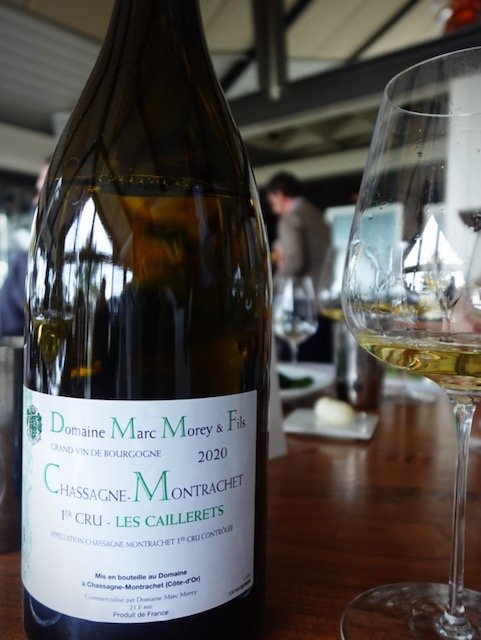
Les Caillerets 2020: A Glass to Stay With
The wine I want to place at the heart of this story is the Chassagne-Montrachet Premier Cru Les Caillerets 2020, poured from a double magnum.
There is generosity built into a bottle of that size. It invites a gathering. Looking back on our encounter, I find that especially fitting for a woman whose deepest explanation of her work would lead us toward the people sharing it.
It quieted me. There was a lovely tension between its breadth and its freshness, a mineral thread holding everything in place. The finish gave me a reason to pause before taking another sip. I wanted to stay with it.
I keep returning to Les Caillerets as the wine through which to tell her story. A wine can offer a way into someone’s character without becoming a tidy portrait. What interests me here is patience: the attention required to make it, the time allowed for it to develop, and the willingness, at the table, to give it a little of our own.
That patience becomes harder to sustain when an entire season’s work is at risk. Sabine knows that part of the story, too.
The Year the Question Returned
In the second part of our interview, Sabine went back to the 2021 frost.
The damage was severe. She knew there would be little wine to make, and for two or three days her spirits were low. She found herself asking why she did this work.
I am grateful she let that uncertainty into our conversation. Accounts of family wineries often move quickly from hardship to perseverance. Living through the hardship takes longer. Some days, the next task still needs doing before you have found a convincing answer to the question underneath it.
The domaine’s approach depends on close attention: manual work in the vineyard, measured intervention, and decisions adapted to the season. Such care requires judgment every day. It also requires accepting that judgment has limits. Weather can undo good work.
For Sabine, the answer came from someone who had opened a bottle.
An 85-year-old long-time customer wrote to tell her about sharing a wine with his grandson. The bottle carried the significance of a birth year; what reached Sabine was the happiness of the occasion, the pleasure they had found together.
“When I read the email, I almost cried,” she said.
Then the reason returned to her.
“That’s why I do this job.”
I keep thinking about the distance that message traveled. From a vineyard, through a cellar, into a bottle, onto someone’s table—then back to the woman who helped make the moment possible.
She had been looking at what the frost had taken. The customer reminded her of something her work had already given.
The People on the Other Side of the Bottle
That story lingered as I thought about the wines we discussed: a Virondot finding its voice with age, her pleasure in Les Pucelles, the Les Caillerets I wanted to linger over.
We spend so much time talking about wine origins. We trace a parcel, a family, a vintage. Sabine’s story led me to think just as carefully about where the wine goes. Who opens it? Who is sitting beside them? What makes them choose that particular bottle on that particular day?
For the person making it, most of those answers remain unknown. A wine leaves the cellar and becomes part of lives its maker may never see. Occasionally, someone writes back.
That exchange carries a particular tenderness. The customer could not change the harvest. He could tell Sabine that her work had mattered at his table.
I understood how that could be enough to help her begin again.
Leave a Place at the Table
When I think of Sabine now, I think of the many decisions held inside the apparent simplicity of a bottle: the decision to learn a profession she had not planned, to carry forward a family domaine, to trust a wine that needs time, to continue after a season that gives very little back.
Her story leaves room for doubt. I value that. It makes the pleasure she takes in her wines feel earned, and the customer’s email feel all the more precious.
I find myself thinking again of the grandfather and grandson. I was not there with them, could not see what filled their plates or hear the words exchanged as the wine was poured. All Sabine knew was what the message revealed: a moment had been shared, and it was wonderful.
Somewhere, a bottle was opened and two people lingered together. In Chassagne, the woman who made the wine received this small echo of joy, and found in it a reason to continue.