
Life in Villany Wine Country
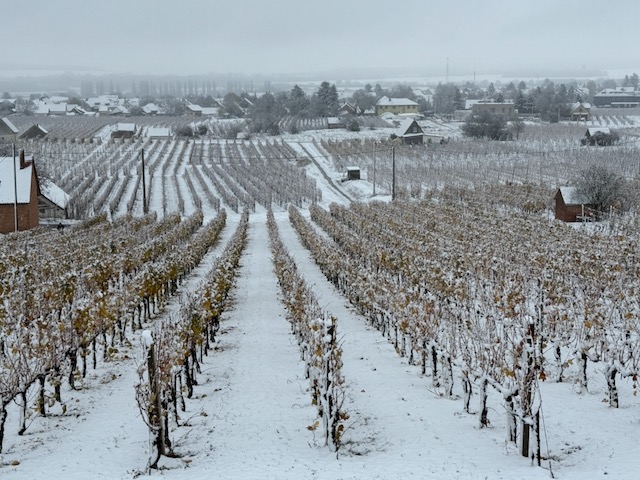
Hidden in Hungary’s deep south lies a tiny village of just 2,000 souls that’s quietly rewriting the rules of world-class wine: V I L L Á N Y. This is where Cabernet Franc reaches utter perfection (many say it’s one of the planet’s greatest terroirs for the grape). Where Bordeaux-style blends are exploding onto the global stage. Where ancient cellars meet concrete eggs, photocatalytic oxygenation, and 30-year-old vintages that taste like liquid history. Few wine regions in Europe deliver the combination of heritage, innovation, and sheer personality that Villány does. During the exclusive VIP tour curated by Villány Borvidék, we were granted rare access to four benchmark producers, each offering a distinct lens on why this small southern Hungarian appellation is producing some of the world’s most compelling Cabernet Francs—and far more. We woke up to a once-in-a-decade winter fairytale — snow blanketing the vineyards — and spent the day spellbound on our tour. Tradition and cutting-edge innovation aren’t clashing here… they’re dancing. My heart was stolen by: ✨ Vylyan – Bold, fruit-driven beauties in a jaw-dropping contemporary winery. Second-gen winemaker Sándor is pure fire and curiosity ✨ Bock – The legendary godfather whose storytelling leaves you utterly charmed. Classic, powerful, soulful reds that demand respect ✨ Csányi – Big but polished to perfection. Elegance in every glass ✨ Gere Attila – The grand patriarch whose stories wrap around you like velvet and won’t let go. Refined, sophisticated, endlessly innovative ✨ Günzer Tamás – Family passion on overdrive & impossible not to love Vylyan Terasz Perched atop the Fekete-hegy with panoramic views across the vineyard quilt, Vylyan is a story of generational evolution. Founded in the early 1990s by a visionary father, the estate is now led by second-generation economist Flóra and her mother, guided since 2017 by winemaker Sándor Montecucco. Creative friction between tradition and modernity is palpable—and highly productive. Vylyan has always treated wine as a form of art and the label as its canvas. From the very beginning, the winery collaborated with prominent contemporary Hungarian artists (especially István ef Zámbó, Oszkár Papp, and others from the neo-avant-garde circle), turning every bottle into a small, collectible piece of art. They are a manifesto of the winery’s values—biodiversity, feminine energy, lunar rhythm, playful duality of devil and angel, and the fusion of fine wine with contemporary Hungarian art. Signature tasting notes: The marriage of contemporary art (textured, braille-like labels) and cutting-edge winemaking makes Vylyan a must-visit for anyone seeking the new face of Villány. Bock Winery There are cellars, and then there is Bock’s underground cathedral. József Bock senior carved these tunnels out of the limestone with his own hands in the 1970s, and the oldest sections have remained untouched since the early 1990s. Black mold carpets every surface like velvet; the air is thick, cool, and sacred. Bottles from the very first private vintages lie quietly under decades of noble rot—no temperature control, no interference, just time. Standing there in candlelight among those silent rows is the closest most of us will ever come to a wine pilgrimage. We were privileged to taste two museum treasures pulled straight from that living archive: Then came the magic above ground. We gathered around a long wooden communal table that felt like it had hosted a thousand family feasts. On a crisp, chilly winter day, József junior welcomed us like long-lost cousins. Sparkling wines flowed: the creamy Chardonnay Blanc de Blancs 2020, the razor-sharp Bock Marcell Cuvée Brut Nature 2021, and a brand-new Sauvignon Blanc fizz that cut beautifully through velvety roasted-pumpkin soup. The soul-warming main course—slow-roasted pork paired with the majestic Capella 2012 (deep, harmonious, still climbing)—had everyone groaning with happiness. Between courses, József told stories: tales of playing in the vineyards as a child, of digging those cellars alongside his father and the wines that his wife loves. His eyes sparkled with pride, yet his voice stayed gentle and humble. You couldn’t help but fall a little in love with the man and the place. Csányi Winery (Teleki Cellars) One of Hungary’s largest and most forward-thinking private producers, Csányi has quietly transformed the historic Teleki estate into a powerhouse of precision and varietal expression. While most estates lean on tradition, Csányi straps satellites to the sky to spy on every vine, plants with computer-guided precision, and throws daring curveballs like Malbec, Grüner Veltliner, and a wickedly fresh Syrah rosé into the heart of red-wine country to deep inside the wine cellar, photocatalytic oxidation (PCO) works like invisible magic: powerful UV light strikes a titanium-dioxide catalyst, instantly transforming mold spores, bacteria, unwanted odor to clean air, zero chemicals, perfect peace for sleeping barrels. Fresh from a multimillion-forint glow-up, their gleaming new winery hums with cutting-edge gear, yet the soul still traces back to 19th-century legend Zsigmond Teleki. László Romsics, CEO, along with head winemaker guided us through the tasting and philosophy of the winery. The tasting was electric: Csányi proves that scale and soul can coexist beautifully. Gere Attila If Villány has a spiritual home of elegance, it is here, in the low-lit barrel hall of Gere Attila, where time seems to slow the moment you step inside. Attila Gere doesn’t just pour wine; he tells its life story. With a voice like aged velvet and eyes that spark every time a barrel is tapped, he pulls samples of 2023 and 2024 Cabernet Franc that are still raw, electric, and singing with red-berry precision. Then comes the 2025 Merlot–Franc blend still fermenting, wild and silk-promised. He speaks of each one as if introducing his children: “This one will be bold, this one quiet, but all of them must speak with their own fruit first.” Oak, he insists with a gentle smile, is only the frame; the picture has to be the vineyard. Between barrels he drifts into tales: the first vines he planted with his father, the 1991 harvest that almost broke them, the night in 2008 he set aside a single barrel of
Why Villány Is a Home for Cabernet Franc
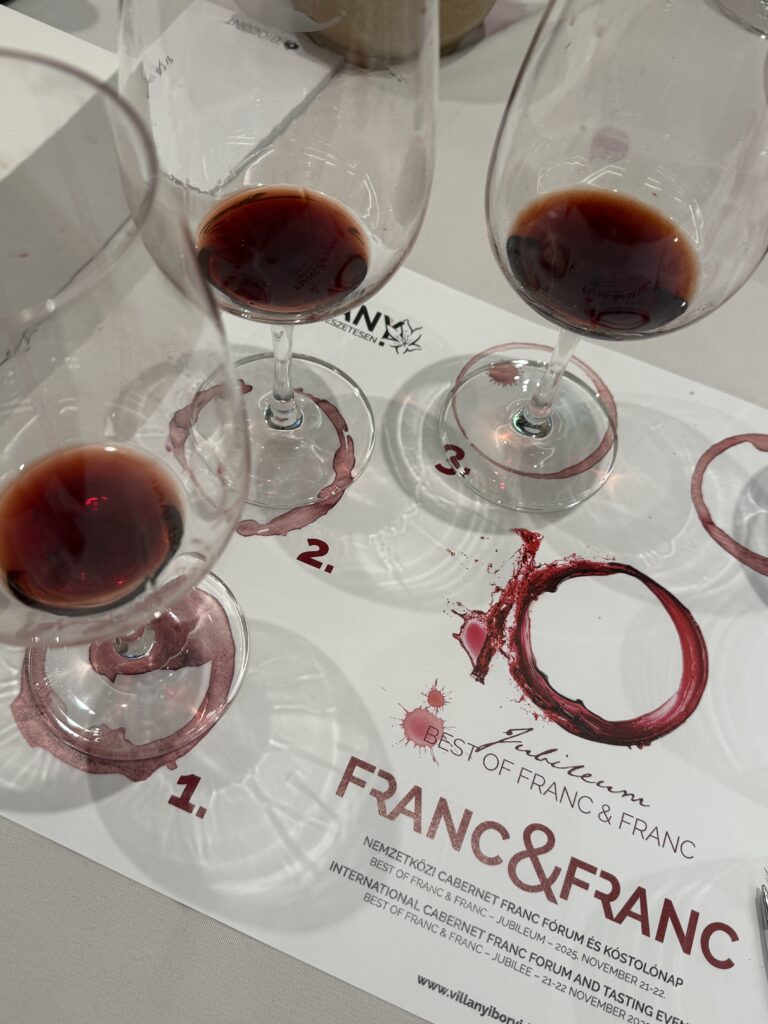
Cabernet Franc didn’t just stumble into Villány and strike gold—it found a terroir that feels tailor-made for its finest qualities. Hungary’s southernmost wine region sits at the same latitude as northern Bordeaux, yet enjoys a warmer, more continental climate. With 2,100–2,200 hours of sunshine a year (among the highest in the country) and long, dry autumns, Villány reliably delivers full physiological ripeness without sacrificing acidity. In cooler climates, Cabernet Franc can turn lean, herbal, and aggressively pyrazinic. Here, it unfurls dense blue and black fruit—cassis, blueberry, black cherry—along with pronounced violet notes and that signature cracked-pepper and tobacco-leaf spice, all wrapped in vibrant freshness. The soils are the clincher. The finest sites, particularly the Siklós and Fekete-hegy slopes, rest on thick Eocene limestone capped with loess and red clay. The active calcium in the limestone promotes refined, polymerised tannins and superb drainage, forcing vines to root deeply (often 6–10 metres) in search of water. Yields stay naturally low—rarely exceeding 35–45 hl/ha in top parcels—and the small berries deliver intense colour, firm yet silky tannic structure, and explosive aromatics. A pronounced diurnal shift locks in the magic: September days can climb to 28–30 °C, while nights drop to 10–14 °C, preserving malic acid and perfume. The surrounding hills shield vines from cold northern winds, and morning fog rolling in from the Drava River valley gently extends hang-time. Hungarian growers didn’t leave it to chance. From the early 1990s, pioneers such as Attila Gere and József Bock planted top-quality Loire and Bordeaux clones on devigorating rootstocks. Meticulous canopy management—vertical shoot positioning, aggressive morning-side leaf thinning, and green harvesting—has become standard at the best estates, pushing concentration while keeping alcohols in an elegant 13–14 % range. Furthermore, to cement its reputation, Villány implemented one of Europe’s most stringent protected-origin systems and established the Villányi Franc designation—a category reserved exclusively for varietal Cabernet Franc and Cabernet Franc-based blends that meet exacting production criteria. Within this framework, two upper tiers were created: These designations are far more than marketing labels; they represent a deliberate shift toward a refined, terroir-expressive style. To qualify, yields are strictly limited, only the region’s top vineyard sites are eligible, and the wines must exhibit balanced alcohol levels (typically 13–14 %), bright natural acidity, finely polymerised tannins, and a clear imprint of Villány’s limestone-driven minerality. Heavy extraction, excessive oak influence, and overripeness are effectively excluded by regulation. The objective to move beyond the powerful, internationally influenced reds that characterized the post-communist era and to establish a distinctive, elegant, and age-worthy Villány signature—one capable of standing alongside the finest examples from the Loire Valley and Bordeaux’s Right Bank. The Franc & Franc Jubilee Conference: A Decade of Leadership The Franc & Franc Jubilee Conference opened in Villány with electric energy, marking ten years of the region’s rise as a global beacon for Cabernet Franc. Before the official conference kicked off, international guests were treated to an exclusive, intimate preview tasting that felt like sneaking into the cellar after hours. This wasn’t just a polite welcome pour—it was a full-on seduction showcasing Villány’s broader brilliance beyond its beloved Cabernet Franc. We dove into a dazzling line-up: The opening tasting set the tone: a curated flight of twelve benchmark Hungarian wines—two Classics, six Premium, and four Super Premium selections—showcasing the extraordinary depth, precision, and consistency Villány has achieved with the variety. Day one began with heartfelt words from the pioneers themselves, József Bock and Attila Gere. What moved me most was the turnout: fully 80 % of Villány’s producers were present—an extraordinary show of unity and regional passion. In an industry often defined by fierce individualism, this near-total community mobilisation revealed a rare spirit of collaboration and shared ambition. The symposium sessions were every bit as compelling as the wines. “Unity in Diversity” explored how Villány’s mosaic of terroirs produces strikingly different yet unmistakably related expressions. A deep dive into the impact of skin-contact duration illuminated its profound influence on flavour, colour, and structure. We then travelled the globe—from the Loire to Tuscany (presented by Pasi Ketolainen MW, South Africa (presented by South African winemaker Reino Thiart), Argentina, Chile, and the United States (presented by Peter McCombie MW) —marvelling at Cabernet Franc’s astonishing versatility. A special tasting of Villány through the decades as we journeyed from 2015, 2009 and 2006. Each one had its own identity, freshness and expressed the true refinement of Cab Franc. Villány is not just part of the Cabernet Franc conversation – it is helping define its future. Ten years on, Franc & Franc has evolved from a regional celebration into the world’s premier annual gathering for serious Cabernet Franc lovers and professionals. This community isn’t just riding the wave; they’re steering it. My heartfelt thank you to Andras Horkay & the organizers for this unforgettable journey through unity in diversity and to the new connections made The next decade promises to be exhilarating. If you love Cabernet Franc, book your ticket to Villány now. You won’t just taste great wine—you’ll witness a revolution in the making. Welcome Dinner – Sauska 48 Hungary’s only Michelin-starred restaurant outside Budapest, tucked inside the breathtaking Sauska estate overlooking the moonlit vineyards. Sleek architecture, warm lighting, and an open style kitchen that treats local ingredients like royalty. The evening was a dazzling collaboration between two of the country’s most visionary producers: Sauska and Heumann. Sauska is the restless perfectionist who decided Hungary’s two greatest wine regions deserved the same uncompromising vision. Christian Sauska began in 1999 by resurrecting forgotten volcanic slopes in Tokaj, turning them into benchmarks for crystalline dry Furmint and legendary Aszú. In 2007 he crossed the country to Villány, built a gravity-flow masterpiece on limestone ridges, and started crafting reds that instantly stood shoulder-to-shoulder with the region’s icons. Today he farms 120 hectares split evenly between Tokaj’s electric whites and Villány’s dark, spicy reds—obsessively low yields, zero compromise, pure terroir in every bottle. Whether it’s a Furmint that crackles with minerality, a velvet Villány Cabernet Franc, or a 20-year-old Aszú