
Virtually Celebrating 20 Harvests at Argentiera: A Journey into Bolgheri’s Coastal Soul
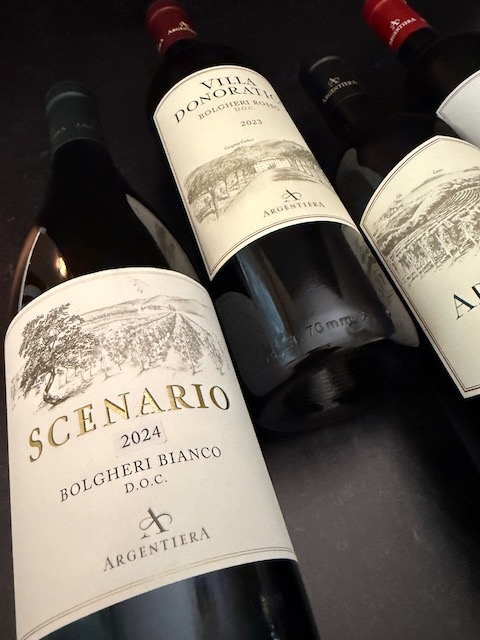
We recently sat down with Nicolò Carrara—who’s been part of the Argentiera family since 2009—to raise a glass to a milestone that feels quietly triumphant: their 20th harvest. You can still hear the awe in his voice when he talks about the place. “This is such a wonderful place to make wines and express the beauty of this place,” he told us, and that sentiment threads through everything at Argentiera: the land, the team, and the wines themselves. Argentiera sits in the heart of the Bolgheri DOC—just one kilometer from the Tyrrhenian Sea, with a protective forest hugging its back slopes. The vineyards step upward from flat coastal terrain to roughly 200 meters above sea level. That incline creates a patchwork of soils—sand, clay, limestone, schist—each plot offering a different voice. “We have treasures of different soils,” Nicolò told us, and you taste that variety across the range. The constant sea breeze is a silent collaborator: cooling, drying, and contributing a saline lift that keeps wines fresh and aromatic. It also makes organic and low-intervention practices more feasible. You don’t need to impose a heavy hand when the site gives you balance to begin with. People First: A Big Family with Deep Roots“What we are is a big family,” Nicolò said, smiling. Argentiera manages about 85 hectares and employs roughly 80 people—many of them long-tenured. That human continuity is more than folklore; it’s the practical foundation for consistency. Hands that know the exact timing for canopy work, the subtle indicators of vine stress, and the micro-variations in each row help produce grapes that are true to their plot year after year. There’s pride in those relationships, and it shows in how they talk about the vines. Conversations with the team are collaborative rather than hierarchical. That shared stewardship is part of why the wines feel steady, precise, and personal. Winemaking: Minimal Intervention, Maximum ListeningArgentiera’s cellar is the opposite of dogmatic. The guiding principle here is to listen—to the fruit, to the vintage, and to the character of each plot—and then choose the most suitable tools. “We don’t want a stamp of method,” Nicolò explained. “We want to be flexible as possible to express the beauty of this place.” What that looks like in practice: An Evolution, Not a RevolutionArgentiera’s style has shifted over the years. Early vintages leaned toward a Napa/Bordeaux-inspired profile, with more prominent new oak. The transition since 2012 has been gradual and intentional: less desire to stamp the wines with a universal house signature, more care in letting terroir and vintage dictate form. “We started with a certain idea,” Nicolò admitted, “and then we listened to the vineyards.” That listening extends to how they confront climate realities. Instead of fundamentally changing the blend or chasing riper, higher-alcohol profiles, their response has been precise vineyard management—canopy control, timing of harvest, and careful pick decisions. The payoff has been wines that maintain ripeness but with lower alcohols and fresher profiles. On top of that, they’re quietly experimenting with Mediterranean white varieties not yet authorized by the DOC—an adaptive, forward-looking move that underscores their pragmatic but curious spirit. Highlights from the 20th Harvest: Wines to Look ForWe tasted through the latest releases and came away impressed by how varied yet coherent the lineup feels—each wine reflecting a distinct plot and purpose. The Human Touch: Stories Behind the BottlesBeyond technique, what stood out in our conversation was how much Argentiera values storytelling through wine. Nicolò shared small moments—harvest mornings when the fog lifts off the sea, a team member pointing out a patch of old vines, the quiet satisfaction of a fermentation that unfolded exactly as hoped. These are the human details that make the wines feel lived-in rather than designed on a spreadsheet. There’s also humility. When speaking about experiments with new varieties or different vessels, Nicolò is pragmatic: “We try, and we listen. Sometimes it works, sometimes it teaches us more than success ever could.” That attitude—curious, unpretentious, and rooted in craft—shines in every bottle.Twenty harvests have given Argentiera the vocabulary to speak fluently about its place. The estate’s evolution isn’t a reinvention; it’s the slow honing of an approach that prioritizes site, people, and nuance over a fashionable house style. The wines from this milestone vintage range from immediate and joyous (Poggio ai Ginepri) to serious and contemplative (Villa Donoratico, Argentiera), with Scenario offering a refined white that captures the estate’s coastal freshness. If you visit—or taste these releases—you’ll feel the human thread: a team that cares deeply for the land, a winemaker who listens before he acts, and a place shaped by sea and forest. These are wines to enjoy now for their charm, and to cellar for the way they promise to evolve. For collectors and newcomers alike, Argentiera’s 20th harvest is a warm invitation to experience Bolgheri’s coastal soul—personal, precise, and undeniably expressive.
VinItaly By Night
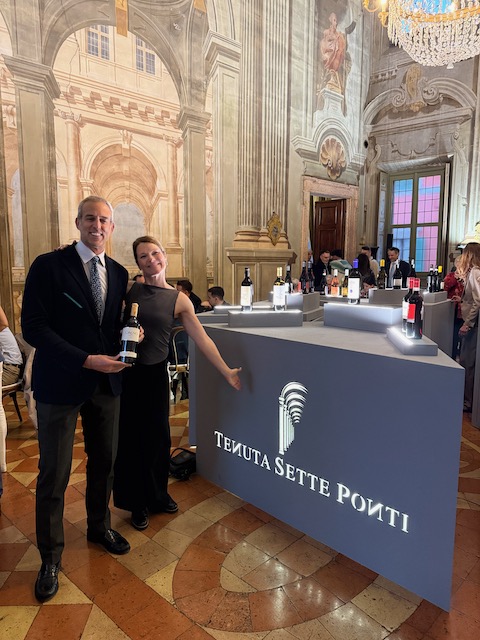
Verona nights, Tuscan soul.During the Vinitaly marathon I was treated to two unforgettable evenings: a Big Bottle Social dinner hosted by Tenuta Sette Ponti at the frescoed Palazzo Verità Poeta, followed by an intimate industry gathering — Chianti Lovers & Rosso Morellino — at AMO Bistrot, hosted by IEEM USA. Both events fused impeccable wine, inspired food pairings, and that ineffable Italian energy. Palazzo Verità Poeta’s frescoed salons and ornate ceilings feel like stepping into a living masterpiece: once the urban residence of the Verità Poeta family, the palazzo evolved from Renaissance elegance to Baroque splendor and has been lovingly restored to host concerts, exhibitions and intimate private events. For Tenuta Sette Ponti’s Big Bottle Social Night the rooms shimmered under gilded cornices as giant bottles gleamed on illuminated plinths, while murmurs of conversation and the clink of glasses echoed through frescoed vaults—history and hedonism entwined, making every taste of wine feel like a discovery suspended in time. Hosts Antonio and Alberto Moretti Cuseri — father and son — presided with warm hospitality, embodying Tenuta Sette Ponti’s ethos of handmade luxury. Tenuta Sette Ponti (Valdarno di Sopra DOC) and Orma (Bolgheri) provided the backbone of the tasting, supported by their wider portfolio: Poggio al Lupo (Maremma) with bold, Mediterranean reds and coastal lift; Feudo Macarri (Noto, Sicily) delivering sun-soaked Nero d’Avola and expressive island whites; Animaetna (Etna, Sicily) offering mineral-driven, volcanic reds and crisp high-altitude whites; and the flagship Sette Ponti bottlings that balance power with finesse. Together the estates showcased the family’s terroir-driven range across Tuscany and Sicily. Big Bottle Tasting highlights: A night for Chianti lovers featuring wines from Chianti & Morellino, the evening was equally compelling through thoughtful, perfectly paired bites elevated every glass; bottles flowed, conversations buzzed, and the rooms pulsed with passion for Tuscan terroir. Tuscany stole the show — and Morellino was my happy star of the night. Chianti Classico (Sangiovese-led) ranges from fresh, floral giovane bottlings with cherry and tomato leaf brightness to more structured Classico and Superiore expressions that layer ripe red fruit, dried herbs, leather and savory spice over firmer tannins and brighter acidity; Riserva bottlings show extended oak and bottle aging, adding tobacco, cedar, earth and long, refined finishes ideal for roasted meats and aged cheeses. Rosso Morellino di Scansano, by contrast, leans toward the sun-warmed, coastal side of Sangiovese: exuberant bright red cherry, ripe plum, Mediterranean herbs and a plush, silky palate, often showing softer tannins and a juicy, fresh immediate appeal. Winemaking choices (shorter maceration, judicious oak or amphora) can push Morellino from bright and fruity to more textured, savory versions with spice and smoky nuances — which is exactly what made the Morellino at AMO Bistrot the night’s standout for me: fresh, vividly fruity, effortlessly drinkable yet complex enough to linger with every bite. Every pour told a story of sun-drenched vineyards, coastal breezes and generations of winemaking — if this is what Tuscany tastes like, I’m already planning my next glass.
The Adventurous Soul Behind Arsenio Winery and Olive Oil
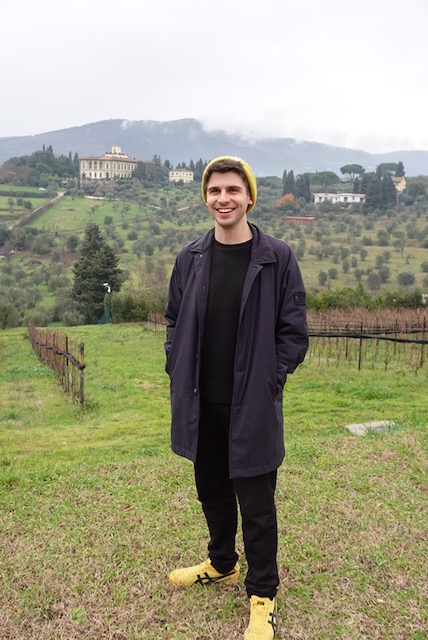
Fellow wine lovers, if you’ve ever dreamed of a bottle that whispers stories of far-off lands while rooting you firmly in the earth’s embrace, let me introduce you to Arsenio—a winery that’s not just producing wine, but crafting a multicultural legacy. From ancient Armenian roots to the sun-drenched hills of Tuscany, an adventurous, charming old soul with a mathematician’s precision chases dreams through olive groves. A confident deep thinker, he weaves heritage, philosophy, and mastery into every sip and every golden drop. Arsen, born in Málaga, Spain, in 2000, is Armenian by blood and a true citizen of the world. With a Bachelor’s in Pure Mathematics from New York University—specializing in differential equations and chaos theory—and a Master’s in Vineyard and Winery Management from Bordeaux Sciences Agro, plus his WSET Diploma earned in 2024, he’s the perfect blend of analytical mind and passionate artist. “I’m already 25,” he commented with a broad smile and spring in his step, sneakers firmly planted on the sandstone soils of his Florence vineyard. But as he explained, exceptional wine (and olive oil) takes time, and he’s in it for the long haul. I was lucky enough to be invited for a private, one-on-one visit with Arsen Khachaturyants, the visionary founder of Arsenio. It was just the two of us, getting to know each other over glasses of his emerging vintages and samples of his exquisite olive oil. My recent visit to Arsen’s estate was energizing and transformative—like an ice-cold morning plunge into a crisp Tuscan stream. I dove headfirst into his fascinating journey: blending Armenian heritage with Tuscan character, a confident visionary pursuing exciting new projects, channeling his culinary passion with mathematical precision, interwoven with soul-stirring music—all grounded in deep family values. His philosophy? Humans are an integral part of nature, reconciling progress with environmental respect. Arsenio’s 10 hectares span three distinct Tuscan areas: Florence, Olena in Chianti Classico, and near Volterra by the coast—all organically farmed. In Florence, where it all began in 2020, you’ll find Sangiovese, Mammolo, Colorino, Pugnitello, Canaiolo, Cabernet Franc, Cabernet Sauvignon, and a nod to his roots with Areni Noir. At 300 meters above sea level on sandstone, with breezes from the Apennines, it’s a hillside haven within the Renaissance city itself. The unofficial 2023 harvest hinted at greatness, which I concur it was “great” labeled Y23 and 2024’s official vintage is set for release in 2027. But it’s not just vines; Arsen’s passion extends to olive groves that dot these landscapes, producing oil that’s as golden and profound as his wines. Walking through those groves with him, he shared how the same borderless vision applies—one golden drop at a time, honoring the saline winds and sun-drenched hills. “Travel has taught me to respect diversity without altering it,” he said, as we tasted the peppery, vibrant olive oil straight from the press. It’s a partnership between human and nature, much like his winemaking. In Chianti Classico’s Olena estate, an eight-hectare gem with three planted to vines, dense forests create a micro-terroir of clay and silt, protecting against winds and amplifying day-night swings. Sangiovese dominates, joined by Cabernet Franc and Grenache for climate adaptability. An old farmhouse is being restored into a intimate cellar— “a place where nothing interrupts your connection with the wine,” as Arsen put it. And near Volterra, the coastal influence shines with Cabernet Franc, Cabernet Sauvignon, Syrah, and Sangiovese. The wines are poised to become future icons, each stemming from a deeply personal relationship with the land, expressing the full potential of its terroir through a pursuit of excellence and uncompromising freedom of interpretation. The flagship is an IGT Toscana, with only one wine produced under the Chianti Classico denomination: The labels, designed by Armenian artists, are small stories in themselves. Yeter shows Arsen in reflection, engaging with chaos; Anddem portrays him pushing forward against the wind; Screeching Soil captures Chianti’s rugged soils; Same Sky’s round shape underscores universality. “Searching for a new language means breaking rules,” Arsen told me, his eyes lighting up. These aren’t uniform—they’re soloists, each telling a tale. As we shared stories, music playing softly in the background—perhaps a nod to his soul-stirring influences—Arsen’s deep family values shone through. We bonded over our shared love for composers Hans Zimmer and Max Richter. I proudly introduced him to my cousin’s songs—a remarkably talented composer and artist who, coincidentally, studied under Hans Zimmer himself. Arsen was visibly moved by the music, and it added another layer of connection to an already profound afternoon. Supported by his loved ones, he’s laying foundations for a new wine chapter, one that speaks to curious souls like us. Huge thanks to Arsen for his warmth and this profound experience. Here’s to the chapters ahead—I’m thrilled to watch (and taste) what unfolds. If you crave innovation wrapped in tradition, keep your eyes on Arsenio. The vines—and olives—are only just beginning.