
Lugana Dreaming – Parte 2
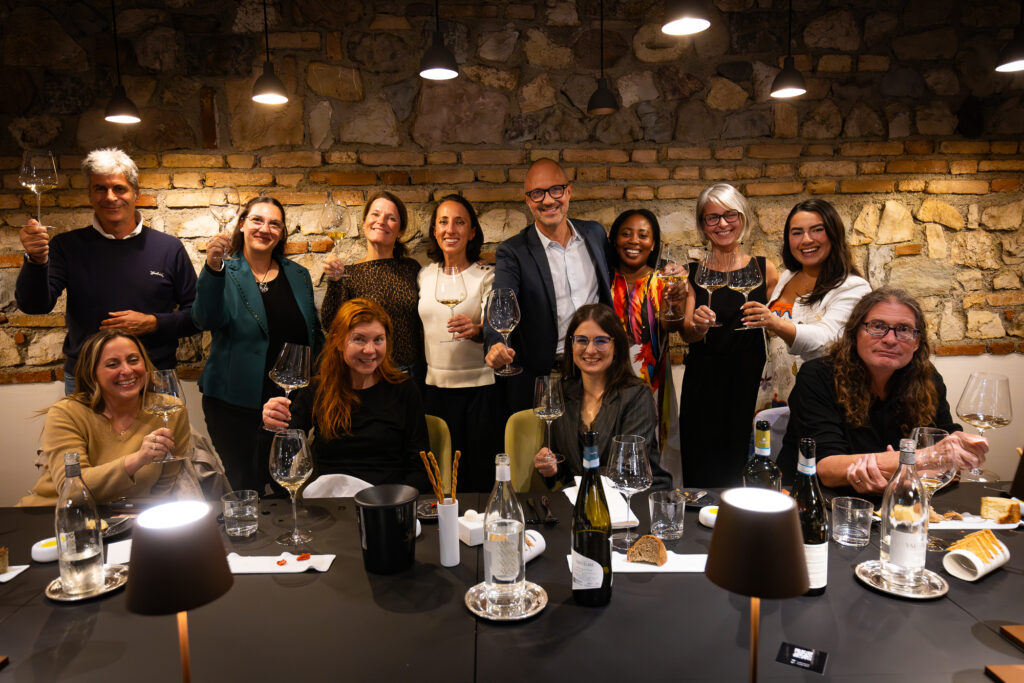
The day began the way every perfect Italian evening should: with a boat. We met at Desenzano del Garda’s graceful port as the sun was beginning its slow descent, turning the water into liquid gold. A restored wooden riva – sleek, varnished mahogany glowing in the light – waited for us. The moment the lines were cast off, the world softened. We cruised north along the southern shore of Italy’s largest lake, past quiet bays and pastel villages, the breeze carrying the faint scent of fig trees and distant grills. Twenty magical minutes later, the fairy-tale silhouette of Sirmione rose from the water: the 13th-century Scaligero Castle, moat aglow, drawbridge silhouetted against the sky. The captain eased us straight through the castle’s watery entrance – an approach that still feels like slipping into another century – and tied up inside the historic center. From there it was a short, cypress-lined walk to the Grotte di Catullo. Perched at the very tip of the peninsula, these sprawling ruins of a 1st-century BC Roman villa are among northern Italy’s most evocative archaeological sites. Olive trees now shade fallen columns, wild caper bushes cling to ancient walls, and the views stretch across the endless lake to the Alps. Legend (though not history) links the villa to the poet Catullus, who called Sirmione “the pearl of all peninsulas.” Standing on the sun-warmed stones as the light faded, it was impossible not to feel the same enchantment two thousand years later. By the time we wandered back through the lantern-lit lanes, twilight had settled and anticipation was high. La Rucola 2.0 – the intimate, one-Michelin-starred jewel hidden just steps from the castle – opened its doors to our small group like an old friend. Inside, the stage was set for something extraordinary: a seven-course tasting menu created by chef Stefano Dall’Ospedale, our seven course meal including a fish from the region ineach dish expressly designed to converse with the Lugana wines of Sirmione’s finest producers. Nestled on the southern shore of Lake Garda, the tiny sub-region of Sirmione within the Lugana DOC stands out for its strikingly compact size and distinctive terroir. Home to just nine wineries, this narrow peninsula benefits from dense, heavy clay soils—often white or grayish in color—that retain water and impart remarkable structure and minerality to the wines. These calcium-rich clays, formed from ancient morainic deposits, give Sirmione’s Turbiana grapes a fuller body and pronounced savory character compared to the sandier, more perfumed expressions found further north in the appellation, making its limited-production Luganas some of the most powerful and age-worthy in the entire zone. Around the long table sat the people who make the magic happen: Chiara Perego (oenologue of Azienda Agricola Sgreva), Sara Salgaro of Tenuta Frontelago, Nunzio Ghiraldi himself, and Eliza Zordan from Cascina Maddalena, who moderated the evening with warmth and precision. Every time a new bottle was opened, the maker told the story behind the wine, and guided us through the glass while the perfectly timed course arrived. With every course, the room grew livelier. Stories of grandfathers planting the first vines, of siblings sketching labels at the kitchen table, of horses galloping between rows, of brain waves translated into art – each tale deepened the flavour in the glass. When we finally stepped back into the cool night air, the castle lights shimmering on the water and the lake lapping gently at the ancient walls, no one spoke for a long time. Some evenings feed the body. This one fed the soul. Sirmione, with its Roman ghosts, thermal springs, white-clay vineyards, and nine fiercely proud winemaking families, had worked its quiet spell once again.
Lugana Dreaming – Parte I:
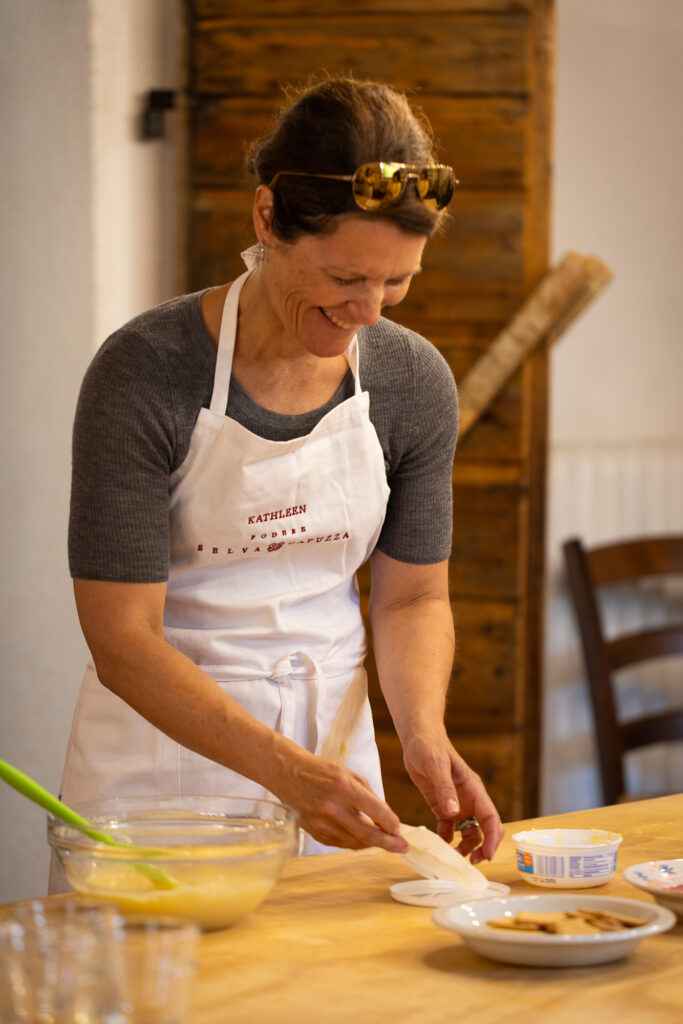
From the Arches of Tenuta Roveglia to the Circle of Time at Selva Capuzza After a night wrapped in the soft hush of Desenzano del Garda, the morning light pulled us south along quiet country roads to Pozzolengo and Tenuta Roveglia – 120 hectares of vines, stories, and famously stubborn clay that have been making wine since the early 1400s. The estate was reborn in the early 1900s by Swiss immigrant Federico Zweifel, but today it is the three Azzone sisters – Sara, Vanessa, and the irrepressible Babettli – who are writing the most vibrant chapter yet. From the moment Babettli greets you with that knowing smile, you feel like you’ve been let in on a wonderful secret. Within minutes she quotes her father’s lifelong creed: “We need to promote the dream – Lugana – and not the winery.” He used to pedal from trattoria to trattoria with sample bottles strapped to his bicycle until the world finally sat up and listened. That same generous, collaborative spirit still pulses through every corner of Roveglia. It’s impossible to miss. Step into the foyer and you’re immediately enveloped by the “family wall” – a sprawling, joyful collage not just of the three sisters, but of every facet of the team – the office, the tractor driver, the seasonal picker, every cellar hand who has ever worked a harvest here. “They are Roveglia,” Babettli says, tapping a faded photo of a man who started at fourteen. “We don’t separate blood from chosen family.” Babettli herself is a whirlwind of passions. Trained as an HR specialist, she’s also a self-taught architect and an obsessive collector of antique telephones. Her office feels like a tiny museum of Bakelite rotaries and candy-apple-red Ericofons. “Each one has its own voice,” she murmurs, cradling a 1930s Siemens like a baby bird, “exactly like old vines.” That love of distinctive voices brought us straight out to the vineyard. She scoops up a fistful of the heavy white clay. “Wet, it’s glue. Dry, it’s stone.” Fifty-five-year-old roots barely reach five metres deep, spreading instead in a desperate spiderweb just to survive. “Survival mode,” she grins, “makes the wine more interesting.” All that character needed a worthy home, so Babettli designed one. To reach the new tasting room you descend a stone staircase behind a monumental door of reclaimed wood and iron – every plank salvaged from centuries-old barns and presses. “Nothing here is wasted,” she whispers, pushing it open like a secret. What waits below is pure, breath-stealing magic: a six-metre-deep golden cathedral of hand-built brick arches, no two alike, each curve sketched by Babettli herself and shaped by eye to carry the exact weight above. Hidden lights make the rosy terracotta glow, and the cool air is thick with the scent of earth and sleeping wine. Yet the true soul of the estate lives upstairs in the 16th-century Cascina Roveglia farmhouse. Thick limestone-and-clay walls – the very same moraine that gives Lugana its mineral snap – keep it cool in summer and cosy in winter. Ancient chestnut beams that once held grain now frame intimate tastings; pink Veronese rose marble floors shimmer beneath humble arches originally built for oxen, not ostentation. The former stable has become the coziest tasting room imaginable: a scarred oak table, a fireplace blackened by five centuries of smoke, family photos watching over us, and the low hum of sleek steel tanks just next door. At one point Babettli disappears for a moment and returns cradling their very first commercial vintage – 1989 – one of only twelve bottles left in the world. And then, beneath those glowing arches, the wines spoke for themselves. – Lugana Spumante Brut: A silver river of pinpoint bubbles carrying crisp green apple, spring flowers, and warm brioche. Dry, electric, celebratory. – Limne Lugana DOC: So pale it flashes green at the rim. Lime blossom, white peach fuzz, wet river stones – pure Garda breeze in a glass. – Vigne di Filiberto Lugana DOC: Ripe yellow plum, roasted almond, a twist of lemon confit, and a saline snap that makes your mouth water again and again. – Riserva Vigne di Catullo Lugana DOC 2012 – Cork vs Screwcap: Deep, luminous gold. The nose explodes: candied orange, acacia honey, toasted hazelnut, smoky minerals. Velvety, almost chewy, then a blade of acidity lifts ginger biscuit and sea salt into an endless, resonant finish. The cork bottle was tired and mushroomy; the screw-cap version still singing with lemon peel and almond blossom. “Dad made the switch in 2007,” she laughs. “Everyone thought he was crazy. Sales tripled the next year.” – Bonus: 2021 Late-Harvest VT : Golden like November sun, swirling with candied ginger, toasted walnut, and river-stone freshness. 14 g/L of honeyed sweetness balanced by acidity so bright your jaw tingles. “A me-wine,” Babettli declares, a wine that can last an hour. We left Roveglia with hearts full and Babettli’s parting words ringing in our ears: “Now go taste the other side of the dream.” So we pointed the car just a few kilometres east, toward the hills of San Martino della Battaglia and Podere Selva Capuzza – another family, another century-old cascina, another unforgettable chapter of Lugana waiting to be uncorked. We left Roveglia with hearts full, and Babettli’s parting words ringing in our ears: “Now go taste the other side of the dream.” So we pointed the car just a few kilometres east, toward the hills of San Martino della Battaglia and Podere Selva Capuzza – another family, another century-old cascina, another unforgettable chapter of Lugana waiting to be uncorked. We didn’t taste in a cellar or a sleek tasting room – we tasted right where the magic happens, among the vines of the San Biagio vineyard at Podere Selva Capuzza, in the heart of the Lugana DOC on the gentle morainic hills of San Martino del Garda, just a few kilometres south of magnificent Lake Garda itself. Glasses balanced on an old wooden table facing the rows, late-afternoon