
Life in Villany Wine Country
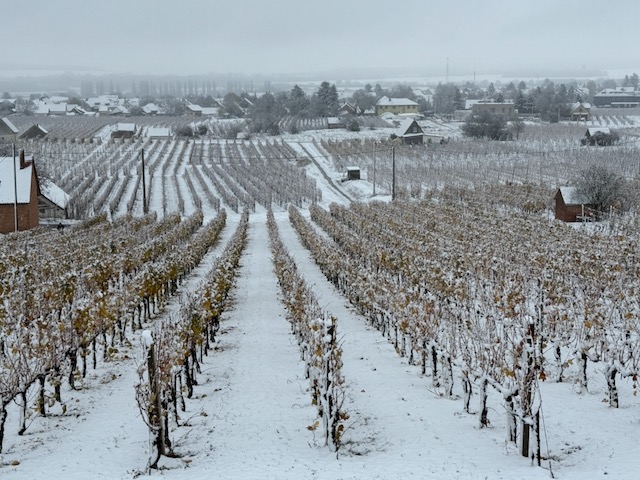
Hidden in Hungary’s deep south lies a tiny village of just 2,000 souls that’s quietly rewriting the rules of world-class wine: V I L L Á N Y. This is where Cabernet Franc reaches utter perfection (many say it’s one of the planet’s greatest terroirs for the grape). Where Bordeaux-style blends are exploding onto the global stage. Where ancient cellars meet concrete eggs, photocatalytic oxygenation, and 30-year-old vintages that taste like liquid history. Few wine regions in Europe deliver the combination of heritage, innovation, and sheer personality that Villány does. During the exclusive VIP tour curated by Villány Borvidék, we were granted rare access to four benchmark producers, each offering a distinct lens on why this small southern Hungarian appellation is producing some of the world’s most compelling Cabernet Francs—and far more. We woke up to a once-in-a-decade winter fairytale — snow blanketing the vineyards — and spent the day spellbound on our tour. Tradition and cutting-edge innovation aren’t clashing here… they’re dancing. My heart was stolen by: ✨ Vylyan – Bold, fruit-driven beauties in a jaw-dropping contemporary winery. Second-gen winemaker Sándor is pure fire and curiosity ✨ Bock – The legendary godfather whose storytelling leaves you utterly charmed. Classic, powerful, soulful reds that demand respect ✨ Csányi – Big but polished to perfection. Elegance in every glass ✨ Gere Attila – The grand patriarch whose stories wrap around you like velvet and won’t let go. Refined, sophisticated, endlessly innovative ✨ Günzer Tamás – Family passion on overdrive & impossible not to love Vylyan Terasz Perched atop the Fekete-hegy with panoramic views across the vineyard quilt, Vylyan is a story of generational evolution. Founded in the early 1990s by a visionary father, the estate is now led by second-generation economist Flóra and her mother, guided since 2017 by winemaker Sándor Montecucco. Creative friction between tradition and modernity is palpable—and highly productive. Vylyan has always treated wine as a form of art and the label as its canvas. From the very beginning, the winery collaborated with prominent contemporary Hungarian artists (especially István ef Zámbó, Oszkár Papp, and others from the neo-avant-garde circle), turning every bottle into a small, collectible piece of art. They are a manifesto of the winery’s values—biodiversity, feminine energy, lunar rhythm, playful duality of devil and angel, and the fusion of fine wine with contemporary Hungarian art. Signature tasting notes: The marriage of contemporary art (textured, braille-like labels) and cutting-edge winemaking makes Vylyan a must-visit for anyone seeking the new face of Villány. Bock Winery There are cellars, and then there is Bock’s underground cathedral. József Bock senior carved these tunnels out of the limestone with his own hands in the 1970s, and the oldest sections have remained untouched since the early 1990s. Black mold carpets every surface like velvet; the air is thick, cool, and sacred. Bottles from the very first private vintages lie quietly under decades of noble rot—no temperature control, no interference, just time. Standing there in candlelight among those silent rows is the closest most of us will ever come to a wine pilgrimage. We were privileged to taste two museum treasures pulled straight from that living archive: Then came the magic above ground. We gathered around a long wooden communal table that felt like it had hosted a thousand family feasts. On a crisp, chilly winter day, József junior welcomed us like long-lost cousins. Sparkling wines flowed: the creamy Chardonnay Blanc de Blancs 2020, the razor-sharp Bock Marcell Cuvée Brut Nature 2021, and a brand-new Sauvignon Blanc fizz that cut beautifully through velvety roasted-pumpkin soup. The soul-warming main course—slow-roasted pork paired with the majestic Capella 2012 (deep, harmonious, still climbing)—had everyone groaning with happiness. Between courses, József told stories: tales of playing in the vineyards as a child, of digging those cellars alongside his father and the wines that his wife loves. His eyes sparkled with pride, yet his voice stayed gentle and humble. You couldn’t help but fall a little in love with the man and the place. Csányi Winery (Teleki Cellars) One of Hungary’s largest and most forward-thinking private producers, Csányi has quietly transformed the historic Teleki estate into a powerhouse of precision and varietal expression. While most estates lean on tradition, Csányi straps satellites to the sky to spy on every vine, plants with computer-guided precision, and throws daring curveballs like Malbec, Grüner Veltliner, and a wickedly fresh Syrah rosé into the heart of red-wine country to deep inside the wine cellar, photocatalytic oxidation (PCO) works like invisible magic: powerful UV light strikes a titanium-dioxide catalyst, instantly transforming mold spores, bacteria, unwanted odor to clean air, zero chemicals, perfect peace for sleeping barrels. Fresh from a multimillion-forint glow-up, their gleaming new winery hums with cutting-edge gear, yet the soul still traces back to 19th-century legend Zsigmond Teleki. László Romsics, CEO, along with head winemaker guided us through the tasting and philosophy of the winery. The tasting was electric: Csányi proves that scale and soul can coexist beautifully. Gere Attila If Villány has a spiritual home of elegance, it is here, in the low-lit barrel hall of Gere Attila, where time seems to slow the moment you step inside. Attila Gere doesn’t just pour wine; he tells its life story. With a voice like aged velvet and eyes that spark every time a barrel is tapped, he pulls samples of 2023 and 2024 Cabernet Franc that are still raw, electric, and singing with red-berry precision. Then comes the 2025 Merlot–Franc blend still fermenting, wild and silk-promised. He speaks of each one as if introducing his children: “This one will be bold, this one quiet, but all of them must speak with their own fruit first.” Oak, he insists with a gentle smile, is only the frame; the picture has to be the vineyard. Between barrels he drifts into tales: the first vines he planted with his father, the 1991 harvest that almost broke them, the night in 2008 he set aside a single barrel of