
Grilled Seafood Paella
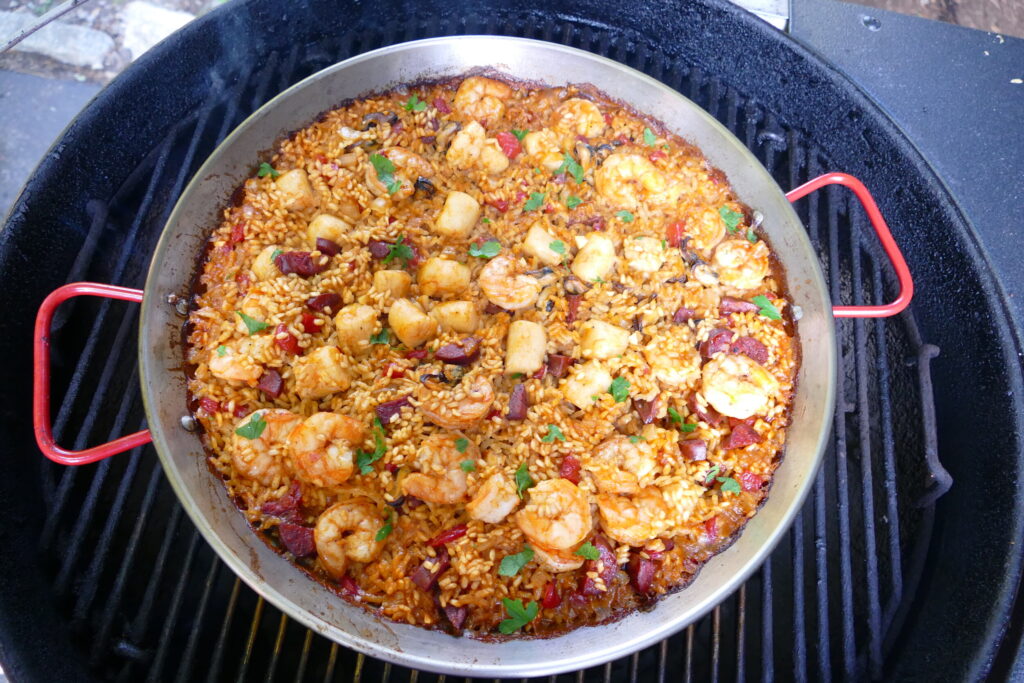
1 lb. jumbo shrimp (16-20 per pound) peeled and deveined 1 tbsp. extra virgin olive oil 6 cloves garlic, minced 1 3/4 tsp smoked paprika 3 tbsp. tomato paste 4 cups fish broth 2/3 cup dry sherry 8oz bottle clam juice pinch of saffron threads 1 small onion, finely chopped 1/2 cup roasted red peppers, chopped 3 cups paella or arborio rice 1 lb. bay scallops, cleaned 1 lb. spanish chorizo, cut into 1/2 inch pieces 1 lb. mussels or little neck clams (optional) Toss shrimp with 1 tbsp. oil, 1/2 tsp. garlic, 1/4 tsp. paprika and 1/4 tsp. salt in a bowl until coated. Heat a small saucepan over medium heat on the stove. Add 1 tbsp olive oil and remaining garlic, cook, stirring constantly until the garlic sticks to the bottom and begins to brown, about 1 minute. Add tomato paste, remaining 1 1/2 tsp paprika and cook, stirring until dark brown bits form at the bottom of the pan. Add the broth, sherry, clam juice and saffron. Increase heat to high and bring to a boil. Set aside. Heat the grill to 350F. Add the pan and 4 tbsp. of olive oil till shimmering. Heat the grill for about 15 minutes until the grill is hot. Place the paella or roasting pan on the grill and add remaining 1/4 cup of oil. When oil begins to shimmer, add in the chorizo, onion, and peppers. Cook for 4-7 minutes. Add the rice and stir until grains are coated. Pour in broth over the mixture and smooth rice all around. When liquid reaches a gentle simmer, place shrimp all over pan in a single layer. Arrange scallops around the pan. Cook, moving and rotating the pan to maintain a gentle simmer, until rice is almost cooked through, 20-30 minutes. Continue to cook uncovered until bottom forms a golden crust at the bottom of the pan, add the clams and cook for another 8-15 minutes. Remove from the grill, cover with foil and let sit for 10 minutes. Serves 6.
Double Dark Chocolate Cupcakes with Rainbow Sprinkles

Cupcakes: 2 cups all purpose flour 1/2 cup unsweetened cocoa powder 1/2 tsp. each baking powder, baking soda and salt 2 sticks (8oz) unsalted butter, at room temperature 1 1/2 cups sugar 2 large eggs + 2 egg yolks, at room temperature 1 tsp vanilla extract 1 cup buttermilk Add cupcake papers to the moulds and set aside. Whisk together the flour, baking powder, baking soda, salt and cocoa. Working with a stand mixer fitted with a paddle attachment, beat the butter on medium speed for 3 minutes till creamy. Add the sugar and beat for another 2 minutes. Add eggs, one at a time and the egg yolks, scraping down the sides after each addition. Beat in vanilla. Reduce the mixer speed to low and add the dry ingredients in 3 additions, alternating with buttermilk in 2 additions. Mix until blended. Divide the batter between moulds. Bake for 18-20 minutes until a tester inserted into the center comes out clean. Transfer to rack and cool completely before frosting. Frosting: 2 sticks (8oz) unsalted butter, softened 1/3 cup whipping cream 2 tsp vanilla extract 1/8 tsp. salt 2 1/2 cups icing sugar 4 oz. unsweetened chocolate, melted and cooled Rainbow sprinkles In a bowl, stand mixer or hand held mixer, beat the butter until light and fluffy. Beat in the cream, vanilla and salt. It will look lumpy, don’t worry it will smooth out later. Beat in sugar, 1 cup at a time until smooth. Beat in the melted chocolate, scrape down the sides of the bowl often, until fluffy, about 2-3 minutes. Set aside till read to frost the cupcakes. Frost the cupcakes and top with rainbow sprinkles. Store up to 2 days in an airtight container in the fridge. Freeze unfrosted cupcakes for up to 1 month. Makes 20 cupcakes. Pair with a Banyuls dessert wine or Port.
Inama Soave Classico
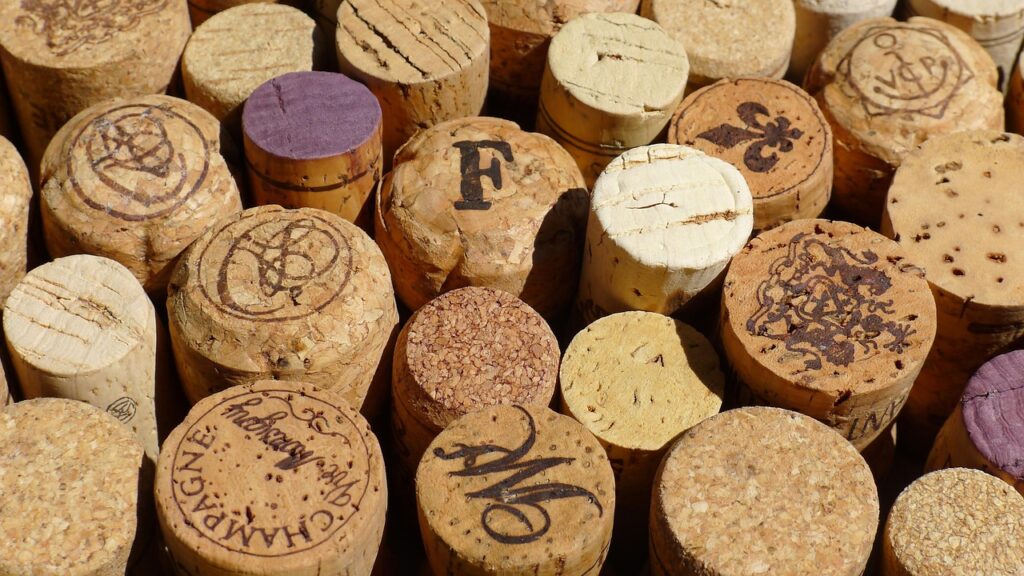
An every day Italian luxury “from Azienda Agricola Inama located in Veneto region in northwest of Italy. Inama Soave Classico 2018 is made from 100% Garganega grape. The grape was introduced to the region 2000 years ago by the Romans. It is grown on hillsides in basaltic, volcanic soils which contributes to the smoke aromas and flavors of the wine. The vines are approximately 30 year old. Azienda Agricola Inama is a third generation winery that was established in 1947. The winery’s core values are to create unique wines that represent the land, to express the essence of what nature has given them and to continuously improve. The wine has a creamy texture full of stone fruit and smoke from volcanic soils and an oily texture. Full of lemon, peach, minerals, pear, chamomile, honeysuckle, marjoram, grass, apricot, peach, honey, and finishes with a bitter almond and herbal finish. Many rival it to Pinot Grigio – It’s a lovely, fresh & elegant wine. Pairs well with with rich Italian Seafood. For example linguine with white clam sauce, fresh herb gnocchi, squid ink linguini, pan seared scallops, and roasted zucchini risotto.
Villa Sparina Monferrato Chiaretto Rosé
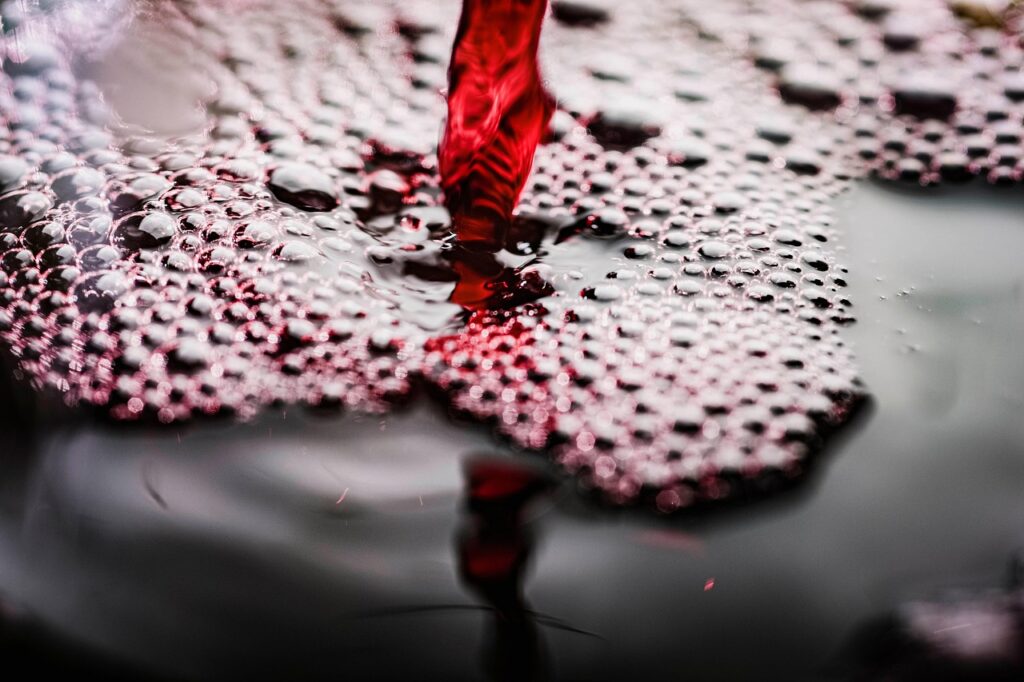
My summer wines from Italy adventures continues- Azienda Agricola Villa Sparina is located in Monferrato, in the southeast of Piedmont below the River Po. The soils are composed of clay and limestone which really brings out the freshness and minerality of the grapes. The vines are planted on southwest facing slopes at an elevation of 350-400 meters. The average vine age is 25 years. The grapes are fermented for 2 weeks at cool temperatures of 63 F (17° C) in stainless steel tanks in order to obtain the desired color. Villa Sparina was bought by the Moccagatta family in the early 1970s. Their Gavi white wine, made from Cortese grapes, rose very rapidly in popularity. They also produce incredible Barbera red wine. The winery is also known for its distinctive bottle shape. Designer Giacomo Bersanetti was inspired by an old bottle that was discovered in the estate’s historic cellar. Villa Sparina Monferrato Chiaretto Rosé DOC 2019 is a lovely salmon pink color. It is creamy, ripe strawberry, cherry, minerals & lemon. It’s lively a blend of Barbera and Dolcetto. Perfect pairing with Parmesan cheese, grilled honey lemon salmon steaks. NOTICE the pull tab to open the wine is the Italian 🇮🇹 flag !! Love the detail!
Oyster River Winegrowers Pétillant Naturel & Rosé
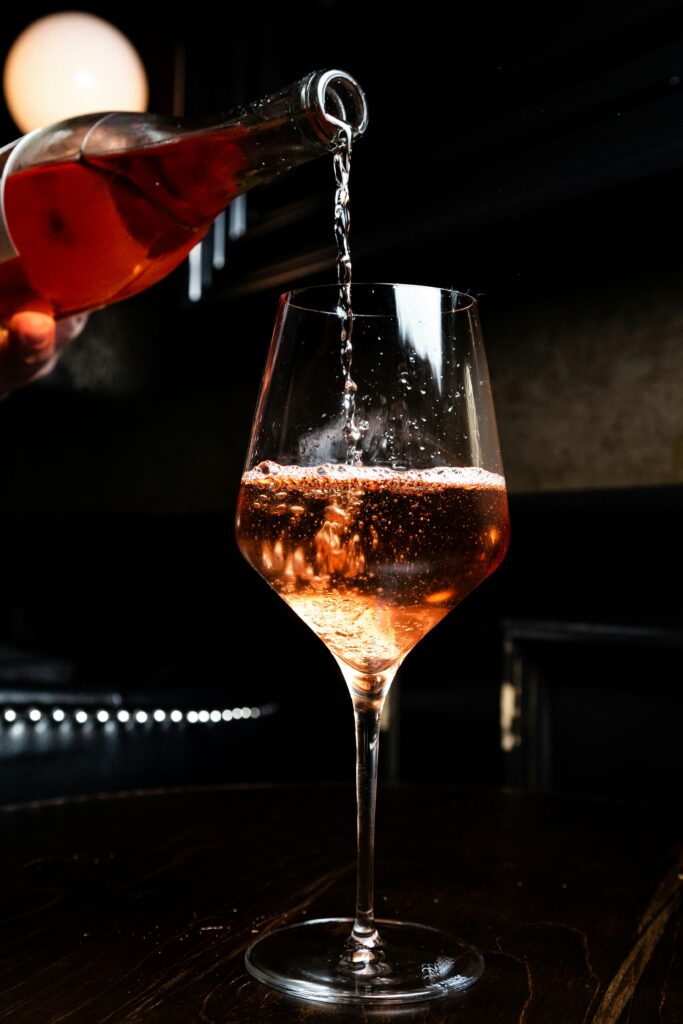
Pétillant Naturel (a.k.a. Pét Nat) is a sparkling wine made in the Méthode Ancestrale, a methode older than Champagne! It is generally less effervescent than Champagne, it has less alcohol and a tad more sugar. It also has less intervention than sparkling wines made in the traditional method (Champagne) – the wine is not disgorged which means to filter out/remove the lees sediment in the bottle. By doing so it creates a cloudy sparkling wine with a funky, earthy flavors. Oyster River Winegrowers is located in Warren, Maine. Yes you read correctly, Maine, USA. They are natural winemakers that make wines from their own vineyard, from other growers and cider from their apple orchard. What does that mean “natural winemakers”? For instance, they do no use sulfites or filter their sparkling wines and ciders. The use ambient yeasts to start fermentation spontaneously and no refrigeration in the winemaking process. Their still wines add minimal sulfites and filtered gently where necessary. Basically they add nothing nor do they take anything away. They leave nature do it’s thing. That is what winemaker Brian Smith’s Moto “ My role in the winemaking process to be more nature’s assistant than winemaker.” The farm is organically run from A to Z. They use draft horse power to plough the farm, horses graze in between vineyard rows and cows provide manure fertilizer for the soil. They use wood from their farm to heat the winery in winter. Their horse and cow livestock enables them to be a self-sustaining ecosystem. Morphous is made with French American hybrid varietals such as 50% Cayuga and 50% Seyval from Doyle Vineyards in Seneca Lake in the Finger Lakes, NY. The wine is a cloudy lemon color. Palate is off dry with aromas of lemon, apple, yeast. Medium intensity, flavors of green apple, white blossom, lemon, pear, yeast, saline and earthy. The Morphous Rosé is made with 100% Merlot from Tucker Lane Vineyards in North Fork in Long Island, NY. The wine is cloudy medium pink color. Aromas medium intensity of rose petal, strawberry, cream and lemon. On the palate is off dry, medium intensity and flavors of rosé petal, cream, strawberry, cherry, minerals pomegranate and hibiscus. The wine and cheese video review on Instagram Oyster River PétNat & Cheese See this link for more information on the Méthode Ancestrale process
Scagliola Sansi Barbera D’Asti DOCG
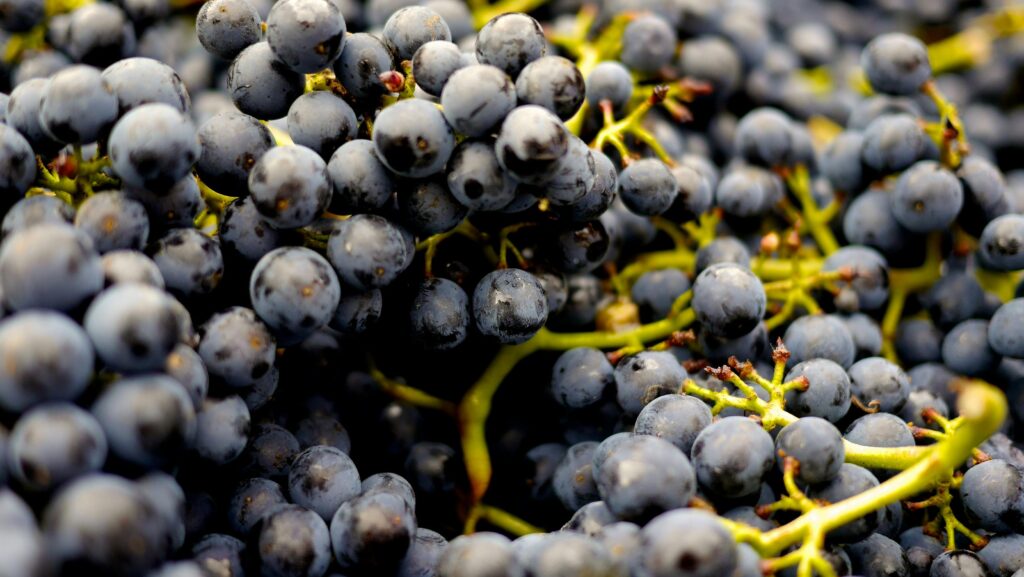
Barbera is the everyday red wine that Italians drink in Piedmont. Typical flavors of tart cherry, plum, strawberry, blackberry, licorice, black pepper, violets, lavender, vanilla (from oak aging), anise and dried herbs such as oregano, sage or thyme. The wines are generally dry, medium tannins, high acidity and medium to full bodied. Barbera goes with many types of food especially those with spices such as cinnamon, sage, star anise. The grape is mostly planted in Italy but has plantings in the USA, Argentia and Australia This wine is from Azienda Agricola Scagliola from Barber D’Asti in Piedmont, Italyi. The winery was established by Camillo Scagliola in 1936. The vineyard survived the passing of a young Camillo Scagliola, World War II and tough times to triumphantly establish what it is today – a vineyard and family run winery who creates quality wines from the region. Their business is a family one deeply rooted to the land and heritage. These particular Barbera vines are 10 years old, relatively young but ideal for an easy drinking red. The grapes are macerated and fermented in stainless settlements temperature controlled tanks for 15-20 days. The wines are then bottled and aged till ready for market. This wine is such a pleasure to drink – Scagliola Sansi creates a beautiful expression of Barbera D’Asti DOCG located in Piedmont, Italy. Barbera is the grape which has a lovely purple ruby color. Aromas of ripe cherry, tomato leaf, meat savory, oregano, blackberry and licorice. Palate is dry, high acid, medium tannins, full body at 14% abv, flavors of ripe cherry, pepper, tomato leaf, meat savory, oregano, blackberry and licorice. Balanced, smooth and moorish. Perfect pairing with stone fire prosciutto buffalo mozzarella pizza, porcini mushroom risotto, blue cheese potato gratin, roasted guinea fowl with sage and garlic or pasta with shaved truffles and olive oil.
Grüner Veltliner – Austria’s Top Planted Varietal
Grüner Veltliner originates in Austria and the signature grape as well as the most widely planted of the country. It is also grown in Czech Republic, Slovakia, Hungary and USA. The typical style of Grüner Veltliner is a light, citrus, vegetal and minerality wine with zippy acidity. Typical flavors of Grüner Veltliner are lime, lemon, grapefruit, green apple, minerals, green beans, tarragon and a white pepper finish. The acidity is also very zippy and active in your mouth. This style is quite common in the Weinviertel region of Austria. The second style is richer, heavier and more complex from warmer regions of Wachau, Kremstal and Kamptal. This style has more spice and needs time aging in the bottle to fully develop. Some use oak for aging, others old barrels or stainless steel. These wines with time become honey-like, marmalade flavors and are similar to an aged Burgundy. This wine is 100% Grüner Veltliner. Winemakers Karl und Peter Steininger is located in the sub region of Langenlois in Kamptal, Austria. They use sustainable farming practice of their 135 acres estate. The vines are approximately 20 years old at an elevation of approximately 212 meters and grown on loess and clay soil. The grapes are fermented in cool temperature stainless steel tanks. The must remains on its lees for 4 months. The wine has a pale lemon color. The nose has aromas of lemon, pear, green apple, grass and stone. Palate is slightly off-dry with medium+ acidity and creamy texture with flavors of lemon, pear, green apple, grass, stone, asparagus, and a white pepper finish. Grüner Veltliner is a great alternative for Sauvignon Blanc or Pinot Blanc fans. Pairs very well with rich flavored foods due to its high acidity such as sheep or cow creamy cheeses such as goat cheese, Camembert or ricotta cheese, Wiener Schnitzel, pork chops, halibut with butter tarragon sauce or wasabi crusted tuna. It also pairs well with the hard to pair vegetables asparagus and artichokes.
Planeta Dorilli Cerasuolo di Vittoria DOCG
I’ve been on an Italian wine adventure all week (and LOVING it)! This particular wine is from Planeta, located in the DOCG of Cerasuolo di Vittoria in Sicily, Italy. Sicily has the largest and still active today volcano, Mount Etna located in the northeastern corner of the country. The last eruption was in 2017 but the major eruption was over the winter of 2008/2009. The soils are mineral rich from . This DOCG, granted in 2005, is the only one in Sicily. The wines are made from Nero Davola and Frappato, both of which are indigenous grapes to Sicily. Nero Davola brings weight and body, the Frappato lively freshness. These wines can age minimum 5 to 10 years. Planeta was founded in the 1600s by cousins Alessio and Santi Planeta and uncle Diego. The family has 6 estates in Sicily. The made a wide range of wines from Fiano, Garganega, Chardonnay, Syrah, Moscato Bianco, Frappato and Nero d’Avola. Seven, yes 7, generations later, the Planeta family has a reputation for innovation, winemaking leaders and revitalizing winemaking in Sicily. This wine is from the Cantina (vineyard) Dorilli which is located in the southwestern corner of the island, near the Dorilli river. The soils consists mainly of loose red sand with no stones and moderately deep with a layer of tufa lies at about 90 cm. The altitude is around 90 meters. The family estates are sustainably farmed. After harvest, the bunches are destalked and spent 14 days macerating on the skin. It is then fermented at 23⁰C in stainless steel vats, a vertical basket pressing and maturation for 12 months in small oak barrels. The wine is a medium ruby color. It is a blend of 70% Nero Davola and 30% Frappato. Aromas of wild cherry, mulberry, plum and ash jump out of the glass. Palate is dry, the tannins are soft with fresh acidity. The flavors of wild cherry, mulberry, cocoa, plum, rose petal, savoriness with a bitter almond and ash finish. The finish is long and lovely. This wine is lean, vibrant and elegant. My video review is available on Instagram Planeta Dorilli Cerasuolo di Vittoria DOCG 2016 Pair with tuna carpaccio, grilled lamb burgers, pork chops, shellfish or clam bake, aged Cheddar or wild mushroom pizza.
Parés Baltà Cava Brut

Summertime + heat = the need for a refreshing, sparkling wine. Time for a great everyday, go-to is Cava. At 4.4g/L of sugar it’s a great alternative for those watching sugar levels. This particular Cava is from the Peñedès region in Catalunya, Spain who makes 95% of Spain’s Cava. Cava is Spain’s answer to wines made in the same manner as Champagne, the Traditional Method. See this link for more details on Cava. Parès Balta was founded in 1790. In 1970 the Cusine family took ownership with the 3rd generation managing it today. The vineyards are just 6 miles from the Baleric Sea with plantings. For instance, the Paralleda vines are 50 years old and located at the foothills of the Ancosa Mountains. The five estate vineyards are planted on stony, calcareous soils comprised of clay and marine fossils at elevation of 212 meters while the Paralleda is grown at 616 meters.. They are certified organic and biodynamically farmed. This wine a blend of 62% Paralleda, 24% Macabeo and 14% Xarel-lo. It has been aged in stainless steel and spent 18 months on lees. The wine has aromas of pear, lemon, white peach and toast. Palate is dry with fine bubbles, medium intensity and finish with flavors of pear, lemon, white peach, apple, honeydew melon, minerals, white blossom, smokiness and toast. It’s lively and refreshing. Pair with Manchego or Parmesan cheese, olives and salted almonds, prosciutto and melon or drink on it’s own well chilled.
Spanish Old Vine Garnacha
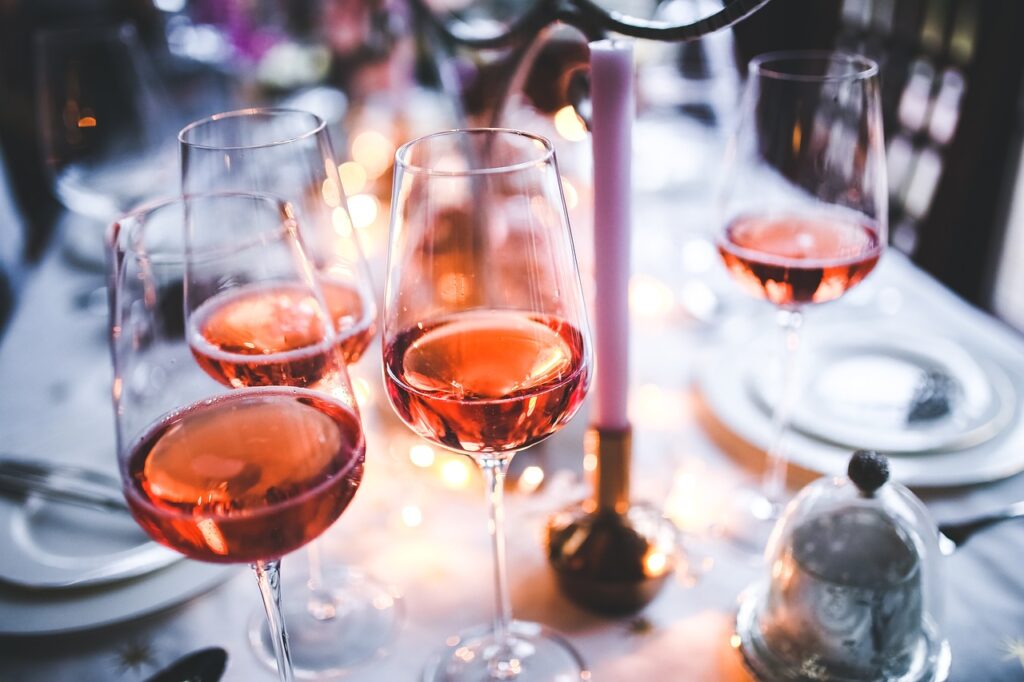
Zestos Old Vine Garnacha is from the DO Vinos de Madrid in the sub zone of San Martin Valdeiglesias. The region used to make bulk wines about 20 years ago that were of acceptable quality. Smaller producers starting taking the forefront on quality wines thus reducing the poorer quality wines. Today the wines are of much higher quality. These particular grapes are grown at a high elevation of 800m which creates an elegant, aromatic wine with a bright acidity. The old vines are head pruned which is a very manual and time consuming task. The soil is mainly composed of sand and limestone. The estate is a dry farmed, organic vineyards. Compania de Vinos del Atlantico makes a wide variety of wines in throughout Spain. This particular wine, Zestos Old Vine Garnacha 2019 is made from 100% old vine Garnacha. The vines are approximately 55 years old. “Zestos” which means basket in Spanish, pays homage to the rich viticultural history of Spain. It is referencing the back-slung baskets that vineyard workers used to transport the grapes from the vineyard to the wineries on foot. The must is macerated with 30% of the skins for 6 to 8 hours which is a very short period of time. This creates a wine with a very pale orange-pink color. The wine has lovely aromas of strawberry, pomegranate, black cherries and grapefruit. Lively acidity and flavors of watermelon, strawberry, cherry, grapefruit, floral, minerals and wet stone. Pair with Manchego cheese, Moroccan spiced lamb, pulled pork sliders, cheese quesadillas, and pastrami and corned beef sandwiches, halibut tacos with mango salsa and grilled calamari.